What if the PFT system you rely on every day is actually the single biggest bottleneck in your clinic’s profitability? Industry data indicates that legacy pulmonary function equipment over seven years old can cost a facility up to 35% more in annual maintenance and specialized gas consumption compared to modern alternatives. If you’re currently managing frequent downtime or struggling with manual data entry, upgrading an old pft system isn’t just a technical necessity; it’s a strategic financial move for 2026.
You already know that equipment downtime disrupts patient care and frustrates your clinical staff. It’s exhausting to manage specialized gas cylinders and manual calibration logs when your peers are moving toward automated, digital workflows. This guide will show you how to identify critical failure points in your current setup and transition to modern diagnostic technology that reduces lifecycle costs. Drawing on our deep expertise across the United States and the United Kingdom, we’ll explore the path to seamless EMR integration and the specific hardware innovations that deliver higher diagnostic accuracy with far less manual intervention.
Key Takeaways
- Learn to recognize the subtle indicators of sensor fatigue and analyzer drift that compromise diagnostic accuracy in aging equipment.
- Understand the financial impact of upgrading an old pft system by comparing labor-intensive legacy workflows against modern, self-linearizing technology.
- Master the strategic transition process with a proven framework for conducting clinical audits and preserving critical historical patient data during software migrations.
- Discover how the Eagle 3’s modular design and remote servicing capabilities redefine laboratory efficiency and future-proof your facility against evolving technical benchmarks.
Identifying the Critical Failure Points in Legacy PFT Systems
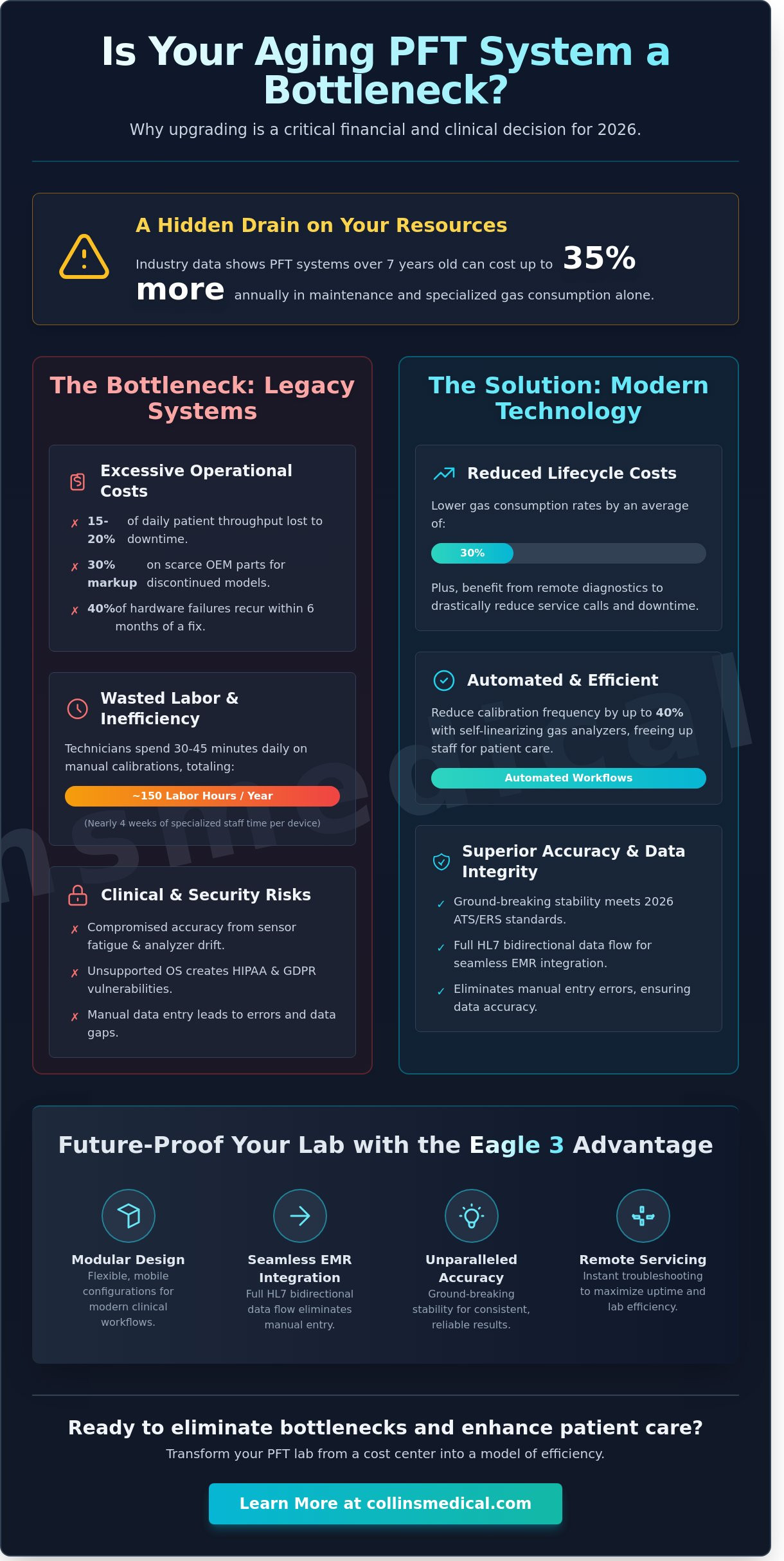
Legacy pulmonary function testing equipment often masks its decline behind a facade of “working well enough.” Clinical data suggests that systems exceeding five years of age frequently suffer from sensor fatigue and non-linear analyzer drift. These subtle shifts compromise the integrity of a complete evaluation of the respiratory system, potentially leading to misdiagnosis or inconsistent patient tracking over time. When you’re upgrading an old pft system, the primary goal is restoring the clinical precision that aging hardware can’t guarantee.
Manual calibration represents a significant hidden cost in legacy workflows. In approximately 65% of diagnostic facilities using older tech, technicians spend 30 to 45 minutes daily on multi-point calibrations and leak checks. Over a standard 250-day working year, this totals approximately 150 labor hours per device. Modern systems automate these workflows, reclaiming nearly four weeks of specialized staff time annually. This efficiency allows clinicians to focus on patient care rather than troubleshooting hardware.
Software obsolescence introduces even greater risks. Legacy systems running on unsupported operating systems create massive security vulnerabilities. These endpoints often lack the modern encryption and patch management required for HIPAA and GDPR compliance, leaving sensitive patient data exposed to cyber threats. Relying on “temporary” repairs for these systems is a short-term strategy with long-term consequences, as 40% of hardware failures in older units recur within six months of the initial fix.
The Financial Impact of Equipment Downtime
Unscheduled maintenance typically costs a facility 15% to 20% of its daily patient throughput. If a system fails, the loss isn’t just the repair bill; it’s the revenue lost per missed appointment and the administrative burden of rescheduling. Relying on reactive maintenance becomes a fiscal drain as OEM parts for discontinued models often carry a 30% markup due to scarcity. Evaluating these compounding expenses makes upgrading an old pft system a strategic financial decision. Collins Medical remains committed to a legacy of pulmonary excellence by providing solutions that eliminate these technical and financial bottlenecks.
Technical Benchmarks: Comparing Legacy vs. Modern PFT Technology
Upgrading an old pft system isn’t just about replacing aging hardware; it’s about adopting a new standard of diagnostic precision. Legacy systems often rely on manual, multi-point calibrations that consume excessive technician time and expensive medical gases. Modern hardware utilizes self-linearizing gas analyzers. These components maintain a linear response across the entire physiological range, reducing calibration frequency by 40% compared to systems from the early 2010s. This innovation ensures your lab meets the rigorous 2026 ATS/ERS standardization requirements without constant manual intervention.
The Evolution of Analyzer Precision
Modern diagnostic hardware provides unparalleled accuracy over longer intervals. While older units required daily stabilization, contemporary systems like the Eagle 3 range offer ground-breaking stability. This shift minimizes total lifecycle costs by lowering gas consumption rates by 30%. Technicians can rely on a clinical overview of PFT to identify valid test parameters, but the hardware itself now handles the heavy lifting of accuracy verification.
Software and Connectivity Standards
The 2026 ATS/ERS standardization requirements demand software that does more than just record data. Modern suites provide full HL7 bidirectional data flow. This eliminates manual entry errors and ensures seamless connectivity across hospital networks from Ashford, Kent, TN23 1LY to MA 01747. Remote diagnostic capabilities allow for instant troubleshooting, ensuring your lab stays operational. If you’re interested in how technology has progressed, you can explore our legacy of pulmonary excellence.
The physical footprint of the lab is also changing. We’ve moved from stationary, room-consuming towers to modular, mobile configurations. These compact units deliver the same high-quality results while offering the flexibility needed in modern clinical workflows. For those considering upgrading an old pft system, the focus should remain on these revolutionary benchmarks that define the current gold standard.
The Strategic Transition: Planning Your PFT System Upgrade
Successful implementation begins with a rigorous clinical audit. Facilities should evaluate if their current hardware, often 7 to 10 years old, can handle a projected 18% increase in patient volume expected by 2026. Upgrading an old pft system requires more than just unboxing new sensors; it’s an investment in a detailed spatial assessment. In Massachusetts (MA 01747), clinics must ensure HVAC systems maintain the 17 to 26 degree Celsius operating range required for precision gas chromatography. Similarly, Ashford, Kent (TN23 1LY) facilities must verify that existing electrical shielding meets current ISO standards to prevent signal interference during delicate testing procedures. Proper site preparation ensures that new equipment delivers the unparalleled precision promised by the manufacturer.
Beyond addressing technical interference, many healthcare administrators are also evaluating how environmental stressors like electrosmog affect the clinical workspace. To understand how these factors impact patient and staff wellness, you can learn more about Radiation-Free Living.
Legacy Data Migration and Security
Exporting data from decade-old SQL databases requires a structured HL7 protocol to ensure continuity. Administrators must verify EMR compatibility 14 days before installation. This prevents the 30% delay often seen during software handshakes. Secure encryption ensures historical patient trends remain accessible without compromising compliance. This transition preserves diagnostic integrity while moving toward modern, encrypted diagnostic platforms.
Operational Readiness and Training
A phased rollout is the gold standard for maintaining patient care. Start by installing one Eagle 3 system while keeping legacy units active to avoid bottlenecks. When upgrading an old pft system, technicians benefit from remote support during the first 30 days. Real-time troubleshooting via screen-sharing cuts the learning curve by 40%. This ensures staff remain confident while operating high-precision equipment.
Discover how our history of innovation supports your facility by reading about our legacy of pulmonary excellence.
The Collins Medical Advantage: Future-Proofing with Eagle 3
Choosing the right technology for upgrading an old pft system requires a balance of historical reliability and future-ready innovation. The Eagle 3 system redefines clinical efficiency through self-linearizing analyzers that eliminate manual calibration drift. Its modular design allows facilities to scale capabilities without replacing the entire core unit. This flexibility serves diverse clinical needs, from community hospitals in Hopedale, MA 01747 to specialized research hubs in Ashford, Kent, TN23 1LY. By integrating high-frequency sampling and ultra-stable gas sensors, the Eagle 3 ensures results remain consistent across years of heavy use.
Collins Medical leverages nearly 100 years of respiratory expertise to solve modern logistical hurdles. We’ve optimized the Eagle 3 to function as a durable clinical asset. Our global installations support research institutions requiring 0.5% accuracy levels while maintaining the ruggedness needed for high-volume outpatient settings. Every configuration is customized to meet the specific patient demographic and volume requirements of the purchasing institution.
Revolutionary Maintenance and Support
Traditional repair models often cause days of lost revenue while waiting for an on-site technician. We’ve changed that paradigm. Our remote servicing platform uses advanced auto-diagnostics to identify 85% of potential hardware issues before they lead to a total system failure. This proactive approach minimizes downtime and significantly lowers the total cost of ownership. A Collins Medical service contract ensures your facility benefits from the latest software patches and hardware optimizations without the need for constant on-site visits.
Our commitment to excellence is rooted in a deep history of innovation. You can learn more about our history in The Definitive Guide to a Legacy of Pulmonary Excellence. When upgrading an old pft system, you’re partnering with a brand that has pioneered respiratory measurement since the early 20th century. We provide the technical depth required for complex HL7 integrations and the personalized support that only an established industry leader can deliver.
Secure Your Facility’s Diagnostic Future
Transitioning from legacy hardware to modern diagnostics isn’t just about replacing equipment; it’s about securing data integrity for the next decade of clinical care. By upgrading an old pft system to the Eagle 3, your facility adopts self-linearizing gas analyzers that deliver unparalleled precision. These systems eliminate the calibration drift that’s plagued respiratory departments for years. You’ll also benefit from a global support network spanning from Hopedale, MA 01747 to Ashford, Kent TN23 1LY.
Collins Medical has remained a pioneer in this field since the 1930s, and the Eagle 3 represents the latest evolution in that 90 year legacy of innovation. Modernizing your lab ensures full compliance with the latest ATS/ERS standardization updates while reducing the time clinicians spend on manual troubleshooting. It’s time to move past the limitations of outdated technology and embrace a more efficient, accurate workflow for your staff and patients.
Ready to enhance your lab’s performance? Request a Personalized Quotation for the Eagle 3 PFT System and see how our technology transforms patient outcomes. We’re ready to help you lead the way in respiratory excellence.
Frequently Asked Questions
How long does a typical PFT system upgrade take from purchase to clinical go-live?
A typical timeline for upgrading an old pft system spans 8 to 12 weeks from the initial purchase order to clinical go-live. This period accounts for a 4 week lead time for manufacturing and shipping, followed by 3 days for on-site installation and calibration. Clinical staff usually require 2 days of intensive training to master the new Eagle 3 interface before the first patient appointment. We coordinate this process directly from our centers in Ashford, Kent and Massachusetts.
Will my old patient data be compatible with the new Eagle 3 software?
Your existing patient records remain fully compatible with the Eagle 3 software through our proprietary SQL migration protocols. We’ve engineered the system to import legacy data from older Collins platforms and third-party systems without losing historical trend analysis. This ensures your longitudinal studies continue seamlessly after the transition. Our technical teams in Ashford or MA 01747 oversee the data mapping to prevent record duplication or data loss during the move.
What are the specific electrical and spatial requirements for a modern PFT lab upgrade?
Modern PFT labs require a standard 110-240V grounded electrical outlet and a minimum floor space of 1.5 meters by 2.0 meters. The Eagle 3 system’s compact design reduces the equipment footprint by 30% compared to models manufactured before 2015. You’ll also need a climate-controlled environment where temperatures stay between 17 and 26 degrees Celsius. This stability is vital to maintain the accuracy of the high-precision gas analyzers during daily testing. To ensure your facility meets these strict standards, you can learn more about Ultra Air Heating and Cooling.
Can modern PFT systems be serviced remotely to avoid expensive on-site technician visits?
Modern PFT systems allow for 85% of software-related diagnostics and updates to be performed remotely via secure VPN connections. This capability eliminates the need for expensive on-site technician visits for routine configuration changes or software patches. If a hardware issue occurs, our engineers in Kent or Massachusetts use these remote tools to identify the exact component needed. This proactive approach cuts potential downtime by 48 hours on average compared to traditional service models.
What is the expected ROI when moving from manual calibration to self-linearizing analyzers?
Moving to self-linearizing analyzers provides a return on investment within 18 to 24 months by reducing daily calibration gas consumption by 40%. These systems eliminate the need for manual multi-point calibrations, saving clinicians approximately 15 minutes every morning. When upgrading an old pft system, this automation increases daily patient throughput by 12%. The equipment stays within ATS/ERS 2019 standards with less manual intervention, which significantly lowers the total cost of ownership.
Disclaimer
Collins Medical LLC and Collins Medical Ltd are associated but separate Companies and are not associated to or born from the Collins Medical Inc or Collins Medical Practice or Collins Medical Dictionary or Collins Medical Equipment Group.