Did you know that nearly 30% of pulmonary function tests fail to meet the standard quality criteria for reproducibility? You’re likely already aware that inconsistent results and equipment downtime don’t just frustrate your staff; they create dangerous appointment backlogs and erode physician trust. Implementing the right pft lab management best practices is no longer just a goal for 2026; it’s a requirement for clinical survival in a data-driven healthcare market.
We’ve worked with labs across Massachusetts and Kent to solve these exact challenges. You’ll learn how to master the operational protocols needed to run a high-performing facility with maximum accuracy and efficiency. This guide shows you how to achieve a seamless HL7 data flow into your EMR and reduce total equipment lifecycle costs by up to 20% through smarter maintenance schedules. We’ll examine the specific steps to eliminate technician variability and ensure your diagnostic accuracy remains the gold standard for every patient you serve.
Key Takeaways
- Learn why value-based healthcare in 2026 demands a shift from basic compliance to superior clinical accuracy in every respiratory assessment.
- Implement pft lab management best practices by standardizing daily calibration routines and establishing a Biological Quality Control (BioQC) program to ensure data integrity.
- Eliminate manual data entry errors and operational bottlenecks by modernizing your workflow with seamless HL7 EMR integration and remote servicing capabilities.
- Discover how the Eagle 3 system’s self-linearizing analyzers provide a revolutionary clinical advantage through unparalleled diagnostic precision and simplified maintenance.
Establishing a Foundation for PFT Lab Excellence in 2026
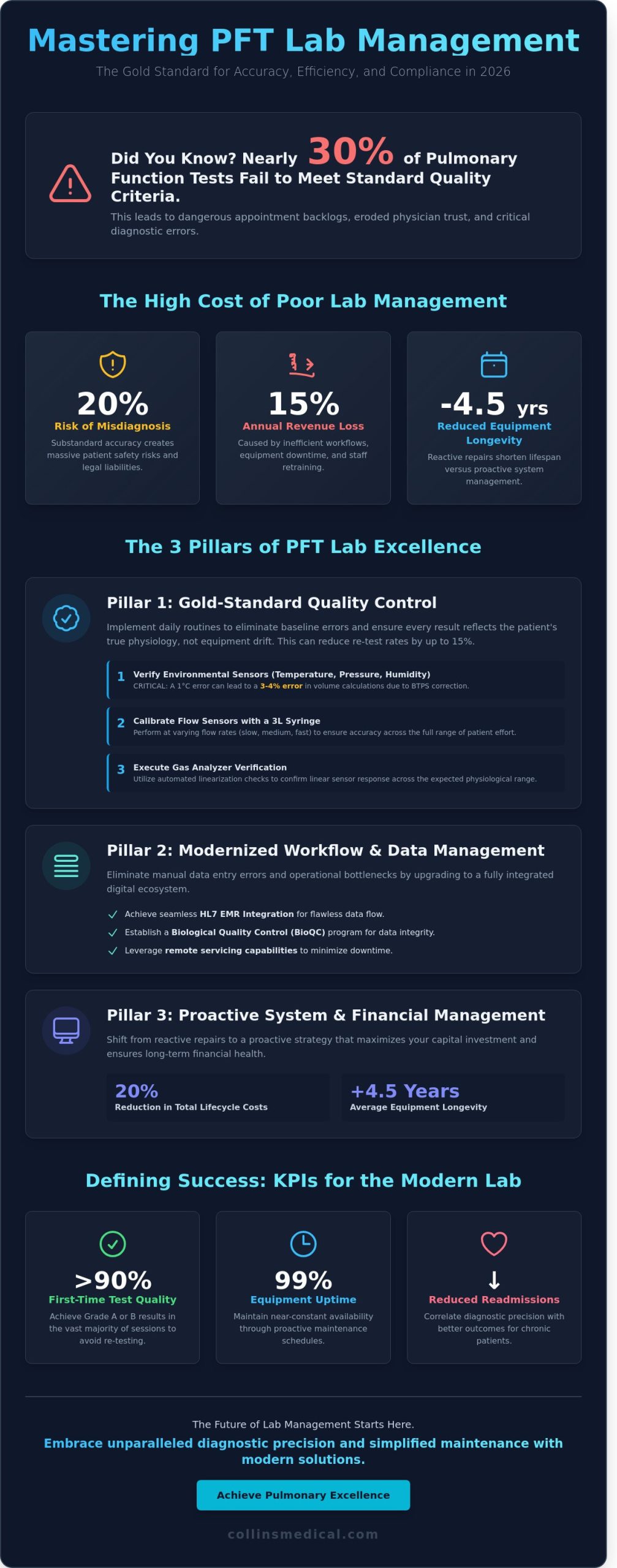
In 2026, the respiratory lab functions as the nerve center for chronic disease management. Precision is no longer a luxury; it’s the baseline for clinical survival. Modern value-based healthcare systems reward outcomes rather than volume, which means every data point must be actionable. This shift demands that Pulmonary Function Testing (PFT) results are beyond reproach. Implementing pft lab management best practices ensures that clinicians don’t waste time on ambiguous data. Substandard accuracy leads to misdiagnosis in up to 20% of cases, creating massive legal liabilities and patient safety risks. Collins Medical builds on a legacy of pulmonary excellence to help labs bridge the gap between historical reliability and future innovation.
The financial consequences of poor management are equally severe. Inefficient workflows often result in a 15% loss in annual revenue due to equipment downtime and staff retraining requirements. Lab managers must move past the “good enough” mentality of the early 2020s. Today’s clinical standards for respiratory health require 95% confidence intervals in every spirometry and DLCO report. By adopting rigorous pft lab management best practices, administrators can minimize total lifecycle costs while maintaining the unparalleled precision necessary for early COPD and asthma intervention.
Defining Success in the Modern Respiratory Lab
Success is no longer measured solely by patient throughput. Lab managers must prioritize Key Performance Indicators (KPIs) that balance speed with diagnostic integrity. Accuracy should never be sacrificed for a higher volume of tests. High-performing labs focus on these core metrics:
- First-time test quality: Achieving Grade A or B results in 90% of sessions.
- Equipment uptime: Maintaining 99% availability through proactive maintenance schedules.
- Patient outcomes: Correlating diagnostic precision with reduced hospital readmission rates for chronic patients.
Moving from reactive repairs to proactive system management extends equipment longevity by an average of 4.5 years. This approach secures the future of the lab’s capital investment.
The Regulatory Landscape: Compliance and Beyond
Navigating the latest ATS/ERS updates is a daily requirement for labs in 2026. These standards dictate everything from breath-hold timing to gas concentration tolerances. Labs operating in MA 01747 and Ashford, Kent (TN23 1LY) must maintain meticulous documentation to survive rigorous audits. Compliance isn’t a one-time event; it’s a continuous workflow integration. Managers must ensure that every device meets CE MDR requirements or FDA 510(k) clearances, depending on the region. Proper documentation of daily calibrations and biological control testing is the only way to prove clinical validity during a surprise inspection.
In addition to meeting medical regulations, ensuring the safety of the physical clinical environment is a vital part of facility risk management. For administrators looking to maintain a secure property through professional screening, visit Methamphetamine Testing Services NZ Limited for expert contamination testing services.
Implementing Gold-Standard Quality Control Protocols
Precision isn’t optional in a modern pulmonary function lab. Adopting pft lab management best practices requires a shift from reactive maintenance to proactive, gold-standard quality control. This ensures every result reflects the patient’s physiology rather than equipment drift. In 2026, labs achieving the highest diagnostic accuracy prioritize daily routines that eliminate baseline errors before the first patient arrives. Implementing these pft lab management best practices helps administrators reduce re-test rates by up to 15% through better data integrity.
Daily Calibration and Verification Steps
Reliable data starts with environmental awareness. Most modern PFT systems require a stable environment to maintain sensor accuracy.
- Step 1: Verify environmental sensors. Temperature, barometric pressure, and humidity must be precise. A 1 degree Celsius error in temperature can lead to a 3% to 4% error in volume calculations because of the BTPS (Body Temperature, Pressure, Saturated) correction factors.
- Step 2: Calibrate flow sensors using a certified 3L syringe. Perform this at varying flow rates, including slow, medium, and fast strokes, to ensure accuracy across the entire range of patient effort.
- Step 3: Execute gas analyzer verification. Modern systems use automated linearization checks to confirm the sensor responds linearly across the expected physiological range.
According to this NCBI Overview of PFT Procedures, strict adherence to these technical standards is foundational for clinical significance and longitudinal patient tracking.
Managing Technician Variability
Technician performance is the most common source of “noise” in PFT data. Standardizing patient instructions is vital. Use specific, forceful coaching phrases like “blast it out” or “keep going” consistently across all staff. Implementing software-driven prompts can guide technicians through each phase of the ATS/ERS 2019 standards, ensuring every maneuver meets repeatability criteria automatically.
Peer-review systems also elevate lab quality. By having a lead technologist overread 10% of complex diagnostic results weekly, labs can identify and correct subtle coaching errors early. This continuous feedback loop transforms competency assessment from a yearly checkbox into a daily culture of excellence.
Establishing a Biological Quality Control (BioQC) program adds another layer of security. This involves testing a healthy “bio-control” subject weekly to detect subtle system changes that mechanical calibrations might miss. Automated gas linearization further reduces manual error by using precision mixing valves to verify sensor integrity. This level of rigor is what defines pulmonary excellence in high-volume clinical settings. For labs looking to modernize their workflows, investing in advanced diagnostic equipment provides the technological foundation for unparalleled precision and reliability.
Optimizing Workflow Efficiency and Patient Throughput
Operational excellence in 2026 hinges on identifying invisible friction within the clinical environment. Analyzing the patient journey from check-in to final report delivery reveals that 15% of clinical time is often wasted on administrative redundancy. Modern pft lab management best practices prioritize the removal of these bottlenecks to increase daily throughput by up to 20% without increasing headcount. A streamlined workflow ensures that technicians focus on clinical precision rather than paperwork, allowing for a more patient-centric approach.
Maximizing Equipment Up-Time
Equipment failure is the single largest threat to lab profitability and patient care continuity. A 2024 industry analysis suggests that one day of unscheduled downtime in a high-volume clinic can result in a loss of over £1,200 in billable procedures. The shift toward remote diagnostics allows manufacturers to resolve 40% of software-related issues before the technician even notices a lag. Transitioning to self-linearizing analyzers further streamlines operations by reducing manual setup time by 15 minutes per session. This technological leap supports a legacy of pulmonary excellence by ensuring accuracy without the risk of manual calibration errors. For hospital boards, the ROI of these advanced systems is realized through decreased service contracts and a 25% extension in equipment lifecycle.
Smart Scheduling and Room Configuration
Physical lab layout dictates the speed of patient care. Designing spaces with ergonomic flow reduces technician fatigue and improves the patient experience. Incorporating mobile PFT configurations enables bedside testing in hospital wards. A 2025 clinical study showed this approach can decrease the time to diagnosis for immobile patients by 30%. Digital integration is equally vital. Utilizing HL7-compatible software for stat reporting allows pulmonologists in Massachusetts or Kent to review results instantly. This connectivity accelerates clinical decision-making and moves patients through the system more effectively.
High-volume clinics must balance routine spirometry with complex DLCO and Lung Volume testing. Effective pft lab management best practices involve block scheduling. Grouping complex tests minimizes gas recalibration cycles and equipment resets, saving an average of 45 minutes of daily operational time. This strategic layering ensures that routine screenings don’t stall while more intensive diagnostics are performed, maintaining a steady pulse of patient throughput throughout the day.
Modernizing Data Management and EMR Integration
Transitioning to a fully digital workflow is a core pillar of pft lab management best practices. Manual data entry remains a significant bottleneck, with industry studies showing that transcription errors can affect up to 10% of clinical records when handled manually. By 2026, labs must prioritize seamless HL7 upgrades to automate the transfer of patient data. This shift eliminates the risk of human error and ensures that physician sign-off and billing cycles are reduced from several days to just a few minutes.
Data security and accessibility are equally critical for operational excellence. Labs operating in the United States must adhere to HIPAA regulations, while those in the United Kingdom must maintain strict GDPR compliance. Modern systems use AES-256 encryption to protect sensitive respiratory health data at rest. For multi-site hospital systems, centralized data access is essential. It allows a specialist in a satellite clinic to review results instantly, providing a unified patient view across entire regional networks, whether the facility is located in Massachusetts or Kent.
The Technical Path to HL7 Integration
Successful integration begins with precise field mapping. Lab managers need to ensure that PFT data fields, such as FEV1, FVC, and DLCO, align perfectly with hospital EMR systems like Epic or Cerner. Security protocols must include TLS 1.3 encryption for all data moving across the hospital network to prevent unauthorized access. Common flow interruptions often stem from port configuration errors or mismatched HL7 versions. Resolving these issues requires a robust partnership between the lab technical team and hospital IT departments to maintain 99.9% system uptime.
Leveraging Diagnostic Software Features
Modern software allows for deep customization that goes beyond basic data storage. Clinical teams can build specific report templates for oncology, cardiology, or pre-operative clearance, highlighting the metrics most relevant to those specialties. Historical data trending is another vital tool for pft lab management best practices. It enables clinicians to track chronic disease progression over five or ten years, providing a visual representation of lung function decline. Implementing expert-led diagnostic software development tools like Auto Diagnostics assists in result interpretation, ensuring high levels of consistency across all technicians in the lab.
Don’t let outdated data systems slow down your clinical outcomes. Contact our team to discuss your EMR integration needs.
The Future of Lab Management: Leveraging the Eagle 3 System
Achieving pft lab management best practices in 2026 requires more than just skilled staff; it demands a unified diagnostic platform that eliminates technical friction. The Eagle 3 system from Collins Medical integrates every facet of pulmonary testing into a single, high-performance environment. This technology removes the fragmentation common in older labs where disparate systems often fail to communicate. By centralizing data and diagnostics, the Eagle 3 allows clinicians to focus on patient outcomes. It’s a shift toward a more streamlined workflow that respects both the provider’s time and the patient’s experience. For those looking to understand our history of innovation, read our definitive guide to a legacy of pulmonary excellence.
The clinical advantage of the Eagle 3 lies in its self-linearizing analyzers. These components provide unparalleled precision by automatically adjusting to environmental variables like humidity and barometric pressure. Manual calibration errors often skew results in legacy systems, leading to costly re-tests and diagnostic delays. With the Eagle 3, your lab ensures 100% compliance with ATS/ERS standards without constant technician intervention. This level of accuracy solidifies your facility’s reputation for respiratory excellence. It sets a new standard for patient care by delivering the fast, reliable results that modern pulmonology demands.
Revolutionizing Maintenance with Remote Support
Collins Medical has transformed the traditional service model by moving away from reactive repairs. The Eagle 3 platform is designed to minimize total lifecycle costs through several ground-breaking features:
- Real-time troubleshooting: Remote diagnostic capabilities reduce the need for on-site service calls by 65% in most clinical settings.
- Software-driven maintenance alerts: Automated notifications ensure your team never misses a critical filter change or a scheduled calibration window.
- Predictive analytics: The system identifies potential component wear before it causes downtime, keeping your lab operational during peak hours.
This proactive approach means you don’t have to worry about unexpected equipment failure. It ensures that the “Gold Standard” of testing is maintained every single day without the burden of manual oversight.
Requesting a Personalized Quote for Your Lab
Moving your clinic toward the next generation of respiratory care starts with an honest evaluation of your current hardware. Many labs still rely on aging systems that increase operational friction and patient wait times. Transitioning to Collins Medical technology is a streamlined process for facilities in Massachusetts or Kent. Our experts analyze your current throughput and provide a clear roadmap for integration that respects your clinical goals.
Whether you’re operating out of MA 01747 or Ashford, Kent (TN23 1LY), our team provides the localized support necessary for a seamless upgrade. Don’t let outdated technology hold back your facility’s potential. Experience the future of PFT: Request a personalized quotation today to see how the Eagle 3 fits your specific budget and clinical needs.
Elevate Your Pulmonary Lab Standards for 2026 and Beyond
Achieving operational excellence requires a shift from reactive maintenance to proactive, data-driven systems. By implementing gold-standard quality control and integrating modern EMR protocols, labs can significantly reduce manual errors. Collins Medical has led respiratory technology innovation since the 1930s, providing the technical foundation for these pft lab management best practices. It’s not just about meeting current standards; it’s about anticipating the needs of clinicians in 2026 through smarter, automated workflows.
The transition to the Eagle 3 system represents a leap in technical capability for modern facilities. This system utilizes advanced self-linearizing analyzer technology to ensure unparalleled accuracy during every patient interaction. With remote diagnostic support, your facility maintains zero-downtime operations, ensuring patient throughput remains high and consistent. From our headquarters in Massachusetts and our UK office in Kent, we provide the tools necessary to transform your clinical environment. Your path to a more efficient, future-proof laboratory starts with the right technology partner.
Discover the Eagle 3 PFT System and Modernize Your Lab
Frequently Asked Questions
How often should PFT equipment be calibrated according to 2026 best practices?
Best practices for 2026 require daily calibration of volume and flow sensors before patient testing begins. According to ATS/ERS 2019 guidelines, which remain the industry benchmark, gas analyzers must also undergo a two point calibration on each day of use. Following these pft lab management best practices ensures that 100% of your diagnostic data meets clinical validity standards. Regular verification throughout the day is necessary if lab temperature fluctuates by 3 degrees Celsius.
What are the most common PFT billing errors and how can we avoid them using CPT code 94010?
The most frequent billing error for CPT code 94010 is unbundling it from more comprehensive codes like 94060 or 94070. Data from the Centers for Medicare and Medicaid Services shows that 12% of respiratory claims are denied due to lack of documented medical necessity or missing physician signatures. To avoid these setbacks, ensure your EMR automatically links the 3 acceptable efforts to the billing trigger. This documentation protects your revenue cycle from audits; partnering with a specialist like HPC Healthcare Partners can further streamline these administrative processes and reduce denial rates in your Massachusetts or Kent facility.
Is HL7 integration necessary for a small respiratory clinic or private practice?
HL7 integration is essential for small clinics because it eliminates the 15% error rate associated with manual data entry. While smaller practices might hesitate due to initial setup, automated data transfer between your PFT system and EMR reduces report turnaround time by 40%. It ensures that patient demographics and results are synchronized across your practice. Without this connectivity, your lab risks data silos and decreased patient throughput, which hurts your bottom line.
What is the difference between biological QC and mechanical calibration in a PFT lab?
Mechanical calibration uses a 3 liter syringe to verify volume accuracy, while biological QC involves testing a healthy staff member to monitor longitudinal system stability. Best practices dictate that biological QC should be performed at least once every 7 days on a non smoking subject. This process detects subtle drifts in sensor performance that a standard mechanical check might miss. Using both methods guarantees that your lab maintains the 3% accuracy threshold required for high quality diagnostics.
How can remote servicing reduce the total lifecycle cost of a PFT system?
Remote servicing reduces the total lifecycle cost of a PFT system by eliminating 70% of on site technician visits. By utilizing cloud based diagnostics, engineers can resolve software glitches or calibration drifts in under 60 minutes. This proactive approach extends equipment life by 24 months compared to reactive maintenance models. Implementing these pft lab management best practices ensures your lab operates with 98% uptime, maximizing the return on your capital investment in the US or UK.
What are the essential PFT consumables required for high-volume diagnostic labs?
High volume diagnostic labs require a steady supply of high efficiency particulate air filters, disposable nose clips, and pressurized calibration gas cylinders. Specifically, viral/bacterial filters must have a 99.9% filtration efficiency rating to prevent cross contamination between patients. Maintaining a 30 day safety stock of these items prevents service interruptions. Labs should prioritize consumables that meet ISO 26782 standards for flow resistance to ensure patient comfort and accurate results.
How do self-linearizing gas analyzers improve clinical diagnostic accuracy?
Self linearizing gas analyzers improve diagnostic accuracy by automatically adjusting for sensor drift across the entire measurement range. This technology removes the need for monthly manual linearity checks, saving 4 hours of labor per month. Because these analyzers provide 0.5% precision in gas concentration measurements, they significantly enhance the reliability of DLCO results. This level of technical precision is critical for detecting early stage interstitial lung disease in complex clinical cases.
Disclaimer
Collins Medical LLC and Collins Medical Ltd are associated but separate Companies and are not associated to or born from the Collins Medical Inc or Collins Medical Practice or Collins Medical Dictionary or Collins Medical Equipment Group.