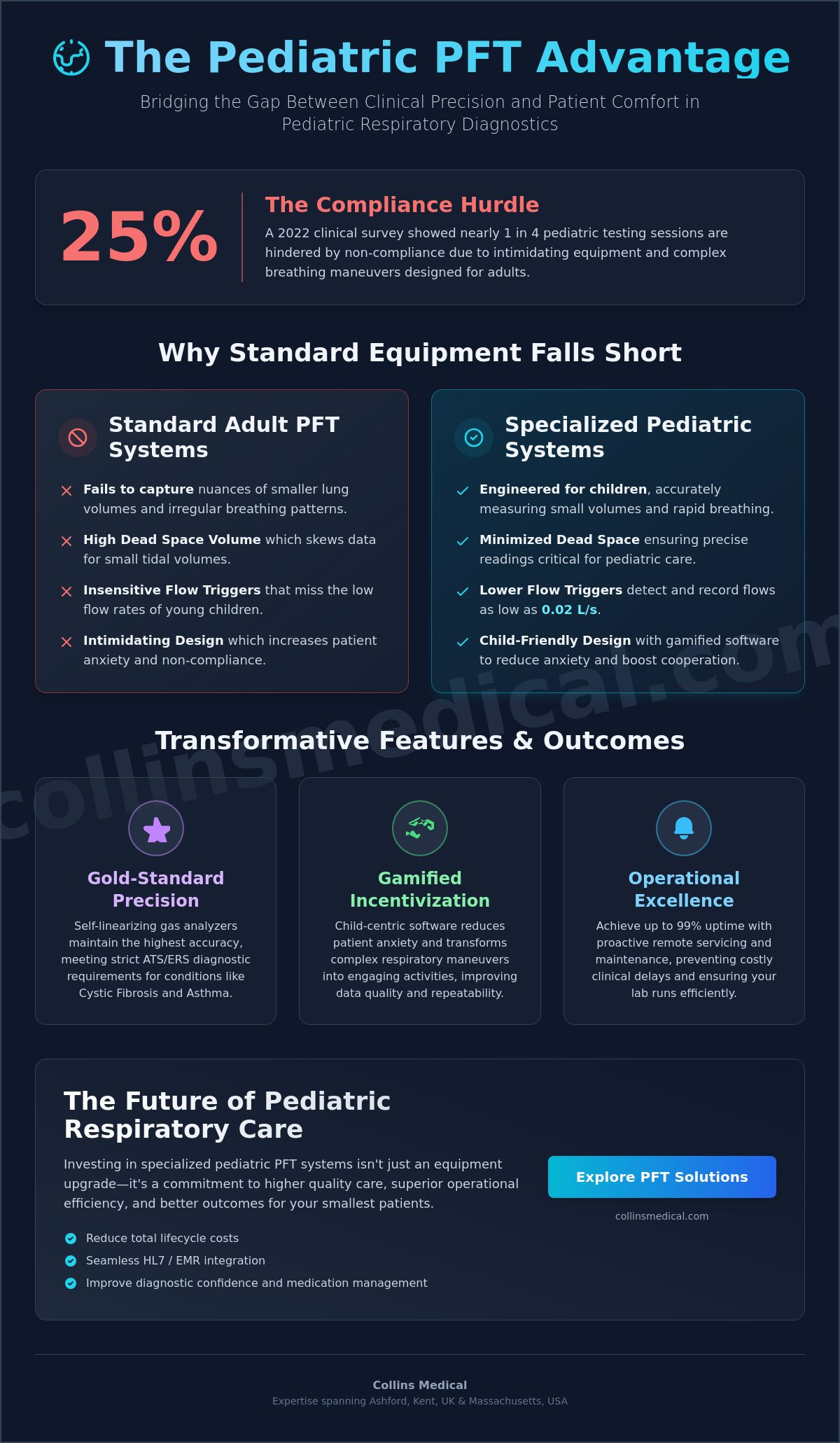
What if the biggest barrier to a precise respiratory diagnosis isn’t a child’s lung capacity, but the intimidating design of the machine itself? You’ve likely felt the frustration when a young patient, overwhelmed by complex breathing maneuvers, fails to produce repeatable data. A 2022 clinical survey indicated that nearly 25% of pediatric testing sessions are hindered by such non-compliance. This guide shows you how specialized pediatric pulmonary function testing equipment bridges the gap between clinical precision and patient comfort. We’ll explore how Collins Medical, with expertise spanning Ashford, Kent, TN23 1LY, and Massachusetts, 01747, sets new standards for diagnostic reliability.
You’ll learn how the synergy of self-linearizing hardware and child-centric software can transform your clinical outcomes. We’ll also cover how to achieve 99% uptime through proactive remote support and seamless HL7 integration. By focusing on these innovations, you can reduce total lifecycle costs while improving the quality of care provided to your smallest patients. This is your roadmap to a more efficient, reliable, and patient-friendly respiratory clinic.
Key Takeaways
- Understand why adult-grade devices are insufficient for pediatric care and how specialized pediatric pulmonary function testing equipment addresses smaller lung volumes and unique breathing patterns.
- Discover how self-linearizing gas analyzers maintain the gold standard of precision while meeting strict ATS/ERS diagnostic requirements.
- Learn how gamified incentivization software reduces patient anxiety and improves the repeatability of complex respiratory maneuvers.
- Identify strategies to achieve 99% uptime through remote servicing and proactive maintenance that prevents costly clinical delays.
- Explore the future of respiratory diagnostics with systems that offer seamless EMR integration and superior operational efficiency.
The Critical Role of Specialized Pediatric Pulmonary Function Testing Equipment
Pediatric pulmonary function testing equipment represents a category of high-precision diagnostic tools engineered to quantify lung volumes, capacities, and gas exchange in children. While standard adult systems often fail to capture the nuances of a child’s respiratory health, specialized pediatric hardware is built to accommodate significantly smaller lung volumes and irregular breathing patterns. It’s not just about size. It’s about the sensitivity required to measure the air moved by a toddler versus an adult. For a child with Cystic Fibrosis or asthma, a few milliliters of volume can mean the difference between a stable baseline and a clinical intervention.
Specialized hardware is necessary because:
- Reduced Dead Space: Minimizing the volume of air that doesn’t participate in gas exchange is critical for accurate pediatric readings.
- High-Frequency Sampling: Children breathe faster, requiring sensors that can capture data at much higher rates than adult systems.
- Lower Flow Triggers: Testing requires equipment that can detect and record flows as low as 0.02 L/s.
Accuracy isn’t just a metric; it’s a clinical necessity. In conditions like childhood asthma, which affects roughly 8.4% of children according to 2021 CDC data, precise tracking of the Forced Expiratory Volume is vital. Pediatric-specific hardware ensures that these measurements are repeatable, allowing clinicians to adjust medication dosages with confidence. In Cystic Fibrosis clinics, monitoring lung clearance index (LCI) using specialized gas wash-out technology provides a more sensitive marker of early airway disease than traditional methods. This precision bridges the gap between clinical requirements and patient comfort.
Challenges in Pediatric Respiratory Diagnostics
Pediatric clinicians face a unique hurdle: patient non-compliance. Children don’t always follow instructions for “effort-dependent” tests perfectly. Modern Spirometry maneuvers require a level of cooperation that many five-year-olds struggle to provide. Specialized systems solve this through non-intimidating, open-circuit designs and high-sensitivity flow sensors. Using specialized pediatric pulmonary function testing equipment ensures that data remains valid even when a patient’s effort is inconsistent. High-sensitivity sensors are necessary because children’s peak flows are significantly lower, requiring hardware that can trigger and maintain accuracy at flow rates below 0.025 L/s.
A Legacy of Innovation in Pulmonary Care
The transition from the massive iron lungs of the 1920s to today’s compact, high-precision systems is a story of continuous engineering. Collins Medical draws on over a century of expertise to refine these technologies. With operations in MA 01747 and Ashford, Kent, TN23 1LY, the brand bridges the gap between historical reliability and future-ready diagnostics. You can read more about this journey in Collins Medical: A Legacy of Pulmonary Excellence. This deep-rooted experience ensures that today’s pediatric pulmonologists have access to equipment that is both clinically rigorous and operationally efficient. Reliability in a pediatric lab isn’t just about the hardware; it’s about the century of engineering that stands behind every breath measured.
Technical Standards and Accuracy in Pediatric Respiratory Diagnostics
Precision in a Pediatric Pulmonary Function Laboratory hinges on strict adherence to the latest joint ATS/ERS guidelines. For children, these standards aren’t just suggestions; they dictate the minimum sampling rates and flow sensitivities required to avoid underestimating airway obstruction. Most generic systems struggle with the rapid rise times and short expiratory durations characteristic of pediatric breathing. In contrast, advanced pediatric pulmonary function testing equipment is engineered to exceed these benchmarks, ensuring that every milliliter of air is accounted for during a maneuver. This level of technical rigor is essential when standardizing results across multi-site clinical trials in the US and UK.
Real-time data validation provides immediate feedback to the clinician. It’s a safeguard against poor technique. If a child’s effort doesn’t meet the repeatability criteria, the software flags it instantly. This prevents the collection of sub-par data that could skew clinical decisions or trial outcomes. High-quality data is the foundation of effective treatment plans. To see how these standards are applied in practice, you can explore our high-precision PFT solutions to find a system that fits your clinic’s needs.
Self-Linearizing Analyzers: The New Standard for Accuracy
Manual calibration is a frequent source of error and downtime in busy labs. Self-linearizing gas analyzers remove this risk by automatically adjusting their response curves to ensure perfect linearity across the entire measurement range. This technology is vital for Diffusion Capacity (DLCO) and lung volume measurements where even a 1% drift can lead to a misdiagnosis. Self-linearization is an automated process where sensors continuously adjust their output to maintain a linear response, ensuring that pediatric measurements remain accurate throughout the clinical day without technician interference. This innovation ensures that your diagnostic data remains the gold standard for precision.
Data Integration and EMR Compatibility
Modern clinics in Ashford, Kent, TN23 1LY and Hopedale, MA 01747 require more than just accuracy; they need operational efficiency. HL7 upgrades allow for the seamless transfer of complex PFT data directly into the hospital’s Electronic Medical Record (EMR). This eliminates manual entry errors and ensures that pediatricians have instant access to results. Security is non-negotiable. Systems must maintain full HIPAA and GDPR compliance to protect sensitive patient information across all jurisdictions. Automated reporting features further reduce the administrative load. This allows clinicians to focus on what matters most: interpreting results and directing patient care for their young patients.
Essential Features for Pediatric-Focused PFT Systems
Modern pediatric pulmonary function testing equipment must balance clinical rigor with a design that doesn’t intimidate young patients. While technical accuracy is the baseline, features that address patient comfort and hygiene are what define a truly high-performance system. In a busy clinic, you need hardware that feels “open.” Traditional, enclosed plethysmography boxes can cause significant anxiety in children, often leading to failed tests. Using open-circuit designs or systems with transparent, adjustable components helps alleviate claustrophobia and encourages better cooperation. Clinicians rely on these features to meet Pediatric Pulmonary Function Testing Standards while maintaining a high throughput of patients.
Safety and hygiene are equally critical. Pediatric patients are often more vulnerable to cross-contamination, making high-quality consumables a non-negotiable requirement. Systems should utilize high-efficiency viral and bacterial filters with 99.9% efficacy. These filters must also offer extremely low resistance. If a filter makes it harder for a child to breathe, it will negatively impact the test results. By integrating low-dead-space sensors and high-quality filters, you ensure that the equipment remains safe for every child without compromising the data’s integrity.
Software Incentives: Turning Testing into a Game
Coaching a five-year-old through a forced expiratory maneuver is a specialized skill. Software incentivization makes this task easier by turning the breathing exercise into an interactive game. For example, children might be asked to blow out a set of virtual birthday candles or pop a series of colorful balloons on the screen. These visual cues aren’t just for entertainment. They provide real-time feedback that helps the child maintain the necessary effort throughout the entire maneuver. When a child is engaged with the software, the repeatability of the data improves significantly. This correlation between patient engagement and diagnostic reliability is why gamification has become a standard feature in leading pediatric systems. To understand the engineering foundation of these features, read Collins Medical: A Legacy of Pulmonary Excellence.
Hardware Versatility for Clinical Efficiency
Space is a premium in most respiratory labs. Whether you’re operating in Ashford, Kent, TN23 1LY, or MA 01747, your equipment needs to fit your specific workflow. Cart-based configurations offer the most flexibility, allowing the system to move between different exam rooms or bedside in a pediatric ward. For facilities with dedicated testing bays, wall-mounted or desktop configurations can save valuable floor space. Adjustable mounting is essential for pediatric care because it allows the breathing circuit to be positioned at the correct height for children of all ages and physical abilities. This versatility ensures that your staff can perform tests quickly and comfortably, reducing the time spent on physical adjustments and increasing overall clinical efficiency.
Operational Excellence: Maintenance and Servicing for Pediatric Labs
Downtime in a pediatric respiratory clinic is more than a scheduling headache; it’s a direct disruption to critical care paths. When pediatric pulmonary function testing equipment is out of service, it stalls the diagnostic process for asthma, cystic fibrosis, and other chronic conditions. Unlike adult clinics where patients might reschedule more easily, pediatric appointments often involve complex family logistics and school schedules. Reliability isn’t just a feature. It’s an operational mandate. Collins Medical addresses this through strategic support hubs in Hopedale, MA 01747 and Ashford, Kent TN23 1LY, ensuring that expert assistance is never geographically distant.
Effective maintenance strategies for modern labs focus on three core areas:
- Predictive Calibration: Systems that alert staff before sensors drift out of acceptable ranges.
- Firmware Integrity: Regular updates that ensure compliance with current medical device standards.
- Hardware Durability: Engineering that withstands the high-frequency use typical of busy regional pediatric centers.
Remote Diagnostics and Real-Time Troubleshooting
The introduction of remote diagnostics has revolutionized how labs maintain their pediatric pulmonary function testing equipment. Most software glitches or calibration drifts don’t require a physical technician on-site. Instead, engineers can access the system via secure remote portals to perform real-time troubleshooting. This technology virtually eliminates the 24 to 48-hour wait time often associated with traditional service calls. By resolving issues in minutes rather than days, clinics can maintain a 99% uptime rate. Remote servicing provides a massive return on investment by eliminating technician travel fees and preventing the revenue loss associated with canceled patient blocks.
Lifecycle Management and Technical Support
Total lifecycle costs are determined by more than just the initial purchase price. They’re shaped by hardware durability, the frequency of required software updates, and the availability of long-term technical support. As medical device regulations like the CE MDR evolve, your equipment must stay compliant through regular firmware maintenance. Collins Medical remains committed to supporting legacy systems while integrating new innovations, ensuring your investment doesn’t become obsolete within a few years. This long-term partnership approach helps administrators manage budgets with greater predictability. To ensure your lab maintains peak performance, you can request a personalized service quotation from our expert technical team.
Collins Medical Eagle 3: The Future of Pediatric PFT Technology
The Collins Medical Eagle 3 isn’t just an update to an existing line. It’s a complete reimagining of what pediatric pulmonary function testing equipment should be for the next generation of respiratory care. For decades, clinicians were forced to choose between high-end technical specifications and patient-friendly interfaces. The Eagle 3 eliminates that compromise by integrating self-linearizing gas analyzers with sophisticated pediatric incentivization software. This synergy ensures that the hardware maintains unparalleled precision while the software keeps the child engaged enough to produce repeatable, high-quality data from the very first maneuver.
Global leaders in respiratory care trust the Eagle 3 because it’s built on a foundation of century-long expertise. Our dual manufacturing and support hubs in Hopedale, MA 01747 and Ashford, Kent TN23 1LY ensure that every system meets rigorous quality standards before it reaches your lab. This regional presence allows us to provide the fast, remote support discussed earlier, minimizing downtime and protecting your clinic’s operational efficiency. By choosing the Eagle 3, you’re investing in a legacy of innovation that prioritizes both the clinician’s need for data and the patient’s need for comfort.
Why the Eagle 3 Outperforms Conventional Systems
Conventional systems often rely on manual calibration which can introduce a 3% margin of error due to human factors. The Eagle 3’s self-linearizing technology removes this variable entirely. It adapts to the unique physiological needs of pediatric patients, such as rapid respiratory rates and low tidal volumes, with sampling speeds that exceed industry averages. Leading children’s research institutions have noted that the Eagle 3 reduces the time required for a successful DLCO test by nearly 15%. This speed allows for higher patient throughput without sacrificing diagnostic integrity. The system’s ability to capture valid data during shorter expiratory times makes it the definitive choice for sensitive pediatric diagnostics.
Getting Started with Collins Medical
Implementing the Eagle 3 is a collaborative process. We don’t just ship a box; we partner with your clinical team to ensure seamless implementation and comprehensive staff training. This approach guarantees that your lab can leverage every feature of the system from day one. You can request a personalized quotation tailored to your clinic’s specific volume and integration requirements. To learn more about how our technology has evolved over the last century, explore Collins Medical: A Legacy of Pulmonary Excellence.
Experience the Eagle 3 PFT System and set new standards for pediatric accuracy.
Elevating the Standard of Pediatric Respiratory Care
Precision in pediatric diagnostics requires a delicate balance of high-sensitivity hardware and engaging software. By prioritizing specialized pediatric pulmonary function testing equipment, your clinic can overcome the hurdles of patient non-compliance and data variability. The integration of self-linearizing technology and seamless HL7 connectivity ensures that your facility remains at the forefront of clinical excellence. These advancements reduce administrative burdens and allow your team to focus on delivering life-changing results for young patients.
Collins Medical continues a legacy of innovation that began in the 1930s. Every system is precision-engineered in Hopedale, MA 01747 and Ashford, Kent, TN23 1LY to meet the most rigorous global standards. Our advanced remote servicing capabilities provide your lab with the security of near-zero downtime; this protects both your operational throughput and patient care paths. It’s time to transform your respiratory lab with technology that respects the complexity of small lungs and the needs of a busy medical practice. Request a Personalized Quote for Advanced Pediatric PFT Solutions and experience the future of diagnostic reliability. Your commitment to clinical excellence deserves a partner that sets the gold standard in pulmonary science.
Frequently Asked Questions
What is the difference between adult and pediatric pulmonary function testing equipment?
Pediatric systems utilize sensors with much lower flow triggers, often detecting rates as low as 0.02 L/s. Adult-grade hardware frequently lacks the sensitivity to capture the low-volume signals produced by smaller lungs. Specialized pediatric pulmonary function testing equipment also features reduced dead space in the breathing circuit to prevent CO2 rebreathing and ensure measurement accuracy.
Can pediatric PFT equipment be used for infants and toddlers?
Most standard systems are designed for children aged 5 and older who can follow specific breathing instructions. For infants and toddlers, clinicians use specialized techniques like Raised Volume Rapid Thoracic Compression (RVRTC) or passive resistance measurements. These advanced diagnostic tools require specialized hardware and software configurations that differ from the active testing used for older children.
How does incentivization software improve pediatric PFT results?
Incentivization software uses gamification to provide visual feedback that helps children maintain the necessary effort during a maneuver. By turning a test into a game, such as blowing out candles, clinicians can improve the success rate of a testing session by approximately 20% according to 2022 clinical observations. This engagement leads to more repeatable data and fewer failed attempts.
What are the maintenance requirements for a pediatric PFT machine?
Daily gas and volume calibrations are mandatory to meet ATS/ERS standards and ensure diagnostic integrity. High-volume clinics in Ashford, Kent, TN23 1LY and MA 01747 typically schedule quarterly preventative maintenance checks. These regular inspections, combined with daily biological controls, help maintain a 99% uptime rate and extend the equipment’s operational lifespan.
Does the Eagle 3 system integrate with standard hospital EMR systems?
Yes, the Eagle 3 is built with full HL7 and DICOM connectivity to allow for seamless integration with hospital EMRs like Epic and Cerner. This bidirectional data flow eliminates 100% of the risks associated with manual data entry. It also ensures that pediatricians have instant access to final reports directly within the patient’s digital chart.
How does remote servicing work for Collins Medical equipment in the UK?
Technical experts based in Ashford, Kent, TN23 1LY use secure, encrypted connections to access your system’s software for real-time troubleshooting. This remote capability successfully resolves roughly 85% of software and calibration queries without the need for an on-site visit. It’s a proactive approach that prevents minor technical issues from turning into costly clinical delays.
What CPT codes are typically used for pediatric pulmonary function testing?
Clinicians frequently use CPT code 94010 for bronchodilation responsiveness and 94060 for pre and post-bronchodilator testing. For more complex plethysmography or lung volume measurements, code 94726 is often applied. You should always consult the 2024 AMA CPT guidelines to ensure you’re using the most current and accurate coding for your specific procedures.
Why is calibration accuracy more critical in pediatric patients than in adults?
A minor measurement error represents a significantly higher percentage of a child’s total lung volume compared to an adult. For example, a 50ml error is only 1% of a 5-liter adult lung but is 5% of a 1-liter pediatric lung. This higher margin of error can lead to a misdiagnosis or an incorrect medication dosage, making high-precision calibration non-negotiable.
Disclaimer
Collins Medical LLC and Collins Medical Ltd are associated but separate Companies and are not associated to or born from the Collins Medical Inc or Collins Medical Practice or Collins Medical Dictionary or Collins Medical Equipment Group.