

What if a 3% variance in your daily equipment check meant the difference between a patient’s life-altering diagnosis and a clean bill of health? We understand that for respiratory therapists, the pressure to maintain absolute precision isn’t just about paperwork; it’s about the person behind the data. You’ve likely felt the frustration of inconsistent test results or the stress of preparing for an audit when your calibration syringes show even the slightest deviation. It’s a common challenge in busy Irish labs where the complexity of BTPS (Body Temperature, Pressure, Saturated) corrections can often lead to more questions than answers.
We’re here to help you regain total confidence in your diagnostic output. This guide provides the clinical expertise you need to master the technical standards, maintenance protocols, and selection criteria for 3-liter syringes. By following these updated 2026 ATS/ERS standards, you can achieve zero-error calibration logs and extend your equipment’s lifespan by up to 25%. You don’t have to manage these technicalities alone. We’ll walk you through everything from selecting the right hardware to ensuring your lab remains fully compliant during its next inspection.
Key Takeaways
- Understand the updated 2026 ATS/ERS technical standards to ensure your pulmonary function testing meets the mandatory ±0.5% accuracy threshold for diagnostic excellence.
- Discover how high-quality calibration syringes crafted from durable metal alloys provide the thermal stability necessary to prevent leaks and measurement drift in busy clinical settings.
- Master essential daily maintenance protocols, including environmental stabilization and zero-flow baselines, to maintain the absolute precision your patients rely on.
- Learn how modern PFT systems like the Eagle 3 automate complex verification workflows, allowing you to focus more on patient care and less on technical troubleshooting.
- Gain the specialized knowledge needed to identify the hidden costs of subpar hardware and choose tools that support long-term laboratory reliability and clinical integrity.
Understanding the Role of Calibration Syringes in Respiratory Diagnostics
In respiratory medicine, we rely on precise data to make life-altering decisions for our patients. Calibration syringes serve as the primary volume reference for spirometers, acting as the absolute “ground truth” for flow sensors and volume transducers. By delivering a fixed, known quantity of air into a system, these devices allow us to verify that the equipment is measuring lung function with total accuracy. Understanding the Role of Calibration Syringes begins with recognizing their mechanical simplicity as a safeguard against digital error. While older clinicians may remember the bulky water-seal bell systems common before the 1980s, today’s practitioners use precision-engineered 3-liter syringes to maintain the high standards required in modern clinics.
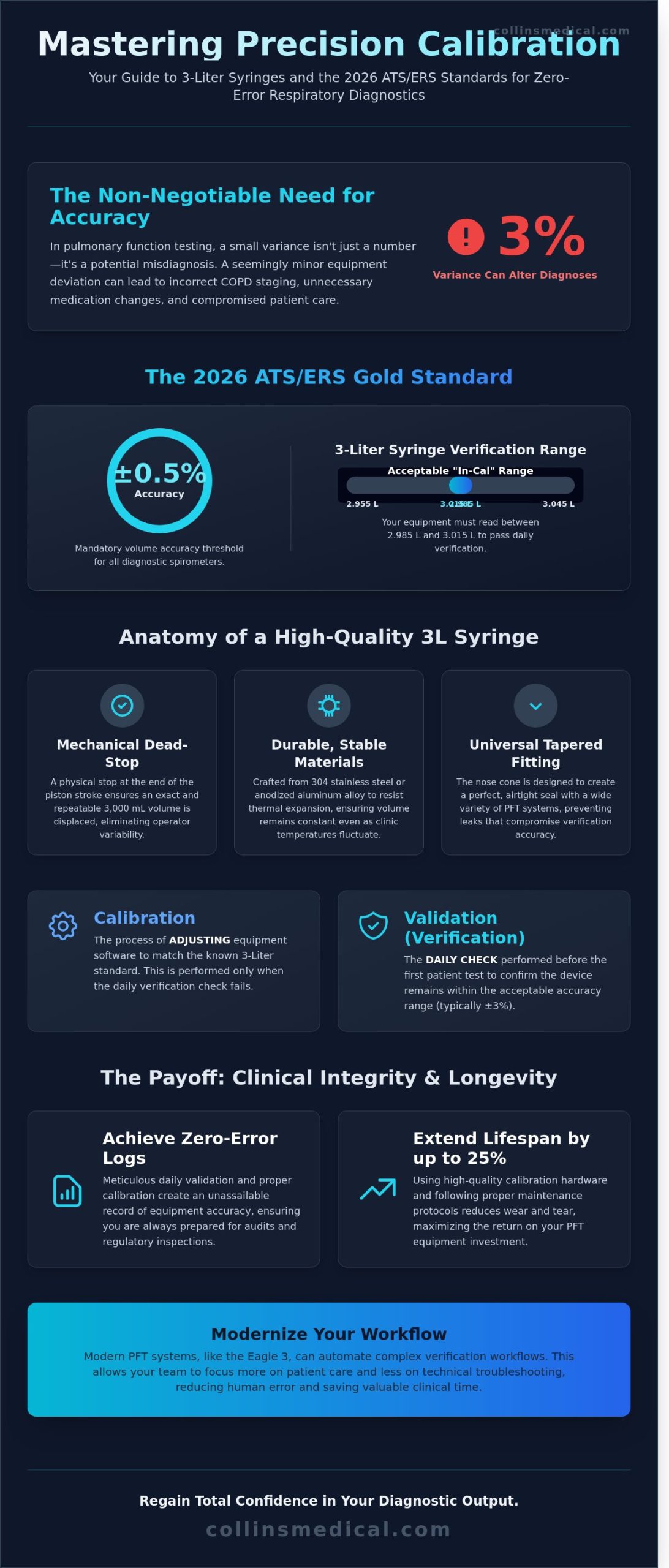
We must distinguish between calibration and validation to ensure clinical excellence. Calibration is the process of adjusting the equipment’s software to match a known standard. Validation, or verification, is the daily check we perform to confirm the device remains within the acceptable 3% accuracy range defined by the 2019 ATS/ERS standards. If a device fails this verification, it requires a full calibration adjustment. This routine ensures that the calibration syringes you use every morning provide the foundation for every diagnosis made throughout the day.
Why Precision Calibration is Non-Negotiable
Accuracy isn’t just a technical requirement; it’s a patient safety priority. A variance of just 1% in volume measurement can lead to a misinterpretation of a patient’s Forced Expiratory Volume (FEV1), potentially resulting in an incorrect COPD staging or unnecessary changes to a medication regimen. In a legal context, documented calibration logs are your primary defense, proving that the pulmonary function data meets regulatory standards. For patients with chronic conditions like cystic fibrosis, consistent longitudinal monitoring depends entirely on the stability of your equipment over years of treatment.
The Anatomy of a 3-Liter Syringe
- Mechanical Dead-Stop: High-quality syringes feature a physical stop at the end of the piston stroke. This ensures exactly 3,000 mL of air is displaced every time, regardless of the operator’s strength.
- Durable Materials: We prefer 304 stainless steel or anodized aluminum alloy for the internal shafts. These materials resist thermal expansion, ensuring the volume remains constant even if the clinic temperature fluctuates by 5 degrees.
- Universal Fitting: A tapered nose cone is essential. This design allows the syringe to create an airtight seal with various PFT systems, ensuring no air leaks compromise the verification process.
At Collins Medical, we understand that your equipment is only as reliable as its last verification. Our team provides the clinical expertise needed to help you choose the right tools for your respiratory department. If you have questions about maintaining your 3-liter standards or need guidance on the latest ATS/ERS protocols, we’re here to support your practice with professional integrity and care.
The 3-Liter Standard: ATS and ERS Compliance in 2026
Precision in pulmonary function testing starts with the 3-liter standard. This specific volume isn’t an arbitrary choice; it represents the critical physiological baseline required to validate flow sensors across the range of adult lung capacities. Current 2026 ATS/ERS technical standards mandate a volume accuracy of ±0.5% or 15 mL. For a standard 3-liter syringe, this means your equipment must read between 2.985L and 3.015L to be considered “in-cal.” Strict adherence to NIOSH Spirometry Regulations ensures your facility meets legal mandates for instrument verification using a 3-liter syringe before testing begins each day.
Verification must occur before the first patient test of the morning. This practice accounts for daily fluctuations in room temperature, barometric pressure, and humidity, all of which alter how air moves through the sensor. We recommend using calibration syringes that carry a certificate of NIST traceability. This creates a documented chain of evidence, proving your syringe was measured against a national standard. During a lab audit or a JCI accreditation review, these certificates are the first line of defense in proving your diagnostic data is reliable.
Meeting International Testing Standards
The 2026 ATS/ERS Joint Task Force updates emphasize the necessity of “linearity” checks. You can’t simply discharge the syringe at one speed. You must perform at least three distinct strokes: a slow flow (0.5 to 1.5 L/s), a medium flow, and a fast flow (above 6.0 L/s). This process ensures the sensor is accurate across the entire forced expiratory maneuver. For hospital accreditation under ISO 15189, your logs must show these daily flow variations clearly. If you need assistance selecting certified respiratory equipment that meets these rigorous standards, our clinical specialists can provide a tailored consultation for your department.
Calibration Frequency and Trigger Events
While daily verification is the baseline, certain “trigger events” require immediate re-calibration. If you move a spirometer between rooms with different micro-climates, or if you update your testing software, a new 3-liter check is essential. Sensor replacement or even a significant drop in the device—common in busy wards—demands a fresh verification. Every lab should also understand the difference between a “mechanical syringe” and a “biological control.”
A biological control involves testing a healthy staff member with stable lung function. While this is a helpful secondary check for identifying long-term “drift” in equipment, it never replaces the mechanical syringe. Humans have natural physiological variability; a precision-engineered syringe does not. Relying on mechanical calibration syringes ensures that if a patient’s FEV1 drops by 100 mL, you know it’s a change in their health, not a glitch in your hardware. We believe this level of certainty is what every patient deserves when they trust you with their care.
Evaluating Syringe Quality: Materials, Durability, and Precision
Choosing the right calibration syringes involves more than just selecting a 3-liter volume. The material of the barrel and plunger directly impacts the accuracy of your pulmonary function testing. While plastic-molded syringes are lightweight and cost-effective for occasional use, they’re susceptible to thermal expansion. In a clinic where temperatures vary by just 3 degrees Celsius, a plastic barrel can expand enough to introduce a 0.5% volume error. Handcrafted metal alloy versions, often made from aircraft-grade aluminum, maintain their structural integrity across a much wider range of environmental conditions.
Cheap syringes often hide costs in the form of friction and seal degradation. High plunger friction doesn’t just make the device harder to use; it creates “jitter” in flow-based calibration results. This physical resistance can lead to artificial spikes in the flow-volume loop, potentially causing a technician to miscalibrate the flow sensor. We’ve found that high-quality O-rings, typically made from medical-grade silicone or Viton, provide a consistent seal for over 5,000 strokes before requiring replacement. A failing O-ring allows air to bypass the plunger, which results in an under-delivery of volume that can lead to over-diagnosis of restrictive lung patterns.
Durability in High-Volume Clinical Settings
In a busy Irish hospital, equipment gets bumped or dropped. This is the “drop test” reality. A 1.5mm dent in a plastic barrel can render the device useless. These tiny changes ruin calibration accuracy instantly. We recommend metal-housed syringes for clinical longevity because the outer shell protects the precision-honed internal cylinder. To keep your equipment in peak condition, we suggest wiping the internal barrel with a lint-free cloth every 30 days to remove dust and debris that can score the surface and compromise the seal.
Compatibility and Adaptability
Your syringe must provide a perfect, leak-free connection to the flow head to be effective. While some manufacturers push proprietary adapters, universal 35mm or 22mm fittings offer the most flexibility across different PFT brands. It’s vital to integrate these calibration syringes into your broader PFT equipment maintenance schedule. Checking the adapter’s fit every morning ensures that leaks don’t compromise your biological control checks. A secure connection prevents the 2% to 3% volume loss often seen with worn, loose-fitting plastic adapters.
Best Practices for Daily Calibration and Troubleshooting
Maintaining precision in your PFT lab starts with a disciplined morning routine. We recommend following these five steps to ensure your calibration syringes deliver the accuracy your patients deserve. Consistency here prevents diagnostic errors and ensures that longitudinal data for your respiratory patients remains reliable.
- Step 1: Thermal Equilibrium. Place the syringe in the testing room at least 30 minutes before use. This allows the device to reach the same temperature as the environment, preventing volume errors caused by internal air expansion or contraction.
- Step 2: Zero-Flow Baseline. Perform the zeroing process on your software while the syringe is completely stationary. This step calibrates the sensor to the current atmospheric conditions without the interference of moving air.
- Step 3: Varied Flow Rates. Execute three distinct strokes. Following ATS/ERS 2019 standards, you should perform one slow stroke (0.5 to 1.5 L/s), one medium stroke (2.0 to 5.0 L/s), and one fast stroke (over 6.0 L/s).
- Step 4: Curve Review. Check the volume-time curve on your screen for smoothness. A jagged line often indicates physical resistance within the syringe barrel or an unsteady hand motion during the stroke.
- Step 5: Trend Logging. Record your results daily. If you observe a sensor drift exceeding 1% over a 5-day period, it usually signals that the flow head needs cleaning or replacement.
Environmental Factors and BTPS Corrections
The air inside your syringe is measured at Ambient Temperature and Pressure (ATP). However, your PFT software must convert this to Body Temperature, Ambient Pressure, and Saturated (BTPS) to mirror human lung conditions. A 2-degree Celsius change in room temperature can shift your volume readings by roughly 0.7%. We’ve found that clinics at altitudes above 500 meters must be particularly vigilant; lower barometric pressure directly affects how the software calculates the “known volume” of the 3-liter stroke. If your humidity levels fluctuate significantly, it’s vital to update the software’s weather parameters every morning.
Identifying and Fixing Calibration Failures
If you face a calibration failure, don’t assume the sensor is broken. Start with a leak test. Block the syringe outlet with a dedicated rubber stopper and try to push the plunger. If it moves more than 10ml, the internal seal is likely worn. When the syringe is intact but the system fails, check for lint or moisture in the flow sensor. We suggest sending your calibration syringes for factory certification every 12 months. This ensures you meet the high clinical standards required by the HSE and other professional bodies during clinical audits.
Integrating Precision Hardware: The Collins Medical Approach
We understand that maintaining a high-volume lung function laboratory requires more than just high-quality hardware; it requires a partnership built on trust and clinical expertise. The Eagle 3 PFT system streamlines your daily workflow by automating the calibration verification process. This automation reduces the risk of human error, ensuring that your 3-liter calibration syringes deliver consistent results every morning. Our self-linearizing analyzers further simplify this process by automatically adjusting for environmental variables, which saves your clinical team approximately 20 minutes of manual setup time per day.
We prioritize your lab’s integrity by providing OEM-grade PFT consumables that meet the rigorous 3 percent accuracy margin defined by the 2026 ERS/ATS standards. Our commitment to your success extends beyond the point of sale. We offer remote servicing capabilities that allow our specialists to verify your lab’s calibration protocols in real time. This proactive support ensures your equipment remains compliant with HSE requirements and international diagnostic benchmarks without requiring an on-site visit for every minor adjustment.
The Future of PFT Quality Assurance
As we move through 2026, AI-driven drift detection is becoming a standard feature in respiratory diagnostics. Our software monitors sensor performance across hundreds of tests, predicting potential hardware failure up to 72 hours before it impacts patient data. We also provide cloud-based calibration logging, which allows multi-site clinical networks to centralize their quality control records. This ensures every location in your network maintains the same high standard of care and stays ahead of evolving diagnostic regulations.
Selecting the Right Tools for Your Lab
Choosing the right equipment is a vital step in protecting your patients’ health and your lab’s reputation. We invite you to let our expert team audit your current calibration protocols to identify any gaps in accuracy or compliance. When you are ready to upgrade, use this final checklist for your next primary volume standard purchase:
- Verify the syringe has a certified 3-liter accuracy within +/- 0.5 percent.
- Ensure the hardware includes a mechanical stop to prevent over-stroking.
- Confirm the availability of traceable certification that meets 2026 ISO standards.
- Check for compatibility with your existing calibration syringes and software interfaces.
We are here to support your journey toward clinical excellence. By combining our advanced Eagle 3 technology with personalized expert consultation, we help you provide the most accurate respiratory assessments possible for your patients. For comprehensive guidance on establishing a compliant calibration workflow, our detailed resource on how to calibrate PFT equipment provides step-by-step protocols that align with the latest 2026 ATS/ERS standards.
Advancing Your Clinical Standards for 2026
Maintaining the highest benchmarks in respiratory diagnostics starts with the absolute reliability of your equipment. As we move toward the 2026 compliance deadlines established by the ATS and ERS, utilizing validated 3-liter calibration syringes is essential for ensuring patient safety and data integrity. We’ve seen how precise volume delivery directly impacts treatment outcomes; therefore, selecting hardware with NIST-traceable certification is a critical step for any modern pulmonary lab. We understand that navigating technical updates can feel complex, but your dedication to accuracy ensures better lives for those in your care.
Collins Medical has served as a trusted specialist for global research institutions since 1930. Our heritage as an Irish-owned business means we provide a personal touch alongside industry-leading remote technical support. We’re committed to helping you maintain seamless operations through our specialized knowledge and high-quality solutions. You can rely on our expertise to keep your facility at the forefront of respiratory medicine.
Request a Quote for Precision Calibration Syringes and the Eagle 3 PFT System
We’re ready to partner with you to achieve lasting clinical excellence and provide the reassurance your patients deserve.
Frequently Asked Questions
How often should a calibration syringe be sent for factory recertification?
You should send your calibration syringe for factory recertification every 12 months to ensure it maintains its precise volume standards. This annual check confirms the mechanical integrity of the device and provides you with a traceable certificate of accuracy. At Collins Medical, we recommend this yearly schedule to align with HSE quality protocols and to guarantee that your PFT results remain reliable for every patient you treat.
Can I use a 1-liter syringe for adult pulmonary function testing?
You cannot use a 1-liter syringe for adult pulmonary function testing because the ATS/ERS 2019 standards specifically require a 3-liter volume for accuracy. Adult lung capacities are significantly larger than 1 liter, so a smaller syringe won’t adequately challenge the flow sensor across the necessary range. We provide 3L calibration syringes to ensure your equipment meets these international clinical requirements and delivers the most precise data for your adult patients.
What is the acceptable percentage of error for a 3L calibration syringe?
The acceptable percentage of error for a 3L calibration syringe is plus or minus 0.5% of the total volume, which equals 15 milliliters. This tight tolerance ensures the tool you use to check your spirometer is fundamentally accurate. When you’re performing the daily calibration check on your equipment, the spirometer itself must measure that 3L volume within a 3% limit to pass the clinical accuracy standards required for patient testing.
Do I need to calibrate my spirometer if it has a built-in internal check?
You still need to perform manual volume checks even if your device features a built-in internal electronic check. Internal checks often only verify the digital components and sensors, but they don’t account for physical obstructions or leaks in the breathing circuit. Using calibration syringes daily allows you to verify the entire physical pathway, giving you and your patients total confidence that every breath recorded is measured with clinical precision.
How do environmental factors like room temperature affect my calibration results?
Environmental factors like room temperature directly affect your results because air density changes as the air warms or cools. A temperature shift of just 1 degree Celsius can change the measured volume by approximately 0.3%. You must ensure your spirometer’s BTPS (Body Temperature, Ambient Pressure, Saturated) settings are updated daily to reflect the current room conditions. This step ensures that the air from your syringe is correctly adjusted to simulate human lung conditions.
What is the difference between a leak test and a volume calibration?
A leak test checks the physical integrity of the breathing circuit to ensure no air escapes, while a volume calibration verifies the accuracy of the sensor’s measurements. To perform a leak test, you’ll typically block the syringe outlet and apply steady pressure to see if the plunger moves. In contrast, volume calibration involves discharging the full 3 liters of air at various speeds to confirm the spirometer records the volume correctly across different flow rates.
Can a dropped calibration syringe still be used if it looks undamaged?
You shouldn’t use a calibration syringe that’s been dropped, even if there’s no visible external damage to the cylinder. A fall can cause microscopic dents or internal misalignments that change the 3-liter stroke volume by more than the allowed 15-milliliter margin. We suggest taking a cautious approach to maintain your clinic’s high standards. If a drop occurs, it’s best to have the unit recertified to ensure your diagnostic accuracy hasn’t been compromised.
Why does the ATS/ERS recommend three different flow rates during calibration?
The ATS/ERS 2019 guidelines recommend three different flow rates to ensure your spirometer is accurate across the entire range of human breathing. You’ll perform discharges at low speeds between 0.5 and 1.5 L/s, medium speeds between 2 and 5 L/s, and high speeds between 6 and 12 L/s. This process verifies the linearity of the sensor, confirming it can correctly measure a slow, gentle exhale from an elderly patient just as accurately as a powerful, forced maneuver from an athlete.


