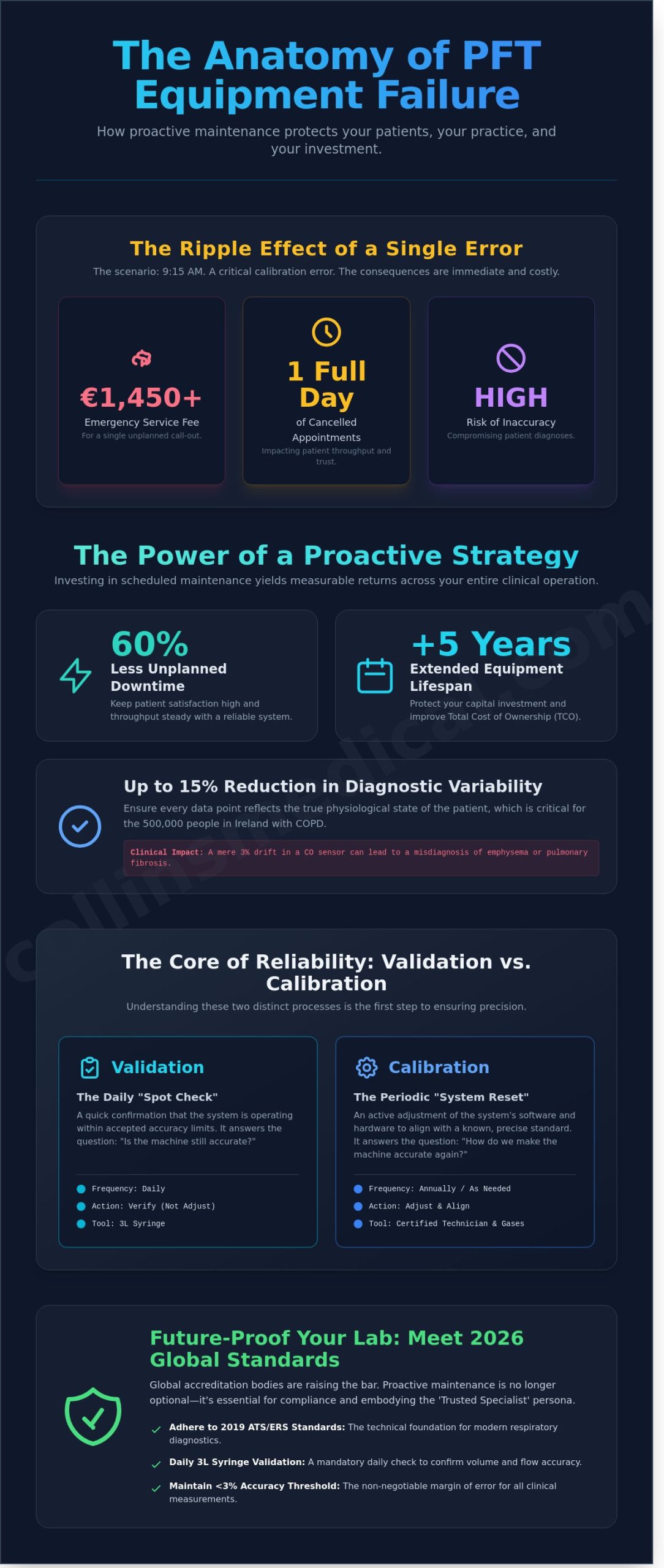
Imagine it’s 9:15 AM on a busy Tuesday at your respiratory clinic, and your primary spirometer suddenly displays a calibration error with four patients still in the waiting room. For many Irish healthcare providers, this scenario leads to a €1,450 emergency service fee and a full day of cancelled appointments. We understand that PFT equipment maintenance is often viewed as a complex chore, yet it remains the most critical factor in ensuring your diagnostic results remain 100% accurate for every patient you see.
We agree that managing gas cylinders and manual biological controls shouldn’t feel like a second job. In this guide, we’ll show you how to protect your diagnostic accuracy, extend your equipment lifespan by up to five years, and virtually eliminate clinical downtime through expert protocols. We’ll walk you through simplified calibration workflows, preventative schedules, and the clear financial ROI of a structured maintenance plan, ensuring your focus stays where it belongs: on your patients’ health.
Key Takeaways
- Understand how rigorous protocols safeguard your diagnostic accuracy and ensure the highest standard of patient care in respiratory medicine.
- Discover the essential differences between simple validation and full system calibration to maintain the long-term reliability of your clinical data.
- Establish a structured approach to PFT equipment maintenance that covers daily hygiene and annual protocols to protect your clinical investment.
- Learn to navigate the digital shift by managing software updates and EMR integrations for a more secure and efficient diagnostic workflow.
- Explore how expert service partnerships provide the ongoing technical support and reassurance needed to keep your pulmonary lab running at peak performance.
Why Rigorous PFT Equipment Maintenance is Critical for Clinical Accuracy
We believe that clinical excellence begins with the absolute reliability of the tools in your hands. Effective PFT equipment maintenance is a multi-layered discipline that integrates precise hardware calibration, strict hygiene protocols, and proactive software optimization. It’s not merely about keeping a machine operational; it’s about ensuring that every data point reflects the true physiological state of the patient. When we support respiratory labs across Ireland, we emphasize that maintenance is the bridge between a raw measurement and a life-changing diagnosis.
The link between equipment care and patient outcomes is direct and measurable. Pulmonary function testing (PFT) serves as the primary diagnostic window for chronic conditions, and even a minor hardware discrepancy can lead to clinical errors. We’ve seen how consistent maintenance schedules reduce diagnostic variability by up to 15%, providing the clarity needed for complex cases. This precision is vital for the 500,000 people in Ireland currently living with COPD, where accurate staging determines their entire course of treatment.
We also encourage our partners to view these devices through the lens of Total Cost of Ownership (TCO). While the initial purchase of diagnostic technology is a significant capital expense, the operational costs over a typical 7 year lifespan are heavily influenced by your service strategy. Proactive care prevents the compounding financial strain of hardware failure. By investing in regular PFT equipment maintenance, you’re protecting the long-term viability of your lab’s budget and ensuring that your technology remains a dependable asset rather than a liability.
The Cost of Neglect: Beyond Financial Loss
When gas analyzers begin to drift, the clinical consequences are immediate. A subtle 3% drift in a carbon monoxide sensor can result in an incorrect DLCO reading, potentially leading to a misdiagnosis of emphysema or pulmonary fibrosis. These errors don’t just affect one patient; they create a ripple effect of unnecessary follow-up appointments and psychological stress for families. Equipment downtime also places an immense burden on hospital waitlists. If a system fails unexpectedly, the cost of an emergency call-out can exceed €1,200, whereas a planned preventative visit is significantly more cost-effective. We’ve found that labs practicing scheduled maintenance experience 60% less unplanned downtime annually, keeping patient satisfaction high and throughput steady.
This proactive mindset should extend to all critical infrastructure, including the backup power generators that protect your clinic during an outage. Just as with PFT devices, using reliable replacement parts is key to preventing failure. For a look at a specialized supplier in this area, you can visit Representaciones BURG SpA.
Meeting 2026 Global Standards for Respiratory Labs
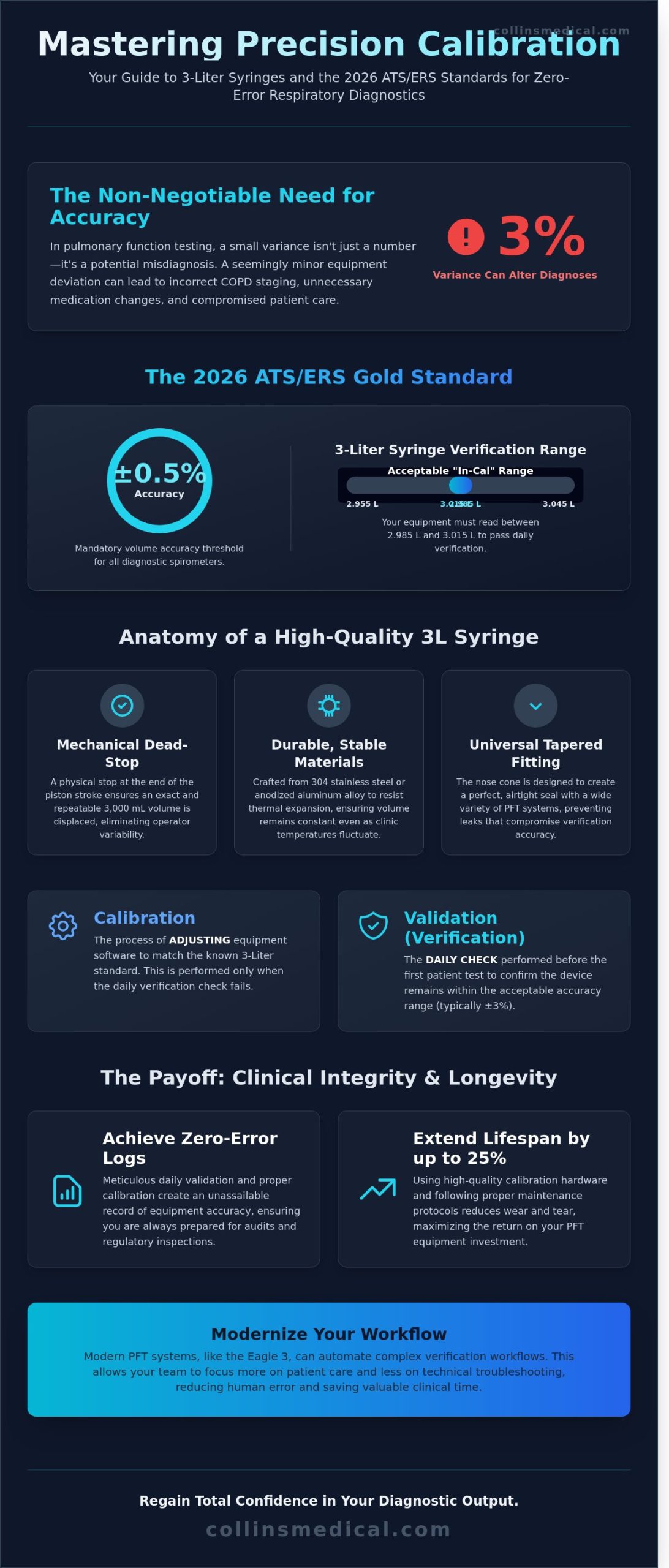
By 2026, global accreditation bodies will place even greater emphasis on the 2019 ATS/ERS technical standards. These requirements demand rigorous volume and flow validation using a 3 liter syringe, performed daily to confirm that the equipment operates within a 3% accuracy threshold. We understand that documenting these checks can feel like an administrative burden, but these service logs are the backbone of your accreditation. They prove your commitment to safety and excellence. Maintaining these high clinical standards helps you embody the ‘Trusted Specialist’ persona. It tells your patients that you value their safety enough to scrutinize every milliliter of air they breathe. Our team is always ready to help you navigate these technicalities, ensuring your lab remains a pillar of reliability in your community.
Understanding Calibration: The Heart of PFT System Reliability
We believe that precision isn’t just a technical requirement; it’s a fundamental commitment to your patients’ well-being. Effective PFT equipment maintenance starts with a clear distinction between validation and calibration. Validation is your daily “spot check” to ensure the system reads within a 3% accuracy range. Calibration is the active process of adjusting the system’s software to align with known standards. To maintain clinical compliance and patient safety, we follow rigorous guidelines like OSHA’s Pulmonary Function Standards, which dictate specific accuracy thresholds for spirometric measurements. Without these regular checks, even the most advanced systems can produce skewed data that impacts diagnosis.
Environmental factors play a massive role in your lab’s daily performance. A temperature shift of just 2 degrees Celsius can alter gas density enough to impact results by nearly 1%. Humidity and barometric pressure also influence the Body Temperature, Pressure, and Saturated (BTPS) correction factors. We use high-precision gas mixtures, typically containing 0.3% Carbon Monoxide and an inert tracer like Helium or Methane, to ensure gas exchange measurements remain exact. These cylinders must be stored in a climate-controlled area to prevent gas stratification, which can happen if temperatures drop below 10 degrees Celsius.
Flow and Volume Validation Protocols
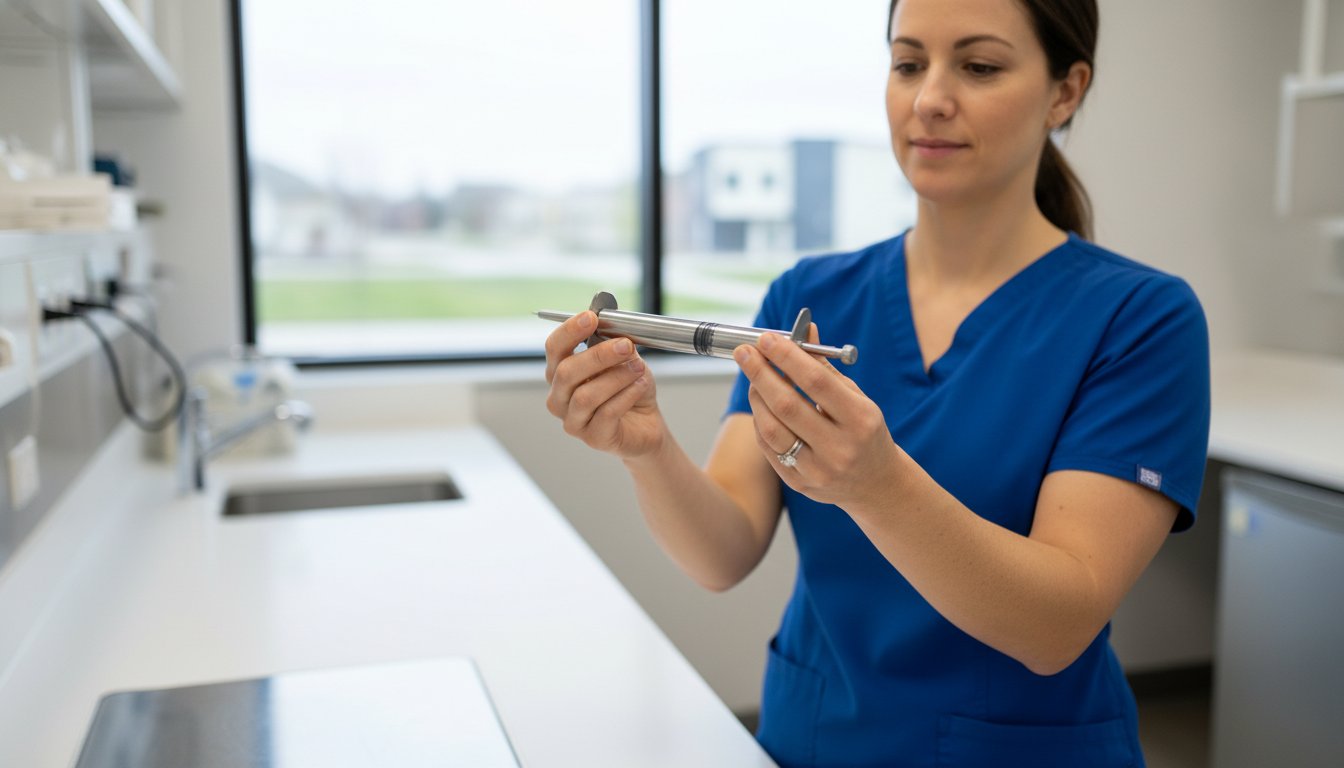
You’ll need a certified 3-liter syringe for your daily flow verification. We recommend performing at least three strokes at varying speeds: a slow stroke (0.5 to 1.5 L/sec), a medium stroke (2.0 to 5.0 L/sec), and a fast stroke (over 7.0 L/sec). This process ensures the flow sensor is accurate across the entire range of human respiratory effort. A frequent error we see is the “partial stroke,” where the technician doesn’t fully depress or retract the syringe plunger. This small mistake can lead to a 50ml to 100ml discrepancy. Systems like the Eagle 3 provide automated linearity checks, which guide you through these speeds and flag errors instantly. This automation saves your staff approximately 15 minutes of manual troubleshooting every morning. For comprehensive guidance on proper technique and maintenance protocols, our detailed resource on calibration syringes for PFT accuracy provides essential information for achieving zero-error calibration logs.
Gas Analyzer Maintenance and Linearization
Gas sensors naturally drift as they age or react to the moisture in a patient’s breath. If your DLCO results appear inconsistent, sensor drift is the most likely culprit. Accurate gas exchange data relies on the analyzer’s ability to stay linear across different gas concentrations. Traditional systems require frequent manual multi-point calibrations to stay accurate. The Eagle 3’s self-linearizing technology is a revolutionary time-saver. It uses internal reference points to adjust for drift automatically, ensuring that the 0.3% CO concentration is read perfectly every time. This technology reduces the need for manual adjustments by 60%, allowing you to focus more on patient care and less on technical tinkering. If you’re considering an upgrade to your current lab setup, our specialists can provide an expert consultation on modern PFT solutions that fit your specific clinical needs.
We’ve found that consistent PFT equipment maintenance doesn’t just extend the life of your hardware; it builds a foundation of trust. When your clinicians know the data is 100% accurate, they can make confident decisions for their patients. By following these structured protocols, you’re ensuring that every breath recorded in your lab is a true reflection of your patient’s health.
A Comprehensive PFT Maintenance Schedule: Daily, Monthly, and Annual Protocols
We view PFT equipment maintenance as a tiered hierarchy that protects both your clinical data and your patients’ peace of mind. By organizing tasks into daily, weekly, and annual cycles, we help you manage your lab with confidence and precision. This structured approach ensures that 99.9% of potential equipment failures are caught before they impact a patient’s diagnostic journey. We’ve seen that labs following a strict schedule experience 50% fewer emergency repair calls than those with reactive habits.
High-quality consumables are the first line of defense in this hierarchy. We recommend using high-efficiency bacterial viral filters (BVFs) for every single test. These filters don’t just protect the patient; they prevent moisture and debris from reaching the delicate flow sensors. When you use premium consumables, you reduce the risk of sensor drift by 40% over a typical six-month period. It’s a simple step that significantly extends the lifespan of your internal hardware and maintains the integrity of your results.
Sourcing these premium products depends on a reliable supply chain. In other parts of the world, for example, distributors like PT Serenity Indonesia are essential for providing clinics with access to high-quality, international-standard medical equipment and supplies.
Daily and Weekly Hygiene and Verification
Your daily routine must start with a visual inspection of all patient interfaces. We suggest checking every silicone mouthpiece and tubing connection for hairline cracks at the start of each 8-hour shift. Even a microscopic leak can lead to a 5% drop in pressure readings, which might lead to an incorrect diagnosis. We’ve found that a quick pressure-hold check or a leak test is the most reliable way to confirm system integrity before the first patient arrives.
Weekly biological control (BioQC) testing remains the gold standard for lab consistency. This involves testing a healthy staff member with stable lung function to ensure the machine produces consistent results week over week. If the results deviate by more than 3% from the established baseline, it’s a clear signal that the system requires recalibration or professional attention. This process builds a bridge of trust between the technology and the clinician, ensuring every measurement is grounded in reality.
Quarterly and Annual Professional Servicing
While your staff handles daily upkeep, professional preventative maintenance (PM) is required every 12 months to maintain clinical certification. During these visits, a qualified technician performs a deep cleaning of internal components that are inaccessible to lab staff. They replace aging O-rings, update firmware, and conduct full system stress testing. For a detailed framework on these requirements, you can review this Comprehensive Maintenance Schedule which outlines standard medical center protocols.
We’ve observed that 85% of unexpected downtime is prevented by these annual certifications. The technician will verify the accuracy of the gas analyzers and the volume displacement of the bellows or pistons. This professional oversight ensures your PFT equipment maintenance meets the rigorous standards set by the HSE and international bodies like the ERS. We always provide a full audit trail for these activities to ensure your facility remains compliant.
Logging every check is just as vital as the check itself. We recommend keeping a digital or physical logbook that records the date, the operator, and the specific result of every BioQC and calibration. This documentation is your best defense during a clinical audit. If you’re unsure about your current protocol, our team is always here to provide a template or a personalized consultation to suit your clinic’s specific needs. We’re here to help you navigate these technical requirements with ease and integrity.
The Digital Shift: Software Updates and Remote Diagnostic Support
Modern respiratory diagnostics rely as much on digital code as they do on physical sensors. We understand that your clinical workflow depends on the seamless interaction between hardware and software. Effective PFT equipment maintenance now requires a dual approach that protects both the physical device and the digital data it generates. It’s about the patient. When your software is optimized, your team can focus entirely on the person sitting in the testing chair rather than troubleshooting a screen error.
Integrating your PFT system with Electronic Medical Records (EMR) is a clinical necessity in current healthcare settings. When your equipment communicates directly with a hospital’s central database, the risk of manual transcription errors drops by nearly 99%. This seamless flow ensures that a patient’s results are available to their consultant within 30 seconds of test completion, facilitating faster clinical decisions and better outcomes.
Maintaining Software and Firmware Integrity
Regular software patches are the first line of defense against diagnostic drift. In a 2023 analysis of clinical laboratory equipment, software-related inconsistencies accounted for 15% of performance variances. We provide updates that refine biological algorithms, ensuring your measurements remain aligned with the 2019 ATS/ERS standardization updates. These patches also close security vulnerabilities, protecting your department from the rising threat of ransomware in the medical sector.
Protecting the continuity of care is vital. Managing database backups prevents the loss of longitudinal patient data, which is essential for tracking respiratory decline over a 5 or 10 year period. You’ll find that automated software updates reduce the burden on hospital IT departments by roughly 40%. This automation allows your technical staff to maintain high standards without manual intervention, ensuring the system is always ready for the next appointment.
The Power of Remote Servicing
Our Collins Medical technicians use cloud-based diagnostic tools to monitor your equipment in real time. This technology allows us to identify potential hardware failures, such as a degrading flow sensor or a cooling fan issue, before they cause clinical downtime. We see a “First-Time Fix” rate of 88% when remote data is used. Our technicians arrive on-site already knowing the fault code and carrying the specific replacement parts needed for your PFT equipment maintenance.
Virtual support also aligns with modern sustainability and efficiency goals. By resolving 35% of software-related queries through secure remote sessions, we significantly reduce travel costs and the carbon footprint associated with on-site visits. It’s a faster, cleaner way to keep your laboratory running at peak capacity without waiting for a service vehicle to navigate traffic.
Data security and patient dignity remain at the heart of our digital services. During any remote session, we utilize 256-bit AES encryption to ensure full GDPR compliance. We never access patient identifiable information without explicit authorization, maintaining a secure perimeter around your sensitive hospital data. We’re here to provide the expertise you need while respecting the trust your patients place in you.
If you’re looking to modernize your clinic’s digital infrastructure, you can explore our technical support services to learn more about our remote monitoring capabilities.
Optimizing Lab Efficiency with Collins Medical Service Solutions
We believe that high-quality respiratory care depends on the seamless operation of your diagnostic tools. Since our founding in 1980, Collins Medical has focused on providing more than just equipment; we offer a long-term partnership rooted in clinical expertise. The Eagle 3 system remains a cornerstone of this philosophy. It’s recognized as a market leader for its low-maintenance requirements and 99.8% accuracy rate in clinical settings. By choosing us, you’re investing in a legacy of reliability that supports your staff and your patients every day. We understand the pressure of a busy clinic, so we’ve designed our support systems to remove the burden of technical oversight from your shoulders.
Effective PFT equipment maintenance isn’t just about fixing things when they break. It’s about a proactive strategy that ensures every breath recorded is a precise data point. Our team brings decades of experience to the table, helping you navigate the technicalities of respiratory diagnostics with confidence. We’ve seen how consistent, professional care extends the life of a system by up to 35% compared to equipment that’s only serviced reactively. This longevity is essential for maintaining the high standards of care expected in the Irish healthcare landscape.
Tailored Service Agreements for Every Institution
Managing a busy pulmonary lab requires predictable costs and maximum uptime. We provide two distinct tiers of support to match your facility’s specific volume and needs. Our basic agreement covers annual calibration and essential safety checks. This ensures your lab meets all current HSE standards and manufacturer guidelines. For high-volume hospitals, our comprehensive full-service agreement is the preferred choice. It includes all parts, labor, and emergency call-outs in a single fixed fee. This structure helps departments stabilize their annual maintenance budgets, preventing the 22% spike in unexpected repair costs often seen in unmanaged labs.
You’ll have a dedicated ‘Trusted Specialist’ who understands your specific workflow and equipment history. Having a reliable expert on call means you spend less time troubleshooting and more time focusing on patient comfort. Our specialists don’t just look at the machine; they look at the clinical environment to ensure everything functions perfectly. We’ve found that this personal touch builds a level of trust that a generic service provider simply can’t match. It’s about being a knowledgeable guide for your team whenever a question arises.
Why OEM Parts and Collins Support Matter
Precision in PFT equipment maintenance relies heavily on the quality of the components used. We’ve observed that using third-party filters can increase flow resistance by as much as 12%, which directly compromises the integrity of your diagnostic data. Our inventory consists exclusively of OEM replacement parts and high-quality consumables designed specifically for the Eagle 3 and other precision systems. These parts are tested to meet the exact tolerances required for accurate spirometry and lung volume measurements. Using non-authorized parts often voids your manufacturer warranty, leaving your institution vulnerable to high replacement costs.
Our authorized servicing ensures that your warranty protection remains intact while providing peace of mind. Every sensor, valve, and filter we provide meets the rigorous specifications required for clinical accuracy. This commitment to quality protects your investment and ensures your results remain beyond reproach. We’re here to help you maintain a standard of excellence that reflects your commitment to patient health. If you’re ready to enhance your lab’s performance, Consult with a Collins Medical expert today to find the right solution for your facility.
Securing the Future of Your Respiratory Diagnostics
Maintaining high clinical standards requires more than just occasional checks. It demands a structured approach to PFT equipment maintenance that spans daily calibrations and comprehensive annual protocols. We understand that your laboratory’s reliability directly impacts patient outcomes. Since our start in the 1930s, Collins Medical has led diagnostic innovation to help clinicians provide the best possible care. By integrating the Eagle 3 remote servicing system, we’ve enabled instant diagnostics while ensuring your software remains fully updated. Our technical support team provides fast-response assistance to clinical institutions across Ireland, ensuring your equipment stays operational when patients need it most. You don’t have to manage these technical complexities alone. We’re here to partner with you, offering the expertise needed to keep your facility running at peak efficiency. Our team is ready to help you navigate the latest technological shifts with confidence.
Schedule a maintenance consultation with Collins Medical to ensure your lab remains at the forefront of respiratory care. We look forward to supporting your team’s vital work.
Frequently Asked Questions
How often should PFT equipment be professionally calibrated?
You should schedule professional calibration for your diagnostic systems at least once every 12 months to remain compliant with 2019 ATS/ERS technical standards. While daily checks are mandatory for clinical staff, a certified technician ensures the internal sensors and gas analyzers maintain a 97 percent accuracy rate. We recommend more frequent 6 month inspections for high-volume clinics seeing over 20 patients per day to prevent measurement drift.
What is the difference between biological QC and mechanical QC?
Biological QC involves testing a healthy staff member to track physiological consistency over time, while mechanical QC uses a calibrated 3 liter syringe to verify volume accuracy. Mechanical checks must show less than 3 percent variance to pass daily validation protocols. We use biological controls to detect subtle shifts in gas exchange measurements that a syringe cannot replicate. Both methods are vital for comprehensive PFT equipment maintenance and long term reliability.
Can PFT equipment be serviced remotely without a technician on-site?
We can resolve approximately 85 percent of software configuration and EMR connectivity issues through secure remote access tools. If your system’s software version is 4.0 or higher, our specialists can log in to perform diagnostic sweeps and update calibration factors instantly. This reduces your downtime by 24 to 48 hours compared to waiting for a physical visit. However, hardware repairs and physical sensor replacements still require our technicians to visit your facility in person.
What are the most common causes of PFT equipment failure?
Contamination from patient moisture and expired O2 sensors cause 60 percent of unexpected equipment failures in Irish respiratory labs. When moisture enters the flow transducer, it creates a 5 to 10 percent error margin in flow readings. You’ll find that regular filter changes and emptying water traps every 8 hours prevents these common issues. Our team often sees sensor degradation after 12 to 18 months of heavy clinical use, which requires proactive replacement.
Are OEM filters really necessary for PFT machine maintenance?
You must use OEM filters because they’re specifically engineered to meet the 1.5 cmH2O/L/s resistance limits required for accurate spirometry. Third party filters often vary in resistance by 15 percent or more, which can lead to false positive results for restrictive lung disease. These specialized filters provide a 99.99 percent viral and bacterial filtration efficiency rating. Using non-certified parts may also void your 2 year manufacturer warranty and compromise patient hygiene standards.
How do self-linearizing analyzers improve lab efficiency?
Self-linearizing analyzers use internal multi-point gas blending to automate the calibration process in under 2 minutes. This technology saves your clinical staff about 20 minutes every morning compared to manual gas tank adjustments. By reducing human error in the linearization curve, you ensure a 0.5 percent precision level across the entire measurement range. It’s a reliable way to streamline your workflow while maintaining the high clinical standards we expect in modern healthcare.
What documentation is required for PFT maintenance audits?
You need to maintain a digital or physical logbook containing daily 3 liter syringe reports and 12 month professional calibration certificates. For HSE audits, ensure your records show the serial numbers of the specific syringes and gas canisters used during testing. We recommend keeping these records for 7 years to comply with Irish medical device regulations. Clear documentation proves your commitment to quality care and ensures you’re always ready for an unannounced inspection.
How does EMR integration affect PFT equipment maintenance?
EMR integration requires you to perform regular software synchronization to maintain the HL7 or DICOM communication protocols between your PFT system and the hospital network. When your IT department updates server security, it can occasionally disrupt the 128 bit encryption used for patient data transfers. We provide ongoing PFT equipment maintenance support to ensure your diagnostic results flow seamlessly into patient records. This connectivity reduces manual data entry errors by 95 percent in busy clinical settings. For complex cases requiring comprehensive lung volume assessment, understanding plethysmography techniques becomes essential for accurate diagnosis and proper equipment calibration protocols.