What if 90% of your diagnostic delays aren’t caused by patient volume, but by the manual intervention points hidden within your testing protocols? As we move through 2026, the traditional approach to respiratory lab workflow optimization is no longer enough to meet the new FDA Quality System Regulations or the updated ISO 80601-2-90:2026 standards. Most labs are still fighting a losing battle against transcription errors and equipment downtime that requires frequent on-site technical support.
You probably feel the constant pressure to increase patient throughput without compromising clinical accuracy. It’s a common challenge to integrate complex PFT data with existing EMR systems while managing heavy manual calibration requirements. This guide will show you how to eliminate those bottlenecks and achieve peak operational efficiency in your PFT lab. We’ll explore how to leverage self-correcting hardware and remote-enabled software to ensure your data flows seamlessly from the device to the patient record, maximizing your ROI through a more resilient, high-capacity clinical environment.
Key Takeaways
- Identify your facility’s current position on the five levels of automation maturity to pinpoint specific areas for immediate operational improvement.
- Discover how self-linearizing gas analyzers eliminate the manual calibration “time thief,” drastically reducing equipment downtime and technician intervention.
- Implement a total system approach to respiratory lab workflow optimization that ensures seamless data flow between PFT devices and EMR systems.
- Navigate the 2026 regulatory landscape with advanced strategies for maintaining data security while maximizing diagnostic throughput.
- Future-proof your clinical operations by adopting PFT platforms designed for remote servicing and flexible mobile configurations.
Understanding Respiratory Lab Workflow Optimization in Modern Clinical Settings
Respiratory lab workflow optimization is the systemic reduction of friction within the test-to-report cycle. It’s not merely about buying faster hardware; it’s about re-engineering the path data takes from the initial patient encounter to the final clinical interpretation. In Modern Clinical Settings, this optimization is the difference between a lab that struggles with backlog and one that operates at peak efficiency. By 2026, the pressure to optimize has intensified as labs face stricter FDA quality system regulations and updated ISO safety standards.
Achieving true respiratory lab workflow optimization requires a focus on three foundational pillars:
- Data Integrity: Ensuring every data point is captured accurately without manual intervention.
- Operational Speed: Minimizing the time between patient arrival and report delivery.
- Lifecycle Management: Proactively managing equipment health to prevent unplanned downtime.
Traditional PFT labs often rely on manual processes that create significant bottlenecks. Technicians might spend hours each week on manual calibrations or re-entering data into separate systems. In contrast, “Smart Labs” utilize self-linearizing technology and automated EMR integration. These advanced facilities treat diagnostic equipment as part of a connected ecosystem rather than isolated tools, allowing for a much higher patient throughput without increasing the clinical staff’s burden.
The Hidden Costs of Inefficient Workflows
Inefficiency isn’t just a nuisance; it’s a financial and clinical drain. Manual data entry errors are a primary source of clinical risk, potentially leading to misdiagnosis or delayed treatment plans. When a lab relies on equipment that requires frequent on-site technician visits for maintenance, the resulting downtime can cost thousands in lost revenue and disrupted schedules. Slow reporting cycles also damage the lab’s reputation, leading to lower patient satisfaction and a drop in physician referrals. If your lab isn’t moving data at the speed of modern medicine, you’re losing money every day.
The 2026 Standards for Pulmonary Excellence
The industry benchmark has shifted toward “Real-Time Diagnostics.” This means results are available for review almost immediately after testing is complete. Hospitals in the United States, particularly across Massachusetts (MA 01747), and in the United Kingdom (Ashford, Kent, TN23 1LY), are rapidly adopting integrated diagnostic systems to meet these expectations. These systems provide a legacy of pulmonary excellence by combining high-precision hardware with software that speaks directly to the EMR. By removing the silos between testing and documentation, labs can finally achieve the seamless flow required for modern pulmonary care.
The 5 Levels of Workflow Automation Maturity: Where Does Your Lab Stand?
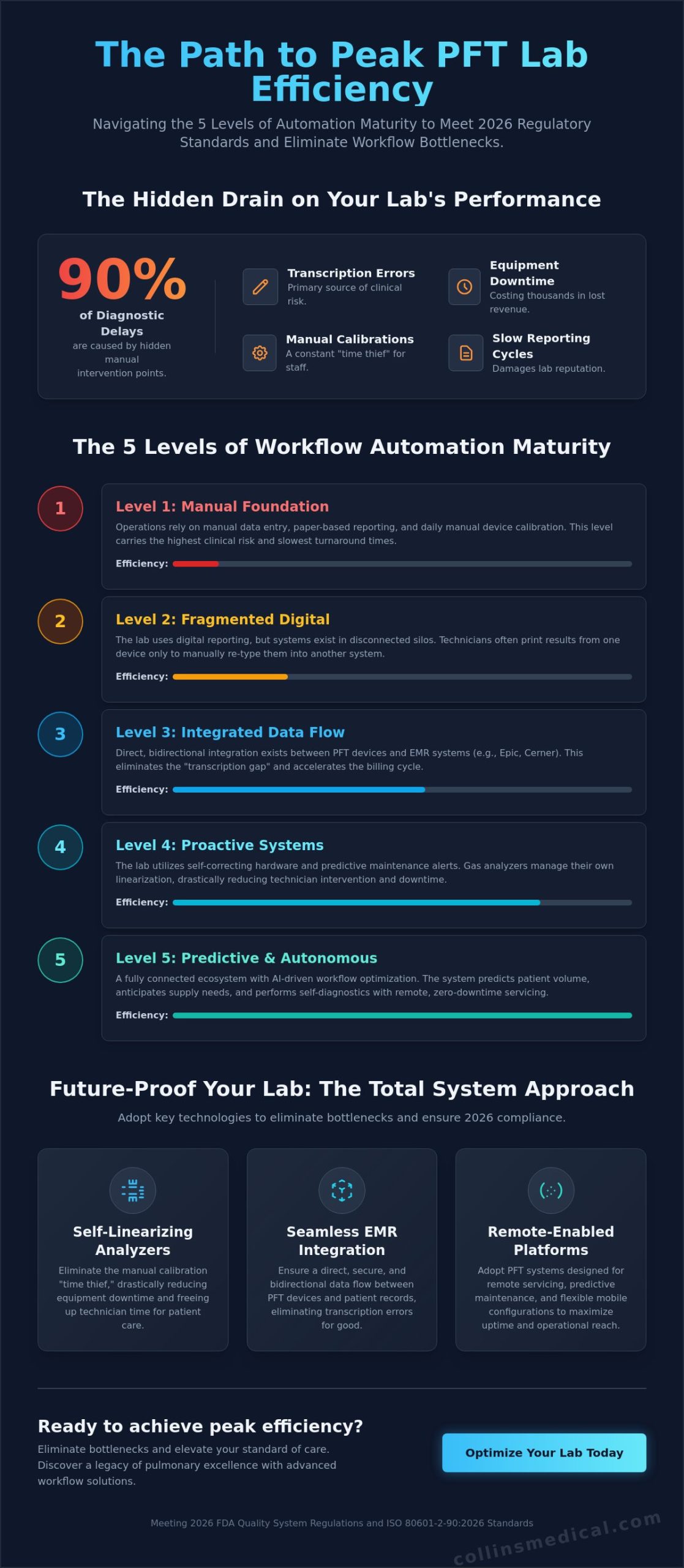
To master respiratory lab workflow optimization, you must first benchmark your current operations against the industry’s evolving standards. Many facilities believe they’re advanced simply because they’ve moved away from paper charts, but true maturity involves the seamless synchronization of hardware and software. We categorize this progression into five distinct levels. Where your lab sits on this scale determines your capacity for patient throughput and your vulnerability to diagnostic error.
- Level 1: Manual Foundation. Operations rely on manual data entry, paper-based reporting, and daily manual device calibration. This level has the highest clinical risk and slowest turnaround.
- Level 2: Fragmented Digital. The lab uses digital reporting, but systems exist in disconnected silos. Technicians often print results from one device only to manually type them into another.
- Level 3: Integrated Data Flow. Direct, bidirectional integration exists between PFT devices and EMR systems like Epic or Cerner. This eliminates the “transcription gap” and speeds up the billing cycle.
- Level 4: Proactive Systems. The lab utilizes self-correcting hardware and predictive maintenance. Analyzers manage their own linearization, reducing the need for technician intervention.
- Level 5: Autonomous Ecosystem. This represents the pinnacle of pulmonary excellence. The lab features fully integrated diagnostics with real-time remote support and automated quality control that meets the strictest 2026 regulatory requirements.
Conducting an Automation Maturity Assessment
Evaluating your lab requires an honest look at your daily “friction points.” A common trap for Level 2 labs is having modern software paired with legacy hardware. You might have a digital interface, but if your technicians still spend thirty minutes every morning performing manual gas calibrations, your hardware is holding your workflow hostage. This “Data Capture” gap is where most diagnostic errors occur. If you’re ready to move beyond manual bottlenecks, you can explore our advanced PFT systems designed for Level 5 performance.
Bridging the Gap from Manual to Autonomous
Moving from Level 1 to Level 3 is often the most significant hurdle. It requires a shift from viewing PFT equipment as standalone tools to seeing them as data nodes within your hospital’s network. Achieving Levels 4 and 5 is nearly impossible with standard equipment; it necessitates advanced platforms like the Eagle 3 that offer self-linearizing technology. Staff training is equally vital. Your team must transition from being “data entry clerks” to “diagnostic specialists” who oversee an automated ecosystem. This transition preserves the legacy of pulmonary excellence while significantly boosting your lab’s ROI through increased volume and reduced technical downtime.
Eliminating Hardware Bottlenecks: The Role of Self-Linearizing Technology
While software integration handles the data, the physical hardware remains the most frequent point of failure in many clinical settings. Manual calibration is the undisputed “Time Thief” in respiratory labs. It’s a tedious, repetitive process that forces highly skilled technicians to spend their time adjusting gas concentrations rather than focusing on patient care. For a lab aiming for true respiratory lab workflow optimization, this manual intervention is a relic of the past that creates a significant hardware bottleneck and increases the risk of human error.
Self-linearizing gas analyzers have emerged as the definitive solution to this problem. Unlike traditional systems that drift and require frequent manual resets, self-linearizing technology allows the device to calibrate itself automatically. This ensures the analyzer is always operating within its optimal range, providing a level of precision that manual methods struggle to replicate consistently. By removing the need for daily manual intervention, labs can finally align their hardware speed with their digital reporting capabilities.
Maximizing Accuracy with Precision-Engineered Devices
The shift toward self-correcting sensors is about more than just convenience; it’s about diagnostic integrity. When sensors maintain their own accuracy, the rate of repeat testing drops significantly. This “First-Time-Right” approach is essential for maintaining compliance with the latest ATS/ERS standards. Self-linearization works by continuously monitoring and adjusting for sensor drift in real-time. This means that even in high-volume environments, the diagnostic output remains stable and reliable. For labs in Massachusetts (MA 01747) or Ashford, Kent (TN23 1LY), this level of hardware autonomy is the new baseline for pulmonary excellence.
The Impact on Daily Throughput
Automating the calibration process has a massive ripple effect on a lab’s daily capacity. If a technician saves just fifteen minutes per calibration cycle, that time quickly adds up to several extra patient slots per week. This isn’t just a minor gain; it’s a fundamental shift in how the lab functions. Beyond the raw numbers, there’s a powerful psychological benefit. Clinicians feel more confident when their equipment is “Always Ready” for the next test. Collins Medical has pioneered this hardware-driven workflow, moving away from the high-maintenance models of the past. By choosing systems like the Eagle 3, labs can eliminate the physical delays that software alone cannot fix. This ensures a legacy of pulmonary excellence through every breath measured.
Designing a Seamless PFT Workflow: Integration, Compliance, and Remote Support
A truly optimized lab doesn’t just produce accurate data; it moves that data where it needs to go without friction. In 2026, the standard for respiratory lab workflow optimization is defined by how effectively your PFT equipment integrates with major EMR and EHR platforms like Epic and Cerner. Disconnected systems create “data islands” that force technicians into manual transcription roles, increasing the risk of error and slowing the billing cycle. By ensuring a bidirectional flow of information, you transform your diagnostic equipment into a core component of the hospital’s digital infrastructure.
Compliance is the other side of the integration coin. As data privacy regulations evolve, maintaining HIPAA standards in the United States and GDPR requirements in the United Kingdom is a critical operational mandate. Security can’t be an afterthought. It must be baked into the software architecture to protect patient confidentiality while allowing clinicians to access results in real-time. This balance of accessibility and security is what separates foundational labs from those achieving a legacy of pulmonary excellence.
Regional Excellence in the US and UK
Global operations require local expertise. Collins Medical maintains dual support hubs to ensure that every lab receives assistance tailored to its specific regional environment. Our facility in Ashford, Kent (TN23 1LY), serves as the primary support center for UK and European respiratory labs, providing deep knowledge of regional healthcare standards. Simultaneously, our headquarters in Hopedale, MA (01747), provides dedicated technical support for North American facilities. This localized presence means you aren’t just calling a generic help desk; you’re speaking with experts who understand the regulatory and operational nuances of your specific geography.
Remote Servicing: The End of Equipment Downtime
The “Remote First” service model is a game-changer for lab uptime. Rather than waiting days for an on-site technician, real-time remote diagnostics allow our engineers to identify and resolve software or analyzer issues before they cause lab closures. This proactive approach includes remote software updates and automated analyzer health checks that happen in the background. By reducing the need for physical service visits, labs can significantly lower their total cost of ownership. This specialized support structure ensures your workflow remains uninterrupted. If you’re ready to modernize your facility’s support structure, you can view our full range of integrated PFT solutions today.
The Eagle 3 Advantage: Future-Proofing Your Respiratory Lab Operations
The Eagle 3 PFT system is the definitive answer to the complexities of 2026 clinical demands. It represents the culmination of every strategy discussed in this guide, acting as the primary engine for respiratory lab workflow optimization. By integrating self-linearizing gas analyzers with a “Remote First” service architecture, the Eagle 3 eliminates the manual hurdles that traditionally stall patient throughput. Whether your facility requires a fixed station or flexible mobile configurations, this platform adapts to your specific operational footprint. It ensures your diagnostic capabilities are never limited by your hardware.
Transitioning from a manual, fragmented lab to a high-performance diagnostic center is a strategic move that protects your lab’s financial health while elevating your clinical standards. Collins Medical remains dedicated to providing the tools that deliver both operational ROI and uncompromising diagnostic accuracy. By removing the “Time Thieves” of manual calibration and disconnected data, you’re free to focus on the core mission of your facility: superior pulmonary care.
Transforming Clinical Outcomes
Efficiency in the lab directly translates to better care for patients with chronic conditions like COPD and asthma. When diagnostic bottlenecks are removed, clinicians can initiate treatment plans faster, improving the overall quality of the end-user experience. A patient’s journey is significantly enhanced when testing is swift, accurate, and professional. This commitment to the patient is backed by a legacy of innovation that continues to drive modern respiratory solutions. Faster results mean faster relief, creating a clinical environment where excellence is the daily standard.
Taking the Next Step Toward Optimization
Modernizing your operations requires a tailored strategy rather than a one-size-fits-all approach. We encourage lab leaders to request a bespoke workflow assessment to identify hidden inefficiencies in their current protocols. You can contact our North American headquarters in Hopedale, MA 01747 or our UK facility in Ashford, Kent, TN23 1LY, for system inquiries and professional consultations. In the current healthcare climate, respiratory lab workflow optimization is a competitive necessity. Don’t let legacy processes hold back your lab’s potential for growth and clinical excellence.
Advancing Your Lab into the Future of Pulmonary Diagnostics
True respiratory lab workflow optimization isn’t just a goal; it’s a necessity for meeting the clinical and regulatory demands of 2026. By addressing both hardware bottlenecks and software silos, you can finally move your facility toward a Level 5 autonomous diagnostic environment. The integration of self-linearizing analyzer technology ensures that your team spends less time on manual calibrations and more time on high-value patient care.
With a legacy of innovation dating back to the 1930s, we’ve built our reputation on precision and reliability. Our dual-continent support hubs in Hopedale, MA 01747 and Ashford, Kent TN23 1LY provide the expert technical backing required to keep your operations running without on-site delays. It’s time to future-proof your facility with systems designed for the modern era of medicine. Optimize Your Lab with the Eagle 3 System today. We’re ready to help you achieve a new standard of diagnostic excellence and operational ROI.
Frequently Asked Questions
What is respiratory lab workflow optimization?
Respiratory lab workflow optimization is the strategic process of eliminating manual bottlenecks in the test-to-report cycle. It focuses on synchronizing high-precision hardware with automated software to ensure data moves instantly from the patient to the medical record. This approach minimizes human error and maximizes the number of patients a facility can serve daily without increasing staff burden.
How does self-linearizing gas analyzer technology improve lab efficiency?
Self-linearizing technology improves efficiency by removing the need for daily manual gas calibrations. Standard analyzers often drift, requiring technicians to stop testing for frequent resets. Self-linearizing systems automatically adjust for sensor drift in real-time, ensuring the equipment is always ready for the next patient. This creates a more predictable testing schedule and reduces the total time spent on hardware maintenance.
Can Eagle 3 systems integrate with my existing hospital EMR?
Yes, Eagle 3 systems are designed to integrate seamlessly with major hospital EMR platforms such as Epic and Cerner. The software facilitates a bidirectional data exchange, allowing patient demographics to flow into the testing system and final results to move back to the patient’s chart. This integration eliminates the transcription gap that often leads to manual data entry errors in disconnected labs.
What are the benefits of remote servicing for PFT equipment?
Remote servicing allows technical experts to troubleshoot and resolve system issues without waiting for an on-site visit. This model provides real-time diagnostics, background software updates, and analyzer health checks that prevent unexpected lab closures. By identifying potential hardware failures before they occur, remote support significantly increases equipment uptime and reduces the overall cost of ownership.
How do I choose between a mobile or fixed PFT system configuration?
Choosing between a mobile or fixed configuration depends on your facility’s space constraints and patient volume. Fixed systems are ideal for dedicated high-volume diagnostic suites where the equipment remains stationary. Mobile configurations provide the flexibility to move testing capabilities between different clinical departments or patient rooms. This is essential for facilities with limited square footage or decentralized testing requirements.
What is the expected ROI for automating a respiratory lab workflow?
The return on investment for respiratory lab workflow optimization comes from increased patient throughput and reduced technical downtime. By automating manual intervention points, labs can handle higher volumes with existing staff. Additionally, reducing the frequency of repeat tests and minimizing on-site service calls lowers operational expenses. This leads to a much faster recovery of the initial equipment investment.
Does Collins Medical provide local support in the United Kingdom?
Collins Medical provides comprehensive local support in the United Kingdom through our dedicated facility in Ashford, Kent, TN23 1LY. This hub serves as the primary technical and administrative center for our UK and European clients. Having a local presence ensures that our partners receive support that’s fully compliant with regional standards and delivered within their own time zone.
How do ATS/ERS 2026 standards impact my lab workflow?
The ATS/ERS 2026 standards, along with updated ISO requirements like ISO 80601-2-90:2026, place a higher emphasis on safety, performance, and automated quality control. Labs must now ensure their equipment meets stricter accuracy benchmarks throughout the entire testing range. Adapting your workflow to these standards requires systems that can maintain high precision automatically, reducing the risk of non-compliance during clinical audits.
Disclaimer
Collins Medical LLC and Collins Medical Ltd are associated but separate Companies and are not associated to or born from the Collins Medical Inc or Collins Medical Practice or Collins Medical Dictionary or Collins Medical Equipment Group.