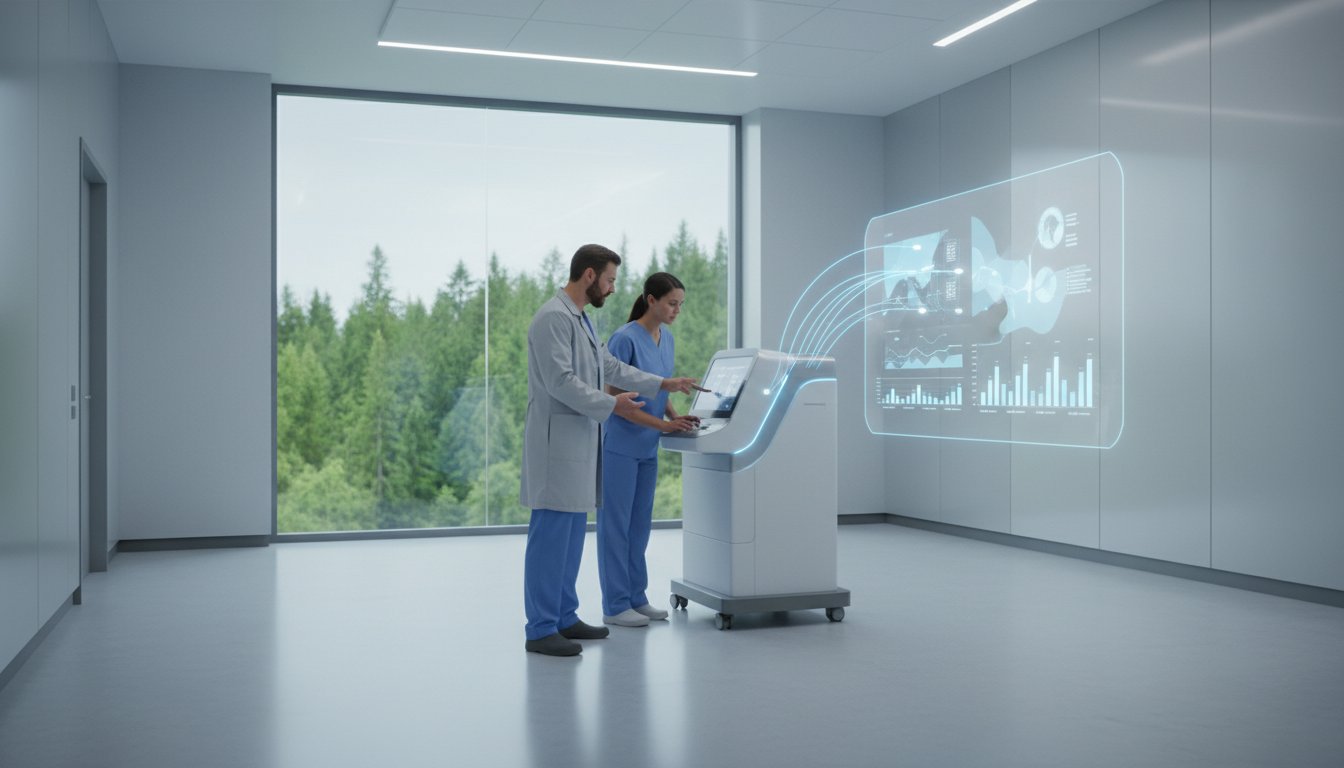
How much clinical time is your practice losing to the “data gap” between your diagnostic hardware and your patient records? In a landscape where the 21st Century Cures Act and USCDI V3 standards now mandate seamless data exchange, relying on manual entry is a liability that modern clinics can’t afford. Implementing sophisticated pft software with emr integration is the most effective way to close this gap, ensuring your facility maintains the gold standard of clinical accuracy.
You likely agree that fragmented patient data and delayed test turnaround times are the biggest hurdles to providing efficient respiratory care. We promise to show you how bidirectional integration eliminates manual errors and streamlines your entire diagnostic workflow. You’ll learn how to leverage the latest FHIR standards and HTI-1 compliance to automate billing, improve interpretation speed, and significantly reduce the total lifecycle costs of your pulmonary function testing equipment.
Key Takeaways
- Learn how modern pft software with emr integration transitions your clinic from static PDF uploads to searchable, discrete data points for better longitudinal patient tracking.
- Understand the technical mechanics of HL7 and Base64 encoding to reduce test turnaround times and eliminate manual billing errors that impact revenue.
- Discover a proven five-step roadmap to align clinical and IT stakeholders while ensuring accurate mapping of complex respiratory data fields.
- Explore how high-precision systems like the Eagle 3 utilize self-linearizing technology to verify diagnostic data before it ever reaches your patient records.
What is PFT Software with EMR Integration?
Modern clinical efficiency requires more than just high-quality hardware. It demands a digital bridge that connects sophisticated diagnostic tools directly to your patient records. At its core, pft software with emr integration is the technology that allows your pulmonary function testing equipment to communicate in real time with an Electronic Health Record (EHR). This technology isn’t just about moving files; it’s about transforming how respiratory data is utilized across the care continuum.
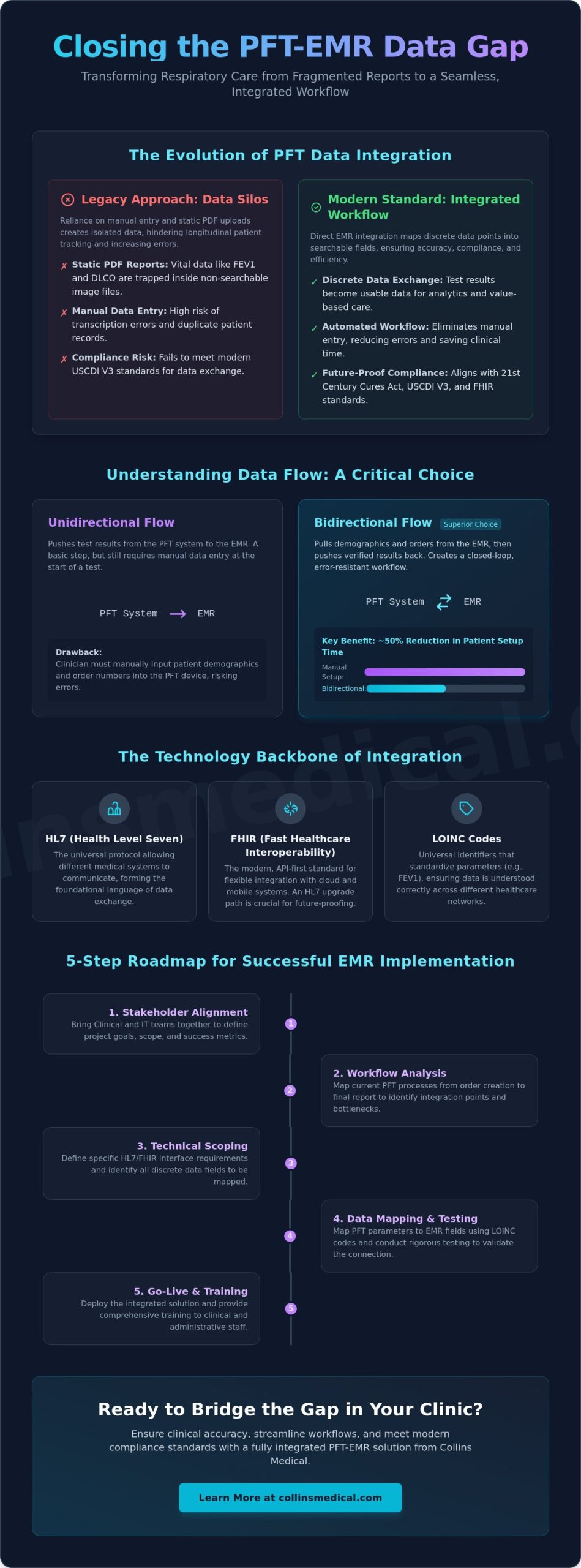
For years, many clinics settled for “integration” that simply meant uploading a static PDF report. This legacy approach creates a data silo where vital parameters like FEV1 or DLCO remain trapped inside an image. In 2026, the industry has shifted toward discrete data exchange. This means specific test results are mapped directly into searchable fields within the patient’s record. This level of connectivity is now essential for value-based care reimbursement models that reward clinicians for documented patient outcomes and longitudinal tracking. Without it, your clinic risks falling behind the USCDI V3 compliance standards that took effect in January 2026.
Bidirectional vs. Unidirectional Data Flow
Unidirectional flow is the basic entry point for many clinics. It pushes results from the PFT system to the EMR after the test is complete. While helpful, it still requires clinicians to manually enter patient demographics or order numbers into the PFT hardware first. Bidirectional flow is the superior choice for high-volume practices. It allows the software to pull demographics and active orders directly from the EMR. This eliminates the duplicate patient errors that often plague hospital databases and cuts setup time by roughly 50%. It ensures that every test is matched to the correct patient identity before the first breath is even taken.
The Role of HL7 and FHIR Standards
To achieve this seamless communication, the software uses HL7 (Health Level Seven) as its primary language. It’s the universal protocol that allows different medical systems to talk to each other. However, as we move through 2026, the industry is rapidly adopting FHIR (Fast Healthcare Interoperability Resources) standards. These API-first protocols allow for even more flexible integration with mobile health apps and cloud-based systems. Choosing a system with a built-in HL7 Upgrade path is critical. It protects your investment from technical obsolescence as hospital IT requirements evolve. You can explore our legacy of pulmonary excellence to see how we’ve pioneered these standards over decades of innovation.
The Technical Mechanics of PFT Integration
Achieving a seamless connection between hardware and software requires more than just a digital link; it demands a rigorous technical architecture that prioritizes data integrity from the moment of the first breath. High-performance pft software with emr integration relies on self-linearizing gas analyzers to verify diagnostic accuracy at the source. These analyzers perform real-time adjustments for environmental factors, ensuring the raw data is precise before the mapping process even begins. By validating the hardware’s performance before transmission, clinics ensure that only high-quality, verified data reaches the patient’s permanent record. This prevents the “garbage in, garbage out” scenario that often complicates clinical decision-making and patient management.
Once the data is verified, the system must handle two distinct types of information; discrete numerical values and formatted visual reports. Discrete data transmission involves mapping specific parameters like FVC, FEV1, and DLCO directly into searchable fields within the patient record. For the visual report, modern systems often use Base64 encoding. This process converts a formatted PDF report into a text string that can be embedded directly into an HL7 message. This allows the clinician to view the full graph and interpretation without leaving their primary software interface. While some legacy setups still rely on networked file shares, the 2026 standard has moved toward direct database queries. This method provides faster report retrieval and a more secure, centralized way to manage diagnostic history across multiple clinic locations.
Mapping Pulmonary Parameters
The complexity of modern diagnostics means mapping over 100 potential data points into a standard template. This requires a deep understanding of standardized nomenclature to ensure interoperability across different healthcare networks. LOINC codes serve as the universal identifiers that ensure a FEV1 value from one system is recognized exactly the same way by the receiving EMR. Beyond the standard FEV1 and FVC, systems must account for flow-volume loops, lung volumes, and diffusion capacity variables. Standardizing these ensures that longitudinal data remains accurate, even if a patient moves between different healthcare providers. If you’re looking for a partner that understands these technical nuances, you might explore our integrated respiratory solutions designed for enterprise-level performance.
Security and Compliance Architecture
Protecting sensitive health information is a non-negotiable requirement for any technical implementation. Robust integration software must utilize advanced encryption protocols for data both at rest and in transit to meet strict HIPAA and GDPR regulations. Role-based access control (RBAC) ensures that only authorized personnel can view or modify test results, while detailed audit trails track every interaction with the data. These trails record who performed the test, who reviewed the findings, and who provided the final sign-off. This creates a transparent and defensible clinical record that is essential for both regulatory compliance and internal quality assurance programs.
Clinical and Financial ROI of Integrated Workflows
Measuring the success of a pulmonary lab in 2026 goes beyond diagnostic precision; it’s about the financial health of the practice. True pft software with emr integration acts as a force multiplier for revenue. It reduces the “dead time” between a patient’s last breath into the machine and the final physician sign-off. By providing instant remote access to raw data and formatted reports, clinicians interpret tests from any workstation. This slash in turnaround time (TAT) means patients receive treatment plans faster. It also allows the clinic to increase its daily throughput without adding administrative staff.
Patient comfort also sees a measurable boost. Reducing administrative check-in friction by pulling demographics directly from the EMR saves valuable minutes per encounter. It creates a calmer clinical environment. Patients spend less time waiting and more time receiving high-quality care. When diagnostics are fast and reliable, the entire patient experience improves, leading to higher satisfaction scores and better clinical compliance.
Streamlining the Billing Cycle
Manual billing entry is a significant source of revenue leakage in modern healthcare. Integrated workflows trigger automated CPT code generation, such as 94010 for bronchodilation responsiveness or 94060 for pre and post bronchodilator testing, the moment a technician marks a session complete. This eliminates the “lost test” phenomenon where procedures are performed but never billed due to missing paper trails. In the 2026 reimbursement environment, where average claim denial rates can reach 5-8%, this automated accuracy is vital for maintaining a healthy bottom line. It ensures that every diagnostic effort is captured and reimbursed at the highest possible rate.
Remote Servicing and Maintenance Efficiency
The most overlooked financial benefit of pft software with emr integration is the reduction in total lifecycle costs through remote diagnostics. Our support hubs in Hopedale, MA 01747, and Ashford, Kent, TN23 1LY, utilize integrated software to perform real-time troubleshooting without an onsite visit. Predictive maintenance algorithms now flag sensor degradation or calibration drift before they impact clinical accuracy. This proactive approach allows for remote firmware updates and calibration checks that significantly reduce onsite service fees. By identifying potential hardware issues before they cause downtime, clinics avoid the high costs of emergency repairs and lost appointment slots. This is the future of equipment maintenance, where software protects your hardware investment.
A 5-Step Roadmap for Successful EMR Implementation
Implementing pft software with emr integration is a significant clinical upgrade that requires more than just a technical install; it requires a strategic roadmap. Many projects stall because they overlook the human and organizational elements of the transition. By following a structured five-phase approach, your facility can ensure a seamless transition that delivers immediate clinical value. Our teams in MA 01747 and Ashford, Kent, have refined this process through decades of enterprise-level deployments.
- Phase 1: Stakeholder Alignment. Success begins with getting Clinical, IT, and Administrative teams on the same page. Clinicians care about workflow; IT cares about security; Admin cares about the bottom line.
- Phase 2: Specification Conference. This is the technical heart of the project. We define exactly how pulmonary parameters will map into the patient record to ensure data remains discrete and searchable.
- Phase 3: Test Environment Setup. We build a “Sandbox” environment. This allows for rigorous testing of the data flow without risking the integrity of your live patient database.
- Phase 4: Interface Validation and Clinical Simulation. Before going live, we run simulated patient tests. This ensures the reports look exactly as the physicians expect and that the HL7 messages are being received correctly.
- Phase 5: Go-Live and Post-Implementation Support. Our experts provide dedicated support during the transition to ensure zero clinical downtime and a smooth handoff to your internal teams.
Working with IT and Interface Engineers
The technical backbone of any pft software with emr integration project relies on clear communication with your IT department. You’ll need to define specific requirements for VPN access, server specifications, and firewall permissions early in the process. The “Interface Engineer” acts as the translator between our diagnostic software and your EMR vendor. Whether you’re working with Epic, Cerner, or Athenahealth, managing the timeline is crucial. These vendors often have long lead times for interface activation, so early engagement is the key to staying on schedule and avoiding deployment delays.
Training and Workflow Optimization
Technology only works if the people using it are empowered. Training respiratory therapists on the new digital workflow is the most critical part of the final phase. We focus on establishing clear protocols for remote physician sign-off, ensuring that the speed gains discussed in previous sections are actually realized. A post-implementation audit should be conducted 30 days after go-live to verify that data is flowing as expected and that the billing automation is capturing every procedure. If you’re ready to modernize your respiratory department, you can request a personalized quotation for your facility today.
The Collins Medical Advantage: Eagle 3 and Beyond
Selecting the right pft software with emr integration involves more than choosing a digital interface; it requires a partner that understands the physical mechanics of gas analysis. The Collins Medical Eagle 3 range represents the pinnacle of this hardware-software synergy. While many vendors focus solely on the data transfer layer, we prioritize the integrity of the data itself. By combining ground-breaking hardware with enterprise-grade connectivity, we ensure that your clinical decisions are based on the most accurate measurements available in the global market.
Our approach is built on the belief that a digital system is only as good as the hardware generating the results. We don’t just provide tools; we provide a foundation for clinical excellence. This commitment to quality has defined our brand for nearly a century. We continue to set new standards for accuracy and reliability, ensuring that modern clinics can meet the rigorous demands of 2026 healthcare regulations without compromising on patient care or operational speed.
Precision Engineering Meets Digital Integration
The Eagle 3 system utilizes self-linearizing gas analyzers that verify and calibrate data in real time. This technical safeguard effectively eliminates the “garbage in, garbage out” risk that often plagues automated systems. When your hardware performs these checks before data transmission, the information reaching the EMR is already validated for clinical use. This is a critical component of A Legacy of Pulmonary Excellence that spans over 90 years. We design our software to be future-proof, providing updates that evolve alongside changing EMR standards and FHIR protocols. Please note that the Eagle 3 and Eagle 3 Plus systems are not currently available in the EU and UK, with CE MDR certification pending as of May 2026.
B2B Partnership and Technical Support
Large-scale hospital integrations require a dedicated partner rather than a simple equipment dealer. We offer personalized quotations and technical consultations to ensure our pft software with emr integration fits your specific network architecture. Our global support infrastructure provides direct access to experts from our hubs in Hopedale, MA 01747, and Ashford, Kent, TN23 1LY. We maintain the “Gold Standard” in remote servicing, utilizing secure digital connectivity to perform firmware updates and system diagnostics without requiring an onsite technician. This proactive support model minimizes downtime and ensures your lab remains operational. Whether you are based in Massachusetts or Kent, our regional teams provide the authoritative guidance needed to optimize your respiratory workflow for the modern age.
Elevate Your Respiratory Practice for 2026 and Beyond
Transitioning to a fully digital diagnostic environment is no longer a luxury for specialized clinics; it’s a clinical necessity. We’ve explored how pft software with emr integration transforms raw data into actionable insights while protecting your bottom line through automated CPT coding. By leveraging over 90 years of respiratory diagnostic innovation, you ensure that every test meets the highest standards of precision. The self-linearizing analyzer technology in the Eagle 3 range provides the hardware reliability needed to eliminate clinical risk before data ever reaches the patient record.
Our dedicated technical support hubs in MA, USA, and Kent, UK, are ready to assist with your enterprise-level deployment. We specialize in navigating the complexities of modern interoperability to ensure your equipment remains a long-term asset. It’s time to close the data gap and focus on what matters most: superior patient outcomes.
Request a Personalized EMR Integration Consultation
Your journey toward a more efficient, accurate, and profitable respiratory lab starts with the right technical partner. We look forward to helping you set new standards in pulmonary care.
Frequently Asked Questions
What is the difference between HL7 and FHIR for PFT software?
HL7 is the established messaging standard for health data exchange, while FHIR represents the modern, API-based evolution of that standard. FHIR allows for more flexible, real-time data access and is increasingly required for mobile health integration. Both protocols are essential for pft software with emr integration in 2026 to ensure your lab remains interoperable with evolving enterprise-level healthcare systems.
Can Collins Medical software integrate with Epic or Cerner EMRs?
Yes, our software is designed to integrate seamlessly with all major EMR vendors, including Epic, Cerner, and Athenahealth. We utilize standardized HL7 and FHIR interfaces to ensure that diagnostic results and discrete data points flow accurately from our hardware into your primary patient records. Our technical teams coordinate directly with your EMR vendor’s interface engineers to manage the entire mapping process.
How long does a typical PFT-EMR integration project take to complete?
A typical integration project generally takes between 8 and 16 weeks to complete, depending on the complexity of your facility’s IT infrastructure. This timeline covers all five phases of our roadmap, from initial stakeholder alignment to final clinical validation and go-live. We provide a structured project plan to ensure milestones are reached without disrupting your daily clinical respiratory workflows.
Is bidirectional data flow necessary for small pulmonary clinics?
Bidirectional flow is highly recommended for clinics of all sizes because it eliminates the need for manual demographic entry on the PFT hardware. By pulling patient orders directly from the EMR, you significantly reduce the risk of duplicate patient records and data entry errors. This level of pft software with emr integration allows even small teams to manage higher patient volumes more efficiently.
Does EMR integration help with PFT billing and reimbursement?
EMR integration improves billing accuracy by automatically triggering the correct CPT codes, such as 94010 or 94060, the moment a test is finalized. This automation eliminates the “lost test” phenomenon where procedures are performed but never billed due to administrative gaps. In the 2026 reimbursement landscape, this ensures higher claim acceptance rates and more predictable revenue cycle management for your practice.
What happens to my data if the EMR system goes offline?
Our software includes a robust local database that acts as a fail-safe if your primary EMR system experiences downtime. You can continue to perform tests, review results, and provide interpretations within our secure local environment. Once your network connectivity is restored, the software automatically syncs all pending data points and reports to the EMR to ensure the patient record is complete.
Are remote servicing capabilities included in PFT software licenses?
Remote servicing is a standard feature within our enterprise software ecosystem. This allows our technical support hubs in MA 01747 and Ashford, Kent, to perform real-time diagnostics, calibration checks, and firmware updates via a secure digital connection. By utilizing these remote capabilities, we can often resolve technical issues and sensor degradation before they cause significant downtime or require an onsite service visit.
How does PFT software ensure HIPAA and GDPR compliance?
We ensure data security through advanced encryption protocols for information both at rest and in transit, alongside strict role-based access controls. The software maintains a comprehensive audit trail that logs every interaction with patient data, from the initial diagnostic session to the final physician sign-off. This multi-layered security architecture is designed to meet the rigorous compliance standards of both HIPAA in the United States and GDPR in the United Kingdom.
Disclaimer
Collins Medical LLC and Collins Medical Ltd are associated but separate Companies and are not associated to or born from the Collins Medical Inc or Collins Medical Practice or Collins Medical Dictionary or Collins Medical Equipment Group.