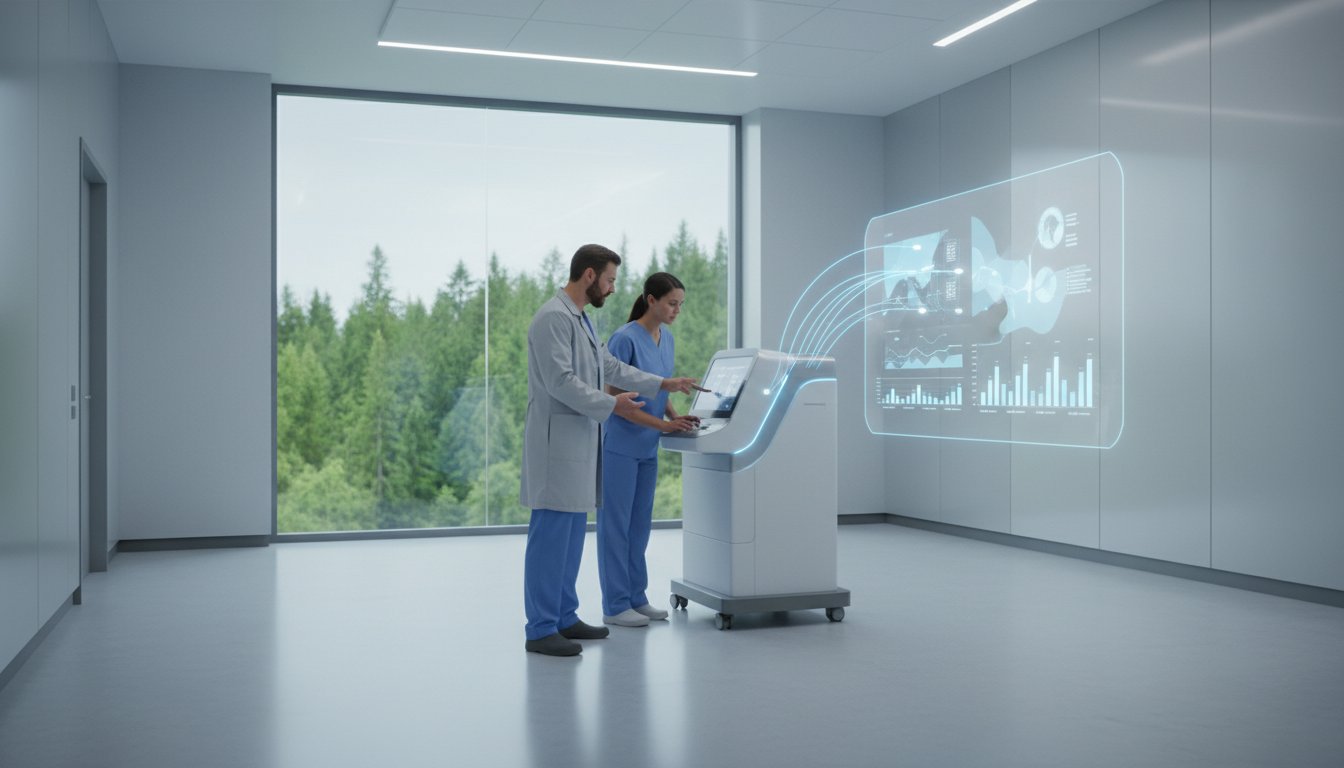
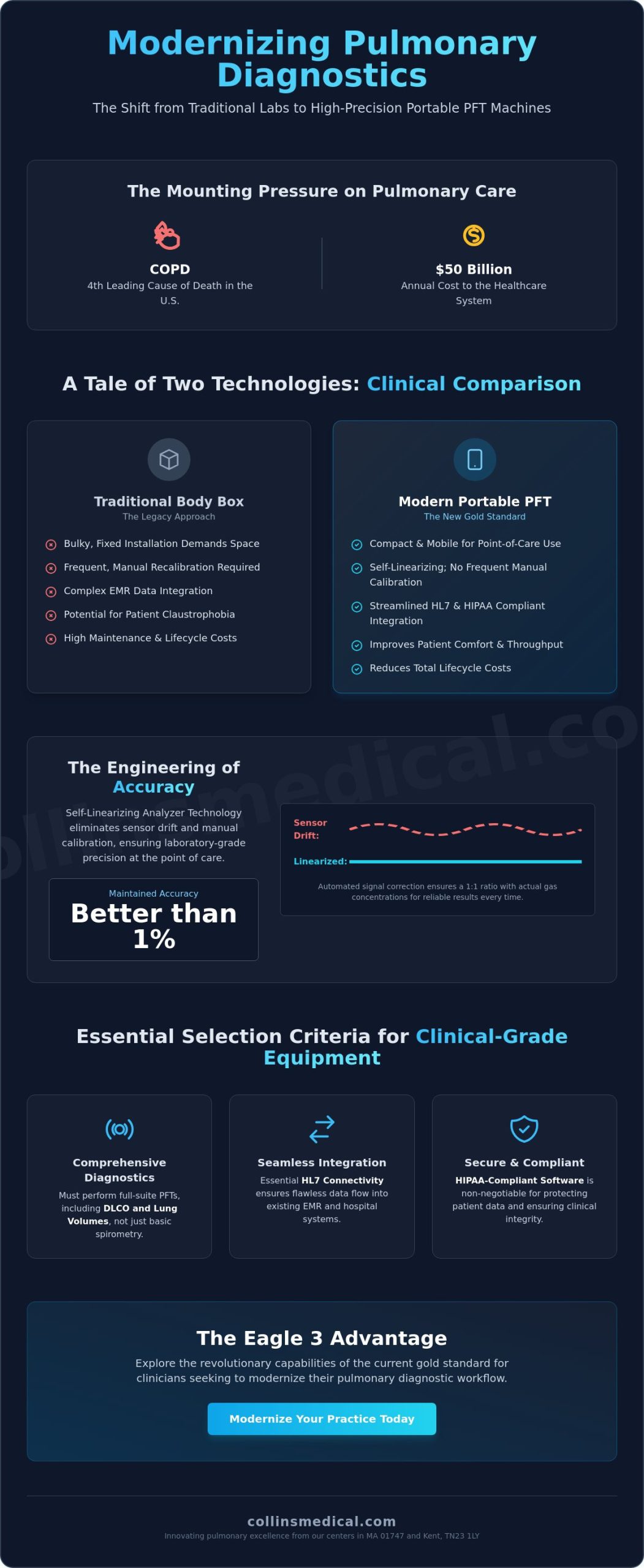
Can a portable pft machine truly match the clinical accuracy of a traditional laboratory body box? For decades, pulmonologists have accepted a trade-off between mobility and precision, assuming that gold-standard results required a fixed, high-maintenance installation. With Chronic Obstructive Pulmonary Disease (COPD) now the fourth-leading cause of death in the United States and costing the healthcare system $50 billion annually, the pressure to increase patient throughput without sacrificing diagnostic quality is intense.
You likely recognize the frustration of managing bulky equipment that demands frequent recalibration and complicates EMR data integration. We agree that clinical excellence shouldn’t be limited by the physical footprint of a testing suite. This guide demonstrates how ground-breaking self-linearizing technology allows modern mobile systems to deliver accuracy of better than 1% while significantly reducing total lifecycle costs. We will examine the essential features of high-performance systems, from HL7 connectivity to the revolutionary Eagle 3 technology developed at our centers in MA 01747 and Kent, TN23 1LY, ensuring you choose the right system for your specific clinical environment.
Key Takeaways
- Understand the critical technical distinction between a comprehensive portable pft machine capable of DLCO and Lung Volumes and basic handheld devices to ensure diagnostic integrity.
- Discover how self-linearizing analyzer technology eliminates the need for frequent manual recalibration while maintaining accuracy better than 1%.
- Learn how to reclaim valuable clinical square footage in Massachusetts or Kent facilities by replacing traditional body boxes with mobile systems that deliver equivalent laboratory-grade results.
- Identify essential selection criteria for clinical-grade equipment, focusing on HL7 data integration and HIPAA-compliant software to streamline hospital throughput.
- Explore the revolutionary capabilities of the Eagle 3 system, the current gold standard for clinicians seeking to modernize their pulmonary diagnostic workflow.
Defining the Portable PFT Machine: More Than Just a Mobile Spirometer
Clinical environments are evolving rapidly. The days of requiring a dedicated, climate-controlled room for a massive plexiglass “Body Box” are fading. A professional portable pft machine represents a complete diagnostic laboratory condensed into a mobile format. Unlike basic handheld devices that only measure flow and volume, these sophisticated systems provide a full suite of assessments at the point of care. They aren’t just scaled-down versions of laboratory equipment; they’re high-precision instruments engineered for the demands of modern medicine.
Many vendors often blur the lines between spirometry and PFT, which can lead to clinical errors. While spirometry is a vital component of Pulmonary Function Testing (PFT), a clinical-grade portable system must also perform Diffusing Capacity (DLCO) and Lung Volumes. This distinction is critical for the accurate diagnosis of complex restrictive and obstructive lung diseases. By integrating these capabilities into a mobile unit, clinicians can maintain diagnostic integrity while moving freely between exam rooms or satellite clinics.
Comprehensive Diagnostics in a Compact Format
Modern respiratory medicine doesn’t accept limited data sets. High-end portable systems allow clinicians to bring the lab directly to the patient’s bedside. This is particularly effective in settings where patient mobility is restricted or in high-traffic urban clinics where space is at a premium. By removing the physical barrier of the traditional body plethysmograph, you eliminate patient claustrophobia and reduce the time spent transporting patients between departments. This shift significantly increases patient throughput and improves the overall clinical workflow without sacrificing the precision of the results.
The Evolution of Pulmonary Technology
Collins Medical has maintained a legacy of pulmonary excellence since the early 20th century. Our journey from 1930s precision mechanical bellows to the digital Eagle 3 platform highlights a commitment to continuous innovation. We’ve replaced bulky mechanical components with sophisticated ultrasonic sensors and self-linearizing gas analyzers. This engineering evolution ensures that healthcare providers in MA 01747 and Ashford, Kent, TN23 1LY, can deliver world-leading care. The transition to digital technology has virtually eliminated the maintenance downtime associated with legacy equipment, allowing for more reliable, long-term operation in diverse clinical settings.
The Engineering of Accuracy: Self-Linearizing Analyzers in Portable Systems
Maintaining laboratory-grade precision in a mobile format requires more than just high-quality sensors. It demands a sophisticated engineering approach to signal processing. While clinical studies often scrutinize the accuracy of handheld spirometers, a professional portable pft machine must meet much higher benchmarks for Diffusing Capacity (DLCO) and Lung Volumes. The most significant hurdle in portable diagnostics is sensor drift, where external factors cause the output to deviate from the true value. Modern digital signal processing effectively neutralizes this drift, ensuring that the system remains stable throughout a full day of testing.
The core of this stability lies in self-linearizing technology. Analyzer linearization is the mathematical correction of sensor output to ensure a 1:1 ratio with actual gas concentrations. This ground-breaking feature eliminates the need for the repetitive, manual calibration cycles that plague older equipment. By automating this process, the Eagle 3 achieves a precision rating of better than 1%, providing clinicians with the confidence to make critical diagnostic decisions at the point of care. This level of reliability ensures strict compliance with the 2019 ATS/ERS standardization updates, which are essential for maintaining clinical excellence.
Precision Gas Analysis and DLCO Accuracy
DLCO testing relies on rapid-response gas analyzers that can track gas concentrations in real-time during a single-breath maneuver. In a portable setting, these analyzers must perform without the controlled environment of a central lab. Self-linearizing technology ensures that the relationship between the gas concentration and the sensor signal remains perfectly linear. This bridges the gap between traditional laboratory standards and the reality of bedside testing, allowing for unparalleled precision without constant technician intervention. It’s a fundamental shift that empowers clinicians to deliver high-quality care anywhere in the facility.
Environmental Compensation and Data Integrity
Portable diagnostics often occur in varied climates, from the humid summers of MA 01747 to the damp winters in Ashford, Kent, TN23 1LY. Data integrity depends on the system’s ability to account for barometric pressure, temperature, and humidity in real-time. Our systems provide full raw data transparency, which is essential for research-grade diagnostics and long-term patient monitoring. If you’re looking to upgrade your facility’s capabilities, you can request a personalized quotation for our latest Eagle 3 range. Key environmental benefits include:
- Real-time barometric pressure adjustment for accurate gas partial pressure calculations.
- Dynamic temperature compensation to prevent sensor sensitivity shifts.
- Humidity filtering to ensure the integrity of the gas sample.
- Digital signal stabilization to eliminate electronic noise in high-traffic clinical areas.
Portable PFT vs. Traditional Body Plethysmography: A Clinical Comparison
For decades, the stationary body plethysmograph, or “Body Box,” was the only reliable method for obtaining a complete pulmonary profile. While it remains a specialized tool for measuring airway resistance (Raw), many modern clinics find it to be an inefficient “white elephant” that occupies excessive square footage. A high-performance portable pft machine now offers a comparable diagnostic yield for Lung Volumes and DLCO, which represent the vast majority of clinical testing requirements. By choosing a mobile system, providers can achieve laboratory-grade results without the physical and financial burdens of a fixed enclosure.
Space is a premium commodity in modern healthcare facilities. A traditional body box requires approximately 25 to 35 square feet of dedicated, climate-controlled space. In high-demand regions like Massachusetts (MA 01747) or Ashford, Kent (TN23 1LY), reclaiming this area allows clinics to add additional exam rooms or testing stations. This transition directly increases patient throughput and clinic revenue. While a body box might be necessary for specific complex research cases, the operational flexibility of a mobile system makes it the superior choice for most diagnostic environments.
Clinical Versatility and Patient Access
Patient comfort is a significant factor in test quality. The glass enclosure of a plethysmograph can be a major barrier for patients suffering from claustrophobia or anxiety. Additionally, morbidly obese patients often find the physical dimensions of a standard box impossible to navigate. A portable pft machine eliminates these physical constraints entirely. It allows for testing in open, comfortable environments, including at the bedside in the ICU or in post-operative recovery areas. This accessibility reduces patient fatigue and improves compliance, leading to more accurate data on the first attempt.
Operational Efficiency for Modern Practices
Maintaining a body plethysmograph is a complex and costly endeavor. Airtight seals must be meticulously maintained, and the enclosure itself requires frequent disinfection and technical calibration. In contrast, mobile systems focus on sensor-array maintenance, which is significantly less labor-intensive. Training requirements for staff are also streamlined; it’s often easier to master the digital interface of an Eagle 3 than the mechanical nuances of a pressurized box. Key operational advantages include:
- Reduction in capital expenditure and long-term maintenance contracts.
- Faster test durations and reduced patient turnover time between sessions.
- Simplified infection control protocols without the need to deep-clean a large enclosure.
- Seamless movement between multiple satellite clinics to maximize equipment utilization.
By focusing on these efficiencies, clinics can maintain a high standard of care while reducing the total lifecycle costs of their diagnostic equipment.
Key Selection Criteria for Clinical-Grade Portable PFT Equipment
Selecting a portable pft machine is a high-stakes clinical and financial decision. While basic vendors often emphasize the initial purchase price, sophisticated healthcare administrators look deeper into the total cost of ownership. A truly clinical-grade system must excel across four primary pillars: accuracy, durability, software sophistication, and long-term technical support. In high-volume settings, the physical ruggedness of the device is paramount. Mobile units are frequently transported between rooms or satellite clinics, making shock-resistant sensors and robust housing non-negotiable for maintaining calibration integrity.
Serviceability is the silent factor that determines departmental success. If a diagnostic system goes down, patient throughput grinds to a halt. Remote diagnostics allow our technical teams in MA 01747 and Ashford, Kent, TN23 1LY, to resolve over 85% of software-related issues without requiring an on-site visit. This capability drastically reduces downtime and eliminates the expensive travel fees associated with traditional field service. When evaluating your options, prioritize partners who offer a clear roadmap for both remote and physical maintenance over the life of the equipment.
Software Integration and Data Management
Seamless data flow is the backbone of a modern pulmonary department. HL7 connectivity is no longer a luxury; it’s a necessity for ensuring that diagnostic data integrates directly with your hospital’s Electronic Medical Record (EMR). This automation removes the risk of transcription errors and ensures that clinicians can review results the moment a test is finalized. Additionally, look for systems that provide automated quality control (QC) grading. These algorithms evaluate every maneuver against the latest ATS/ERS guidelines in real-time, providing technicians with immediate feedback to ensure every session is clinically valid. Whether you choose cloud-based storage for multi-site accessibility or a local secure server, HIPAA compliance must be baked into every layer of the software architecture.
Financial Acumen: Calculating Total Lifecycle Cost
Real financial return on investment (ROI) is found by looking beyond the sticker price. Many facilities fall victim to the “Consumable Trap,” where a seemingly affordable portable pft machine requires proprietary, high-cost filters or single-use sensors. Over a five-year period, these recurring expenses can easily exceed the original cost of the hardware. We recommend performing a detailed five-year projection that includes consumables, software licensing, and maintenance contracts. You can explore our historical commitment to durability in Collins Medical’s definitive guide to pulmonary excellence. By choosing a system with low consumable requirements and high reliability, you protect your department’s long-term budget. To find a solution that balances performance with financial efficiency, view our full range of pulmonary diagnostic solutions.
The Eagle 3 Advantage: Redefining Portable Pulmonary Diagnostics
The Eagle 3 stands as the flagship portable pft machine from Collins Medical, representing the pinnacle of our century-long commitment to respiratory innovation. In the 2026 market, clinicians require more than just mobility; they demand laboratory-grade precision without the laboratory-sized footprint. By utilizing our proprietary self-linearizing analyzers, the Eagle 3 sets a new benchmark for accuracy, consistently delivering results with a variance of less than 1%. This technology ensures that every test, from DLCO to Lung Volumes, meets the most stringent international standards while remaining entirely mobile.
Clinical flexibility is a core component of the Eagle 3 design. We understand that every facility has unique spatial constraints, so we’ve engineered the system for maximum mounting versatility. Whether your department requires a stationary tabletop setup for a dedicated room, a mobile cart for bedside testing, or a space-saving wall-mount configuration, the hardware adapts to your workflow. This versatility allows healthcare providers to maximize their equipment investment across multiple departments, from outpatient clinics to acute care settings.
Revolutionary Maintenance and Remote Support
You can now experience the “future of maintenance” through our proactive remote support infrastructure. Our technical hubs in MA 01747 and Ashford, Kent, TN23 1LY, perform real-time diagnostic checks to identify and resolve potential issues before they impact your patient schedule. This advanced software telemetry allows our expert teams to troubleshoot over 85% of technical queries remotely. By reducing the need for physical on-site visits, we drastically minimize downtime for hospitals in Hopedale, Ashford, and surrounding regions. It’s a partnership designed to keep your pulmonary department running at peak efficiency without the wait for a field service engineer.
Tailored Solutions for Global Healthcare
Collins Medical provides specific configurations optimized for the unique requirements of the US and UK markets. Collins Medical LLC serves the North American region from our Massachusetts headquarters, while Collins Medical Ltd supports our UK partners from our facility in Kent. We remain dedicated to full regulatory transparency; our current systems meet all existing benchmarks, and we’re actively progressing through the CE MDR certification process for future EU and UK availability. This commitment ensures that our clients are always prepared for evolving medical device regulations and can continue to deliver world-leading care.
If you’re ready to modernize your pulmonary diagnostics and improve patient throughput, Request a personalized quotation for the Eagle 3 system today. Our team is ready to help you integrate this revolutionary technology into your clinical environment.
Elevating Pulmonary Care Through Precision Mobility
Transitioning to a high-performance portable pft machine isn’t just about reducing your clinic’s physical footprint; it’s about optimizing patient outcomes through superior engineering. We’ve explored how self-linearizing technology maintains accuracy of better than 1%, ensuring that mobile diagnostics now match the precision of traditional laboratory body boxes. By integrating these systems, you reclaim valuable square footage while providing a more accessible testing environment for claustrophobic or bariatric patients.
The Eagle 3 platform represents our commitment to continuous innovation, backed by a legacy of excellence that dates back to the 1930s. Our specialized support teams in MA 01747 and Ashford, Kent, TN23 1LY, utilize advanced remote servicing capabilities to minimize downtime and keep your department running at peak efficiency. This proactive approach to maintenance ensures your equipment remains a reliable asset for years to come. It’s time to move beyond the limitations of legacy hardware and embrace a more flexible, data-driven diagnostic workflow.
Ready to modernize your respiratory department? Experience the Future of PFT: Explore the Eagle 3 Range. We look forward to helping you set new standards for clinical excellence in your facility.
Frequently Asked Questions
What is the difference between a portable PFT machine and a spirometer?
A portable pft machine is a complete diagnostic laboratory capable of measuring DLCO and Lung Volumes, while a spirometer is a limited tool that only assesses flow and volume. Collins Medical focuses exclusively on comprehensive pulmonary function testing solutions rather than basic spirometry devices. This distinction is vital for clinics that require a full diagnostic profile to manage complex respiratory conditions effectively.
How accurate are portable PFT machines compared to body plethysmography?
Clinical-grade portable systems deliver accuracy within 1% of traditional body plethysmography for most parameters. While a “Body Box” remains necessary for measuring airway resistance (Raw), a mobile system provides equivalent results for 95% of standard diagnostic needs. This high level of precision allows clinicians to reclaim 30 square feet of floor space without compromising the quality of patient data.
Can portable PFT machines perform DLCO testing?
Yes, professional portable PFT machines are specifically engineered to perform single-breath Diffusing Capacity (DLCO) testing. They utilize rapid-response gas analyzers and integrated demand valves to manage the test gas mixture. This capability separates professional PFT equipment from basic handheld devices, allowing for the diagnosis of interstitial lung diseases and pulmonary vascular disorders at the point of care.
How often does a portable PFT machine require calibration?
Modern systems with self-linearizing technology require significantly less manual intervention than legacy equipment. While ATS/ERS 2019 standards recommend a daily calibration verification, the digital sensors in the Eagle 3 eliminate the “drift” common in older mechanical systems. This engineering advancement ensures that the device maintains a stable 1:1 ratio between sensor output and actual gas concentration throughout the clinical day.
Do portable PFT systems integrate with EMR software like Epic or Cerner?
Seamless integration with major EMR platforms like Epic and Cerner is achieved through standard HL7 upgrades. This connectivity allows for the automated transfer of diagnostic data directly into the patient’s electronic record, eliminating the risk of manual transcription errors. Our software team provides the necessary technical support to ensure that your data remains secure and accessible across your entire hospital network.
What are the maintenance requirements for the Eagle 3 PFT system?
Maintenance for the Eagle 3 is primarily managed through advanced software telemetry and remote diagnostic checks. Our technical teams in MA 01747 and Ashford, Kent, TN23 1LY, resolve 85% of software-related issues without an on-site visit. This proactive approach minimizes downtime and reduces the total lifecycle cost of the equipment by eliminating frequent travel fees for field service engineers.
Are portable PFT machines reimbursable under standard CPT codes?
Pulmonary function tests performed on these systems are fully reimbursable under established CPT codes. Common codes include 94010 for spirometry, 94726 for lung volumes, and 94729 for DLCO. Utilizing a mobile system allows clinics to maintain these revenue streams while increasing patient throughput by 20% through improved workflow efficiency and reduced transport time between departments.
Is the Eagle 3 available for clinics in the United Kingdom?
The Eagle 3 PFT system is not currently available for sale in the United Kingdom or the European Union. We’re actively working through the CE MDR certification process to ensure full compliance with evolving regulatory standards. Collins Medical Ltd, located at Ashford, Kent, TN23 1LY, remains the primary contact for updates regarding product availability and regulatory timelines for the UK market.
Disclaimer
Collins Medical LLC and Collins Medical Ltd are associated but separate Companies and are not associated to or born from the Collins Medical Inc or Collins Medical Practice or Collins Medical Dictionary or Collins Medical Equipment Group.