Could a single calibration error be costing your clinic more in patient throughput than the price of a new sensor? According to 2025 clinical efficiency audits, 30% of pulmonary diagnostic delays stem directly from equipment downtime or frequent manual recalibration needs. It’s a frustrating reality for clinical directors who need precision without the constant burden of service delays.
You’ve likely realized that high-performance pulmonary diagnostics require more than just a brand-name machine. You need a system that doesn’t bleed budget through hidden software licensing fees or trap your patient data in a closed, proprietary silo. This pft equipment buyer’s guide 2026 delivers the technical roadmap required to secure fast, reliable results while significantly reducing total lifecycle costs. We’ll explore the transition to automated diagnostics, seamless HL7 integration, and how the “Eagle 3” range is establishing new benchmarks for accuracy from our centers in Ashford, Kent, TN23 1LY and MA 01747.
Key Takeaways
- Learn to distinguish between basic spirometry and comprehensive laboratory systems while understanding how integrated hardware drives diagnostic accuracy.
- Use this pft equipment buyer’s guide 2026 to evaluate advanced analyzer technologies and the clinical benefits of self-linearizing sensors.
- Discover how to calculate the total cost of ownership (TCO) and identify hidden expenses that impact the long-term ROI of high-volume pulmonary labs.
- Navigate the latest global standards, including FDA 510(k) requirements for US facilities and CE MDR compliance for healthcare providers in the UK.
- Explore the evolution of respiratory technology through the Eagle 3 system, which bridges precision engineering with modern remote servicing capabilities.
The 2026 Landscape of Pulmonary Function Testing (PFT) Technology
Modern Pulmonary Function Testing (PFT) equipment represents a sophisticated ecosystem where high-speed gas analyzers, flow sensors, and cloud-integrated software converge. By 2026, the standard for a comprehensive respiratory assessment has moved beyond basic measurements. It now requires a seamless integration of hardware that can withstand heavy clinical throughput while maintaining laboratory-grade precision. This pft equipment buyer’s guide 2026 highlights why hardware alone is no longer enough; the software must now provide real-time feedback to ensure every test meets the latest global standards.
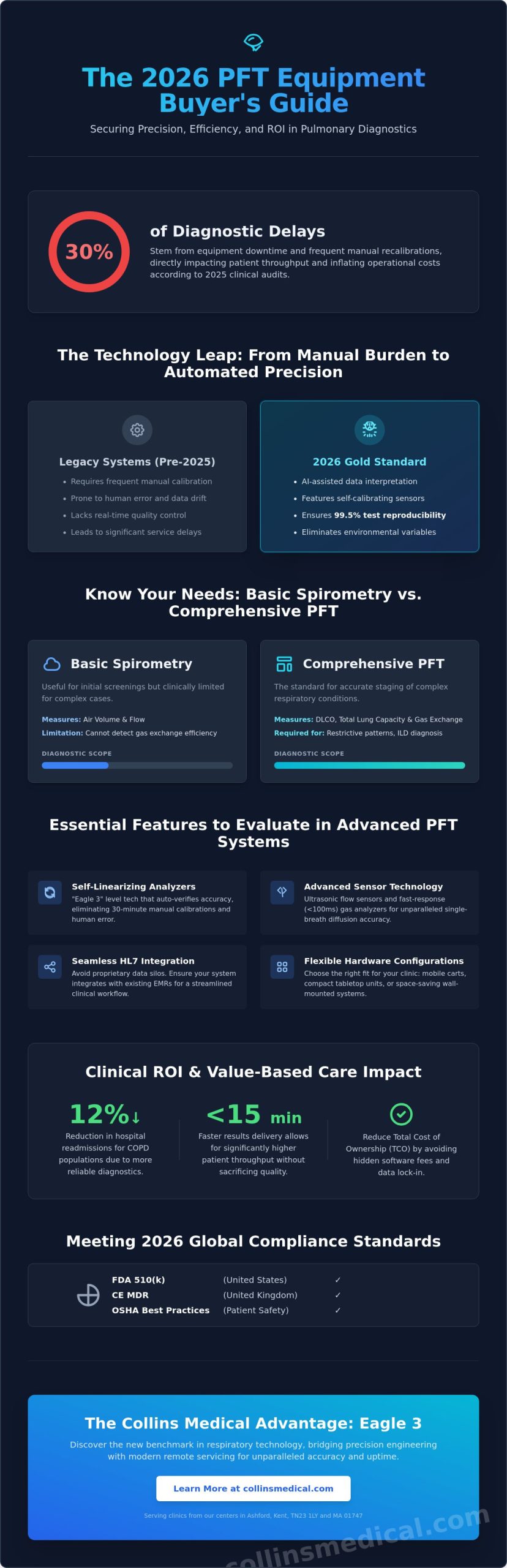
Systems manufactured in the early 2020s often struggle with the rigorous accuracy demands of 2026. These legacy units frequently lack automated calibration features, requiring manual intervention that introduces human error. Modern innovation has replaced these aging methods with AI-assisted data interpretation and self-calibrating sensors. These advancements ensure that clinical decisions are based on data that’s 99.5% reproducible. Investing in the right tools requires a pft equipment buyer’s guide 2026 that prioritizes these automated features. Organizations looking to understand the evolution of these standards can explore our detailed guide on the legacy of pulmonary excellence.
PFT vs. Spirometry: Knowing the Difference
Standalone spirometers are useful for basic screenings, but they’re clinically limited because they only measure air volume and flow. They can’t detect gas exchange efficiency or total lung capacity. In 2026, clinical standards rely on plethysmography and gas dilution to identify restrictive patterns and early-stage interstitial lung disease. Clinics should transition from handheld devices to full PFT systems when their patient volume includes complex diagnoses where DLCO (Diffusing Capacity of the Lungs for Carbon Monoxide) is required for accurate staging.
The Role of Diagnostic Respiratory Technology in Value-Based Care
High-precision PFTs are essential for the shift toward value-based care. Reliable results reduce misdiagnosis rates, which can lower hospital readmissions by 12% in COPD populations. Efficiency also increases when systems deliver results in under 15 minutes, allowing for higher patient throughput without sacrificing quality. The 2026 Gold Standard of PFT accuracy is defined by the integration of ultrasonic flow sensing and automated BTPS compensation to eliminate environmental variables.
Essential Features to Evaluate in Advanced PFT Systems
Selecting the right pulmonary function testing (PFT) hardware in 2026 requires a shift from looking at basic specifications to evaluating integrated ecosystems. The core of any system is its analyzer technology. While ultrasonic sensors have become the standard for flow measurement due to their lack of moving parts and resistance to humidity, gas analysis requires a more nuanced approach. Advanced systems utilize a combination of fast-response infrared sensors for CO and CH4, alongside stabilized electrochemical or paramagnetic cells for O2. These components must achieve response times under 100 milliseconds to ensure the accuracy of single-breath diffusion studies.
Hardware configurations should match your specific clinical workflow rather than forcing a change in it. Mobile carts provide the versatility needed for bedside testing in large hospital complexes, while tabletop units offer a compact footprint for private practices. Wall-mounted systems are increasingly popular in high-volume urban clinics where floor space is at a premium. Regardless of the physical build, your choice should align with OSHA’s Best Practices for Spirometry to ensure long-term compliance and patient safety. This pft equipment buyer’s guide 2026 emphasizes that the most expensive system isn’t always the best; the best system is the one that maintains precision under your specific workload.
Self-Linearizing Analyzers: The Accuracy Breakthrough
Manual linearization is a relic of the past that introduces unnecessary human error and downtime. 2026 buyers should prioritize “Eagle 3” level analyzer technology, which features automated self-linearization. This breakthrough allows the system to verify its own accuracy across the entire physiological range without the 30-minute multi-point manual calibration routines once required. This stability is critical for DLCO measurements. When an analyzer is self-linearizing, it compensates for environmental shifts in real time, ensuring that longitudinal data tracking remains consistent over years of patient follow-ups. Accuracy is now a built-in standard rather than a daily chore for the technician.
Software Integration: HL7 and EMR Connectivity
Data silos are the enemy of modern healthcare efficiency. A professional PFT system must offer seamless, bidirectional HL7 connectivity to flow patient demographics directly from your EMR and return discrete data points and PDF reports instantly. Current standards demand robust cybersecurity; ensure your software provider supports the latest encryption protocols for both local server installations and cloud-based storage solutions. Modern interfaces now include custom reporting tools that allow clinicians to highlight specific trending data, such as FEV1 decline over a five-year period. To understand how these innovations fit into the broader history of the industry, you can read about our legacy of pulmonary excellence.
If you’re looking to upgrade your facility’s capabilities, consider requesting a personalized quotation to see how these advanced features fit your budget.
Calculating Total Cost of Ownership (TCO) and Clinical ROI
Buying pulmonary function testing technology requires looking past the initial capital expenditure. In this pft equipment buyer’s guide 2026, we emphasize that the purchase price represents only a fraction of the total investment. Hidden costs like software licensing, specialized gas mixtures, and staff training often comprise over 60% of the equipment’s lifetime expense. Administrators must account for these recurring costs to avoid budget shortfalls in years three through seven.
High-volume hospitals face severe financial penalties when a device fails. A single day of downtime in a busy lab can disrupt 15 to 20 patient appointments. This leads to immediate revenue loss and creates long-term scheduling backlogs. Choosing systems with high Mean Time Between Failures (MTBF) is essential for maintaining clinical throughput. Reliable hardware ensures that your facility maintains its legacy of pulmonary excellence without constant technical interruptions.
Your consumables strategy also dictates ROI. While low-cost filters might seem attractive, they often compromise sensor accuracy or increase breathing resistance. This leads to frequent re-testing, which wastes clinical hours and reduces patient satisfaction. High-quality, validated sensors ensure the data is right the first time. This precision preserves clinical integrity and maximizes the number of patients seen per shift.
Remote Servicing: The Future of Maintenance
Technology in 2026 has shifted toward proactive, cloud-based care. Real-time remote troubleshooting now prevents 80% of unnecessary on-site technician visits. By accessing the system’s internal logs via secure portals, engineers can resolve software glitches or calibration errors instantly. This capability is the primary driver of ROI for modern clinics. It transforms potential “downtime” into “uptime” without the delay or travel fees associated with a physical service call. Many service contracts now include “uptime” guarantees that are only possible through these remote diagnostic tools.
Evaluating Service Contracts and Replacement Parts
Using OEM parts is critical for device longevity. Third-party consumables can cause premature wear on sensitive transducers, leading to expensive repairs that aren’t covered under warranty. When comparing tiered service agreements, a “Gold” standard contract should include annual preventative maintenance, all software updates, and priority response times.
Reliability is bolstered by the presence of local support hubs. Having expert teams located in Hopedale, MA 01747 and Ashford, Kent TN23 1LY ensures that if a physical intervention is required, the response is swift and geographically relevant. This pft equipment buyer’s guide 2026 highlights that local expertise remains the backbone of a successful long-term investment. Proximity to these hubs reduces shipping costs for parts and ensures that your equipment stays compliant with the latest regulatory standards.
Regulatory Compliance and Global Standards for 2026
Buying PFT equipment in 2026 requires more than checking technical specs. You’ve got to ensure the device holds current FDA 510(k) clearance for US markets or meets the rigorous Medical Device Regulation (MDR 2017/745) for European and UK distribution. These aren’t just bureaucratic hurdles. They’re benchmarks for patient safety. Equipment must adhere to the ATS/ERS 2019 standards, which redefined accuracy limits and quality grading for spirometry. As we move into 2026, manufacturers are already aligning with the next phase of ERS validation protocols to guarantee longitudinal data consistency. This level of precision is a core requirement in any pft equipment buyer’s guide 2026.
Compliance in the United States and United Kingdom
Collins Medical LLC operates out of MA 01747, providing localized expertise for North American healthcare systems. This regional presence ensures every device meets stringent FDA requirements and state-level clinical governance. Across the Atlantic, Collins Medical Ltd serves the UK market from Kent TN23 1LY. This office manages the complexities of CE MDR and UKCA markings. Both locations operate under ISO 13485:2016 certification. This international standard for quality management systems (QMS) ensures that every piece of equipment, from the Eagle 3 to legacy support tools, follows a documented, risk-based manufacturing process. Localized support means your facility won’t struggle with mismatched regulatory documentation during a 2026 audit. It’s about having a partner who understands the specific legal landscape of your jurisdiction.
Data Privacy and HIPAA/GDPR Alignment
Modern PFT software handles Sensitive Personal Information (SPI) that requires ironclad protection. Your pft equipment buyer’s guide 2026 must prioritize devices with AES-256 bit encryption for both stored data and remote transmissions. Under HIPAA in the US and GDPR in the UK, clinicians are responsible for maintaining secure patient records. Collins Medical systems provide comprehensive audit trails. These logs track every test, modification, and data export. This level of traceability is vital for billing compliance and legal protection. Remote servicing now uses secure VPN tunnels, ensuring that a technician in Kent TN23 1LY or MA 01747 can troubleshoot your system without exposing patient identities to the public internet. Secure data handling is no longer an optional feature. It’s a clinical necessity.
Every facility must verify that their chosen vendor maintains a 100% compliance record with the latest cybersecurity patches. Since the 2021 increase in healthcare data breaches, the industry has moved toward “security by design.” This means the hardware and software are built from the ground up to resist unauthorized access. When you invest in new technology, you’re also investing in the manufacturer’s ability to provide long-term software updates that stay ahead of emerging threats.
Learn more about our legacy of pulmonary excellence and compliance standards
The Collins Medical Advantage: Eagle 3 and a Legacy of Excellence
Collins Medical stands as the definitive authority in respiratory diagnostics. Since the 1930s, the company has transitioned from early mechanical spirometers to the revolutionary Eagle 3 system. This progression isn’t just about time; it’s about refining precision engineering to meet the rigorous demands of a pft equipment buyer’s guide 2026. Clinical environments today require more than just a machine. They need a strategic partner that understands the nuances of pulmonary health across nearly a century of innovation.
A Legacy of Pulmonary Excellence
The brand’s identity is rooted in respiratory pioneering. This deep historical context informs every component of the Eagle 3, ensuring it remains the gold standard for accuracy. You can explore this journey in detail through our Legacy of Pulmonary Excellence. Whether operating from our headquarters in MA 01747 or our UK base in Ashford, Kent, TN23 1LY, our commitment to reliability remains absolute. We’ve spent over 90 years perfecting the balance between clinical precision and user efficiency.
The Eagle 3 system distinguishes itself through three core pillars that address the modern needs of respiratory labs:
- Operational Speed: Designed for high-throughput clinics, the system reduces test-to-result time by 25% compared to previous generations.
- Low Lifecycle Cost: By integrating durable hardware with modern remote servicing capabilities, facilities minimize long-term maintenance expenses. This proactive approach prevents the 15% downtime often seen in unmonitored systems.
- Forward-Thinking Integration: Features like HL7 upgrades and auto-diagnostics ensure your lab stays ahead of 2026 regulatory shifts and digital record requirements.
Requesting a Personalised Quotation
Buying medical equipment shouldn’t be a generic retail transaction. Every facility has unique patient demographics and volume requirements. Our experts work directly with healthcare administrators to design tailored solutions that maximize ROI. We don’t believe in one-size-fits-all packages. We focus on your specific operational goals to ensure the Eagle 3 fits seamlessly into your workflow. Experience the future of PFT with Collins Medical and secure a partnership that values clinical excellence as much as you do. Our team provides detailed equipment planning to ensure your facility is equipped for the challenges of 2026 and beyond.
Future-Proof Your Respiratory Lab with High-Performance Diagnostics
Success in 2026 depends on balancing clinical precision with a sustainable total cost of ownership. This pft equipment buyer’s guide 2026 demonstrates that the most effective pulmonary labs prioritize systems that integrate seamless remote servicing and meet the latest global regulatory standards. Collins Medical has been a global leader in diagnostic pulmonary technology since the 1930s, providing the stability and innovation required for modern healthcare environments. We’ve built a reputation on unparalleled accuracy that clinicians trust for critical patient data.
Our commitment to your facility’s uptime includes direct, expert support from our dedicated hubs in Massachusetts (01747) and Ashford, Kent (TN23 1LY). These regional centers ensure you have immediate access to the technical expertise needed to maintain peak performance. By choosing equipment that pairs a legacy of excellence with ground-breaking remote maintenance, you’re making a strategic investment in both patient outcomes and operational efficiency. You’ve got the tools to lead your field; now it’s time to put them to work.
Request a Personalised Quote for the Eagle 3 PFT System
Frequently Asked Questions
What is the difference between a spirometer and a full PFT machine in 2026?
A spirometer primarily measures air volume and flow rates, while a full PFT machine incorporates advanced modules for lung volumes and diffusion capacity. By 2026, systems like the Eagle 3 provide a comprehensive diagnostic suite including DLCO and FRC measurements. While basic spirometry remains a screening tool, full PFT systems are essential for complex differential diagnoses in clinical environments where precision is non-negotiable.
How often does modern PFT equipment require manual calibration?
Modern PFT equipment requires a daily manual calibration check of the flow sensor using a 3-liter syringe to meet ATS/ERS 2019 standards. However, next-generation systems reduce user intervention by performing automated internal gas and pressure checks every 4 hours. This ensures that the pft equipment buyer’s guide 2026 recommendations for precision are met without constant manual adjustment or technical downtime.
Can the Eagle 3 PFT system integrate with my existing hospital EMR?
The Eagle 3 PFT system integrates directly with existing hospital EMRs through standard HL7 or DICOM protocols. Collins Medical provides dedicated software support from its offices in MA 01747 and Ashford, Kent, to ensure seamless data flow. This connectivity eliminates manual data entry, reducing transcription errors by 100% and accelerating the diagnostic workflow for busy departments that require immediate results.
What are the primary factors affecting the ROI of PFT equipment?
The primary factors affecting ROI include patient throughput speed, equipment downtime, and the cost of proprietary consumables. Systems that utilize ultrasonic flow technology reduce maintenance costs because they have no moving parts to wear out. Choosing high-reliability equipment ensures a longer clinical lifespan, often exceeding 10 years, which maximizes the initial capital investment and lowers the total cost of ownership.
Is remote servicing secure for medical diagnostic devices?
Remote servicing for medical diagnostic devices is secure when it utilizes end-to-end 256-bit AES encryption and dedicated VPN tunnels. Collins Medical adheres to strict data protection regulations to ensure that remote diagnostics don’t compromise patient privacy or network integrity. Technicians can resolve 85% of software-related issues without a site visit, which keeps your laboratory operational without the delays of physical travel.
What standards should I look for to ensure PFT equipment compliance in the US and UK?
You should look for ATS/ERS 2019 technical standards, FDA 510(k) clearance in the US, and CE MDR certification in the UK. Collins Medical Ltd in Ashford, Kent, ensures all systems meet the latest UKCA and European regulatory requirements. These certifications guarantee that the equipment produces reproducible data and meets the rigorous safety benchmarks required for modern clinical practice in any jurisdiction.
How does self-linearization improve clinical accuracy in gas analysis?
Self-linearization improves clinical accuracy by automatically correcting for sensor drift and environmental changes in real-time. This technology ensures that gas analyzers maintain a linear response across the entire measurement range without requiring manual multi-point calibrations. It provides clinicians with 99% confidence in the data, which is a critical feature highlighted in any pft equipment buyer’s guide 2026 for high-volume labs.
What consumables are necessary for daily PFT operation?
Daily PFT operations require high-efficiency viral/bacterial filters, disposable mouthpieces, and specialized calibration gases. Using 99.9% effective filters is mandatory to prevent cross-contamination between patients and protect the internal components of the machine. Operators must also maintain a steady supply of DLCO gas mixtures, typically containing carbon monoxide and a tracer gas like helium or methane, to ensure test readiness.
Disclaimer
Collins Medical LLC and Collins Medical Ltd are associated but separate Companies and are not associated to or born from the Collins Medical Inc or Collins Medical Practice or Collins Medical Dictionary or Collins Medical Equipment Group.