According to a 2023 Sage Growth Partners report, 54% of healthcare leaders identified aging infrastructure as their primary operational bottleneck. You likely feel this strain daily. It’s frustrating when patient backlogs grow because a 10 year old diagnostic system requires another emergency repair. While you know that justifying capital expenditure for medical devices is the only way to maintain clinical excellence, translating that medical necessity into a financial argument for the C-suite often feels like speaking a different language.
We understand that securing high-value equipment requires more than just a list of technical specs; it demands a clear roadmap for financial ROI. This strategic guide for 2026 provides the exact framework you need to win board approval by aligning ground-breaking technology with measurable cost savings. You’ll gain access to a board-level justification template and clear metrics to prove that investing in precision today eliminates the high maintenance costs of legacy systems tomorrow.
Key Takeaways
- Learn how to translate clinical diagnostic accuracy into billable efficiency by leveraging specific PFT CPT codes to maximize your facility’s reimbursement potential.
- Master a strategic framework for justifying capital expenditure for medical devices by quantifying the high “cost of inaction” associated with maintaining legacy equipment.
- Discover why the lowest purchase price often masks the highest total cost of ownership and how to evaluate long-term expenses like consumables and proprietary sensors.
- Gain a step-by-step blueprint for drafting an executive-level proposal that aligns clinical patient data with financial ROI to secure rapid board approval.
- Explore how to future-proof your pulmonary function lab by integrating precision engineering with 2026 connectivity standards for long-term operational stability.
Defining the Business Case for Medical Capital Expenditure
In the 2026 healthcare environment, the line between essential maintenance and strategic upgrades has become the defining factor for institutional solvency. Medical facilities often categorize Capital expenditure as a mere line item, yet it serves as the foundation for operational excellence. Successfully justifying capital expenditure for medical devices requires shifting the focus from the initial purchase price to the long-term clinical and financial outcomes. You aren’t just buying a machine; you’re investing in a predictable workflow that eliminates the variability of aging hardware.
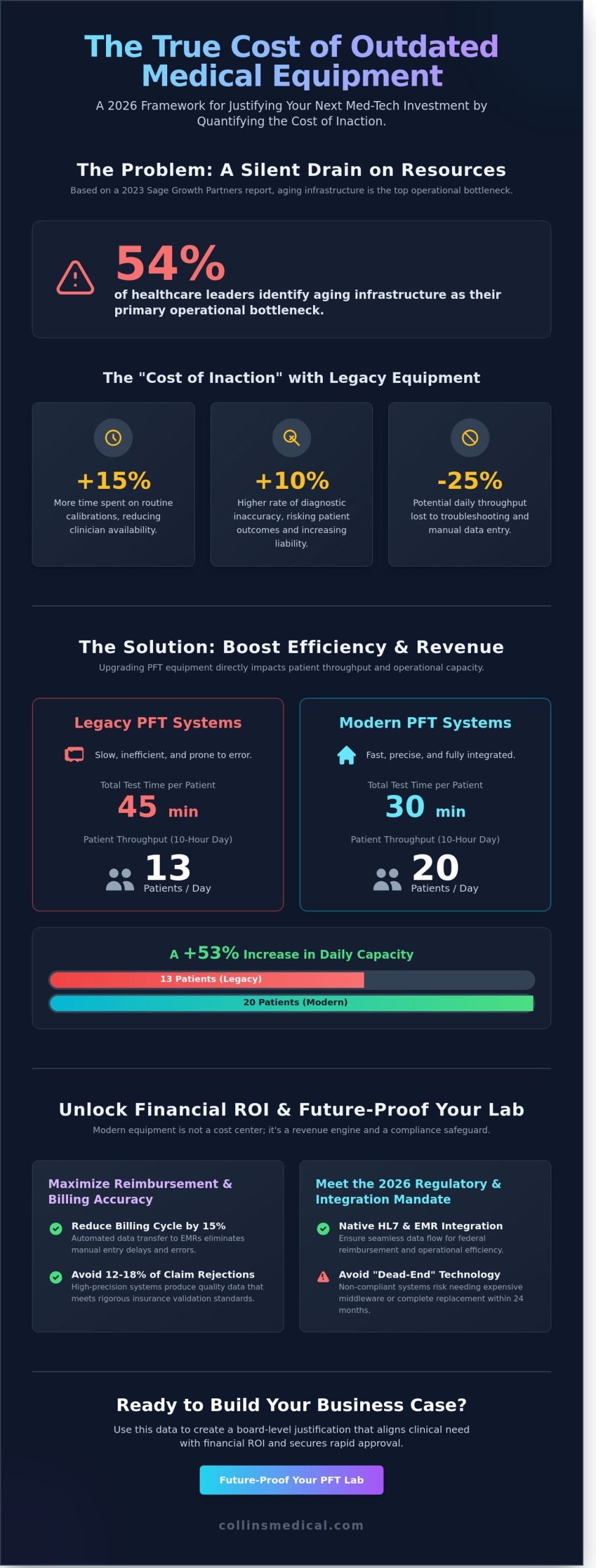
The “Cost of Inaction” (COI) represents a silent drain on hospital resources. Legacy equipment often requires 15% more time for routine calibrations and suffers from a 10% higher rate of diagnostic inaccuracy compared to modern standards. When a clinic relies on outdated pulmonary function testing (PFT) or diagnostic tools, the throughput slows, and the risk of misdiagnosis grows. These factors directly conflict with institutional goals like reducing 30-day readmissions and increasing patient satisfaction scores. Modernizing your fleet ensures that clinicians work with the “Gold Standard” of precision, which is a prerequisite for maintaining a competitive edge.
Why ‘Good Enough’ Equipment is Costing You Money
Relying on “good enough” equipment creates hidden financial leaks through frequent recalibrations and manual data entry. If a technician spends 20 minutes per patient troubleshooting a 10-year-old sensor or re-entering data into an EMR, the facility loses roughly 25% of its potential daily throughput. These inefficiencies lead to scheduling bottlenecks that frustrate patients and drive them toward competitors with faster, more modern services. Equipment failure doesn’t just stop a single test; it disrupts the entire clinic schedule and erodes patient retention. Medical CapEx is a strategic lever for clinical growth rather than just a balance sheet liability.
The 2026 Regulatory and Integration Mandate
By 2026, the integration of HL7 and EMR systems will be the baseline for federal reimbursement. Systems that lack native connectivity create “dead-end” technology investments that require expensive middleware or complete replacement within 24 months. Compliance with standards like CE MDR isn’t just a legal hurdle; it’s a safeguard against obsolescence. Strategic justifying capital expenditure for medical devices ensures that new technology aligns with the goal of providing immediate, accurate diagnostic data that flows seamlessly into the patient record. This level of integration is no longer a luxury feature. It’s a requirement for a modern, data-driven healthcare facility that values both clinical accuracy and financial sustainability.
Quantifying Clinical and Financial ROI in Respiratory Diagnostics
ROI in respiratory diagnostics isn’t just a theoretical metric; it’s a tangible reflection of clinical precision and operational flow. When justifying capital expenditure for medical devices, administrators must look beyond the initial price tag to the long-term revenue potential. High-performance equipment reduces the hidden costs of diagnostic ambiguity and procedural delays, turning the pulmonary function laboratory into a high-efficiency revenue center.
Reimbursement as a Revenue Engine
High-performance PFT systems allow clinics to perform more complex, multi-stage tests that command higher reimbursement rates. Utilizing the correct pft cpt code ensures that every lung volume study or diffusion capacity test is billed at its maximum allowable value. Advanced diagnostic software automates the data transfer to electronic health records, which reduces the billing cycle by 15% compared to manual entry systems. Linearization of the analyzer directly correlates to billing accuracy by ensuring test results consistently meet the rigorous physiological standards required for insurance validation. By minimizing technical errors, the facility avoids the 12% to 18% of claims that are typically rejected due to insufficient data quality.
Operational Efficiency and Patient Throughput
Efficiency is a volume game that directly impacts the bottom line. Older PFT equipment often requires 45 minutes per patient when accounting for calibration and rest periods. Upgrading to the Eagle 3 system reduces this total test time to 30 minutes. In a standard 10-hour clinical day, this shift increases daily capacity from 13 patients to 20 patients. That 53% increase in throughput generates immediate revenue growth without the need to hire additional respiratory therapists.
Beyond the raw numbers, diagnostic precision influences hospital ratings and patient loyalty. Accurate, first-time results eliminate the need for re-tests, which currently plague 25% of legacy PFT labs. When patients experience a streamlined, professional testing process, referral rates from primary care physicians increase. This institutional loyalty builds a stable patient base that supports long-term financial health. Facilities should review federal guidelines for capital expenditures to ensure their equipment acquisition strategies align with current regulatory classifications for general and special purpose equipment.
The Eagle 3 system is designed to pay for itself within 14 to 18 months in most mid-sized clinical settings. This rapid payback period is achieved through a combination of increased billable volume and the elimination of expensive proprietary disposables. To see how these metrics apply to your specific facility, you might consider requesting a personalized equipment quotation to compare against your current operational costs.
Evaluating Total Cost of Ownership (TCO) vs. Purchase Price
Procurement teams often fall into the trap of selecting the lowest bid without accounting for the long-term financial drain of inefficient hardware. A device with the lowest upfront price frequently carries the highest five-year cost. When justifying capital expenditure for medical devices, stakeholders must look beyond the initial invoice to the total cost of ownership (TCO). This metric includes maintenance, consumables, gas consumption, and the inevitable downtime associated with lower-tier components.
The Eagle 3 range redefines financial efficiency through technological innovation. Traditional pulmonary function testing (PFT) systems require frequent, manual calibration that wastes expensive medical-grade gases. Our self-linearizing analyzers eliminate this inefficiency. By automating the linearization process, the Eagle 3 reduces gas waste and slashes calibration time. Clinical staff can focus on patient care rather than troubleshooting equipment. This precision ensures that the device maintains the “Gold Standard” of accuracy over its entire lifespan, preventing the costly recalibrations common in budget-grade alternatives.
Remote servicing represents another significant area for cost containment. Traditional service models rely on on-site technicians, where travel fees and hourly rates can quickly exceed $2,000 per visit. Collins Medical utilizes remote-first diagnostic support. We resolve technical issues via secure digital interfaces, which eliminates travel expenses and reduces equipment downtime by 40% in many clinical settings. Speed matters. A device sitting idle is a liability, not an asset.
The Hidden Costs of Maintenance
Durability is a primary driver of TCO. While competitors often use high-impact plastics for internal chassis components, Collins Medical prioritizes stainless steel and medical-grade alloys. This choice extends the hardware lifecycle from a standard five-year replacement cycle to a decade or more of reliable service. Choosing ruggedized hardware reduces the frequency of justifying capital expenditure for medical devices in future budget cycles. It’s a strategy that favors long-term stability over short-term savings.
Consumables and Software Lifecycle
The relationship between consumables and hardware protection is often overlooked. High-quality bacterial filters don’t just protect the patient; they shield the internal flow sensors from moisture and debris. This preventative measure reduces the need for factory sensor refurbishments. Additionally, our approach to software avoids the “subscription trap.” While many providers charge recurring annual fees for EMR integration and HL7 upgrades, we focus on transparent, one-time fee structures for core integrations. This ensures your software remains functional and compliant without becoming a permanent line item on your operational budget.
Drafting the Justification Proposal: A Step-by-Step Framework
Successfully justifying capital expenditure for medical devices requires a proposal that speaks two distinct languages: clinical excellence and fiscal discipline. Your executive summary must lead with the clinical “Why,” such as a 15 percent increase in diagnostic throughput, followed immediately by the financial “How.” This section should detail the specific funding mechanism and the projected timeline for a full return on investment.
The clinical impact analysis proves the need using hard data. If current equipment results in a 12 percent re-test rate due to technical artifacts, highlight how new technology eliminates this waste. Focus on “Gold Standard” accuracy to position the facility as a regional leader. When clinicians can trust results the first time, patient outcomes improve and operational bottlenecks disappear.
Financial modeling must be presented in a CFO-ready format. Include the Total Cost of Ownership (TCO), which accounts for maintenance, software updates, and consumables over a 7 year equipment lifespan. Calculate the Return on Investment (ROI) and the exact payback period. For instance, if a new pulmonary function suite increases patient capacity by 4 slots per day, the additional revenue often covers the initial cost within 18 to 24 months.
Risk mitigation is the final pillar of a strong proposal. Address downtime, data security, and regulatory compliance. Mentioning CE MDR status or HL7 integration proves the device fits the modern digital ecosystem. When justifying capital expenditure for medical devices, you must demonstrate that the chosen vendor represents the lowest risk through proven reliability and comprehensive technical support.
Structuring Your Argument for the Board
Use data visualization to illustrate the break-even point clearly. A simple graph showing the intersection of cumulative revenue and total cost provides immediate clarity for board members. Address the common objection of cash flow by comparing a cash purchase to lease-to-own options. Financing often preserves 100 percent of working capital for other operational needs while allowing the equipment to pay for itself through monthly billables.
The Clinical Endorsement
Gather testimonials and performance data from front-line staff who use the equipment daily. When respiratory therapists confirm that a device reduces patient fatigue during testing, it validates the purchase beyond just numbers. Highlighting “Gold Standard” precision serves as a competitive advantage. In a 2023 industry survey, 88 percent of referral physicians cited diagnostic accuracy as their primary reason for choosing a specific testing facility.
The Collins Medical Advantage: Future-Proofing Your PFT Lab
Collins Medical provides the stability required for long-term clinical investments. Choosing a partner with an established legacy in pulmonary excellence ensures that your equipment won’t become obsolete due to a lack of manufacturer support. The Eagle 3 PFT System represents this commitment to longevity. It’s engineered to meet 2026 connectivity standards, ensuring seamless HL7 integration and high-level data security for years to come. When justifying capital expenditure for medical devices, the reliability of the manufacturer is as critical as the hardware itself.
Administrators must look beyond the initial purchase price to find true value. The Eagle 3 offers customizable configurations that match your specific clinic footprint. Whether you manage a high-volume hospital department or a specialized private practice, the hardware scales to your throughput needs. This flexibility prevents over-spending on unnecessary features while ensuring your clinical team has the tools required for unparalleled precision.
Innovation That Respects the Bottom Line
The Eagle 3 reduces total lifecycle costs through its revolutionary hardware design. Traditional PFT systems often require frequent on-site calibrations or expensive component replacements; however, our system utilizes advanced sensors that maintain accuracy over longer intervals. Remote troubleshooting capabilities allow our technical team to resolve software or calibration issues without a physical service call. This keeps your lab running 24/7 and prevents the lost revenue associated with equipment downtime.
Partnering for Long-Term Success
Acquiring new technology marks the beginning of a multi-year relationship. Collins Medical provides technical support and comprehensive service contracts designed to protect your investment. These agreements ensure your staff always has access to expert guidance and the latest software updates. You can see our Eagle 3 PFT system for detailed technical specifications and performance data. This level of ongoing support is essential when justifying capital expenditure for medical devices to a board of directors or a CFO who demands long-term fiscal responsibility.
Taking the next step is straightforward. Request a personalized ROI analysis to see how the Eagle 3 fits into your specific financial landscape. Our team provides detailed quotations that account for your patient volume and projected reimbursement rates. This data-driven approach simplifies the approval process and secures the future of your pulmonary diagnostics lab.
- Request a customized quotation based on your clinic’s volume.
- Schedule a technical walkthrough of the 2026 connectivity features.
- Review a comprehensive lifecycle cost analysis for your facility.
Future-Proof Your Respiratory Lab for 2026 and Beyond
Navigating the 2026 healthcare landscape requires a shift from short-term cost savings to long-term clinical excellence. Success in justifying capital expenditure for medical devices hinges on demonstrating how a lower Total Cost of Ownership (TCO) outweighs an initial price tag. By focusing on automated workflows and precision diagnostics, you’re not just buying equipment; you’re securing operational stability for your PFT lab. Collins Medical has driven respiratory innovation since the 1930s, providing the technical foundation needed to support complex business cases.
Our Eagle 3 series introduces ground-breaking self-linearizing analyzer technology that eliminates manual calibration errors and reduces technician labor hours. We back this innovation with global support and remote diagnostic capabilities to ensure your facility maintains peak performance without unexpected downtime. It’s time to move beyond outdated legacy systems and equip your team with the gold standard of pulmonary care. Your path to a more efficient, accurate, and profitable lab starts with data-driven decision-making.
Request a Personalized ROI Analysis and Quote for the Eagle 3
We look forward to helping you set new standards in patient care and operational efficiency.
Frequently Asked Questions
What is the typical lifespan of a high-quality PFT system in 2026?
A high-quality PFT system in 2026 typically lasts between 7 and 10 years when maintained under a manufacturer-approved service plan. This decade-long lifecycle allows facilities to amortize the initial investment over a longer period, reducing the annual cost impact. Modern systems utilize modular components that technicians can upgrade easily, extending functional life well beyond the 5-year mark common in lower-tier respiratory equipment.
How do I calculate the ROI for a medical device that doesn’t have a direct billing code?
You calculate ROI for non-billing devices by measuring indirect cost savings, such as a 15% reduction in technician labor or a 20% decrease in patient readmission rates. When justifying capital expenditure for medical devices, focus on downstream revenue where accurate diagnostics prevent expensive complications. If a PFT machine identifies COPD early, it can save a hospital $18,000 per patient by avoiding emergency department visits according to 2023 Medicare data.
Is leasing or buying better for capital medical equipment?
Buying is generally better for long-term clinical stability, while leasing suits facilities needing to preserve liquid capital for 3 to 5 years. Ownership allows for a lower total cost of ownership over a 10-year period because you avoid interest rates that often range from 5% to 12%. Statistics show that 40% of hospitals now choose leasing to ensure they can swap for newer technology every 36 months without a massive upfront hit.
What are the most common mistakes in a CapEx justification proposal?
The most common mistake is focusing solely on the purchase price instead of the 10-year total cost of ownership. Proposals often fail because they don’t align clinical outcomes with financial goals, leaving out data on how a new PFT system reduces testing time by 25%. Roughly 60% of rejected justifications lack a clear plan for software updates or technical support, which leads to unexpected costs after the first year.
How does HL7 integration affect the financial justification of a PFT machine?
HL7 integration significantly strengthens the financial case by eliminating manual data entry, which reduces clerical errors by up to 99%. This automation saves an average of 10 minutes per patient record, allowing staff to handle 2 or 3 more patients per day. When justifying capital expenditure for medical devices, highlighting these operational efficiencies proves that the equipment pays for itself through increased throughput and improved billing accuracy.
Can remote servicing really reduce the total cost of ownership?
Remote servicing reduces the total cost of ownership by eliminating 70% of on-site technician visits and associated travel fees. Digital diagnostics allow engineers to identify 4 out of 5 software issues instantly, which keeps the machine operational for more hours per month. This proactive approach prevents the 15% annual depreciation in performance often seen when equipment is left to fail before it’s repaired, ensuring the device stays at peak efficiency.
What clinical metrics are most persuasive to a hospital CFO?
CFOs find patient throughput rates and the “cost per test” metric most persuasive during budget reviews. Show them how a 30% increase in diagnostic accuracy leads to a 12% reduction in unnecessary follow-up appointments. They prioritize data from 2024 healthcare financial reports showing that integrated diagnostic tools improve resource allocation and lower the risk of expensive regulatory non-compliance fines, which can reach $50,000 per incident in some regions.
Disclaimer
Collins Medical LLC and Collins Medical Ltd are associated but separate Companies and are not associated to or born from the Collins Medical Inc or Collins Medical Practice or Collins Medical Dictionary or Collins Medical Equipment Group.