Imagine standing before a budget committee only to have your capital request dismissed because they view a new spirometer as a luxury rather than a necessity. For many clinical leads, this frustration is compounded when aging sensors lead to a 15% increase in patient rescheduling due to calibration errors. It’s a difficult position. You know that outdated equipment creates clinical risk, yet the board often focuses solely on the high initial cost. You likely agree that the real challenge in writing a business case for a new pft machine is translating clinical urgency into the financial metrics that executives demand.
This guide changes that dynamic by helping you build a data-driven, CFO-ready proposal for modern pulmonary diagnostics. We’ll show you how to secure necessary funding by providing clear evidence of financial ROI through optimized reimbursement and improved clinical throughput. We’ll examine how a structured document can prove that upgrading to world leading technology minimizes lifecycle costs while eliminating the downtime that plagues older systems. By the end of this article, you’ll have the tools to turn a technical requirement into an irresistible business opportunity.
Key Takeaways
- Identify the true cost of inaction by quantifying how aging systems drain budgets through frequent repairs and compromised clinical accuracy.
- Master the five essential elements of writing a business case for a new pft machine to align your clinical requirements with hospital-wide strategic objectives.
- Learn to build a robust financial model that utilizes 2026 reimbursement rates and calculates the revenue gains from increased patient throughput.
- Gain a step-by-step roadmap for drafting your pitch, including how to leverage downtime data to overcome common board objections.
- Explore how modern innovations like the Eagle 3 PFT System minimize total lifecycle costs through self-linearizing analyzers and revolutionary remote servicing.
Identifying the Cost of Inaction: Why Your Current PFT Equipment is a Liability
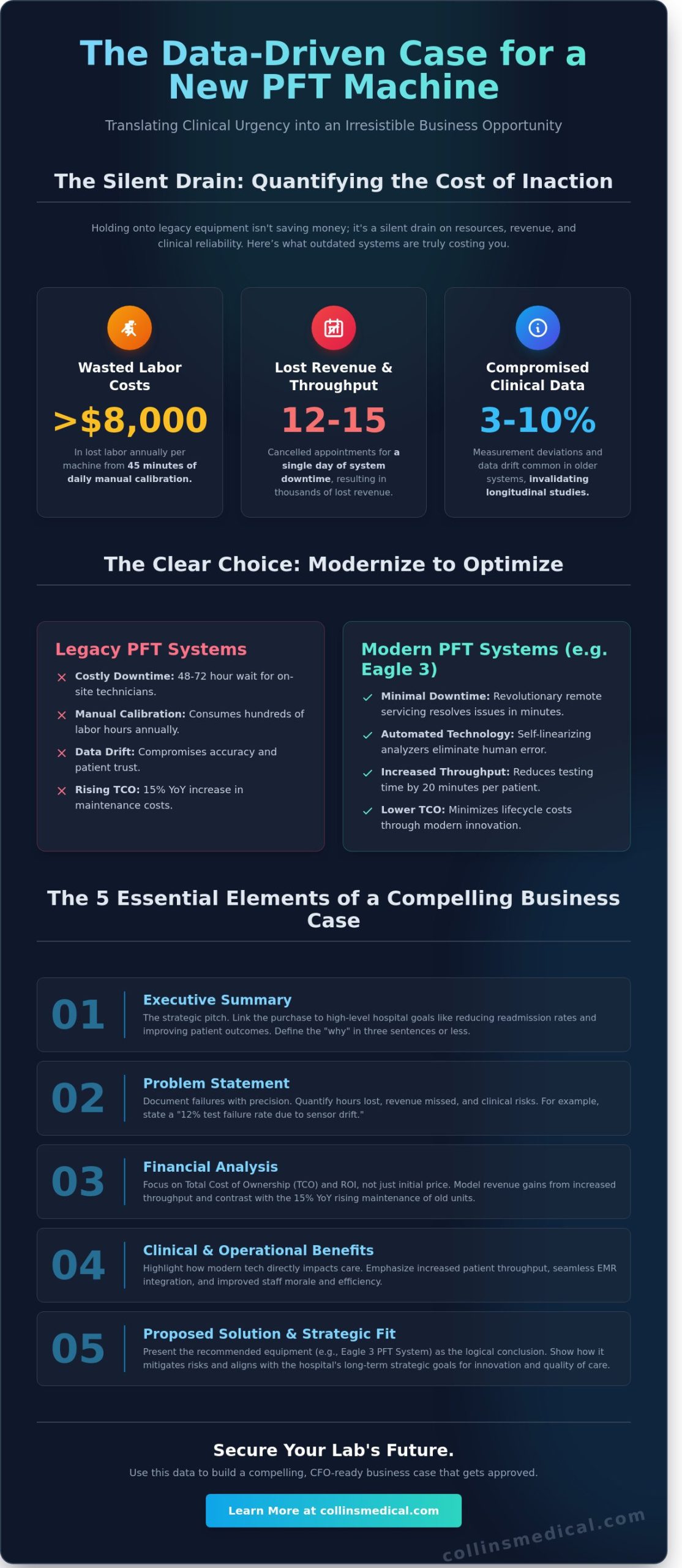
Holding onto legacy pulmonary function testing (PFT) equipment feels like a safe financial choice, but it creates a silent drain on clinical resources. When writing a business case for a new pft machine, you must first quantify the “Cost of Inaction” (COI). Legacy systems often require 45 minutes of manual calibration every morning. If a technician earns an average of $35 per hour, that equates to over $8,000 in lost labor annually for just one machine. Beyond labor, aging gas analyzers suffer from data drift. This inaccuracy compromises longitudinal studies where even a 3% variance can invalidate years of patient data. Reliability isn’t just a technical metric; it’s a financial one.
Modernizing your lab isn’t only about acquiring new features. It’s about aggressive risk mitigation. Understanding The 5 Essential Elements of a Compelling PFT Business Case helps administrators see that old hardware is a liability rather than an asset. While your current system might still “work,” its declining throughput and increasing repair needs represent a significant opportunity cost. If your outdated tech cannot handle high patient volumes, you’re essentially turning away revenue every single day. For a deeper look at how the industry moved from these manual burdens to modern standards, explore the definitive guide to a legacy of pulmonary excellence.
The Hidden Costs of Manual Calibration
Legacy PFT systems rely on manual linearization. This process consumes hundreds of labor hours each year. Technicians frequently spend the first hour of their shift troubleshooting sensors rather than seeing patients. In contrast, the Eagle 3 utilizes automated, self-linearizing technology. This shift eliminates human error and ensures data integrity for clinical research. High-precision environments in the US and UK can’t afford the 5% to 10% measurement deviations common in non-linearized analyzers. Accuracy is the foundation of patient trust.
Operational Downtime and Service Lag
A single day of downtime in a high-volume lab can result in 12 to 15 cancelled appointments. For a busy clinic in Massachusetts or Kent, this translates to thousands in lost billable revenue. Traditional repair models involve waiting 48 to 72 hours for an on-site technician. Collins Medical addresses this through modern remote servicing capabilities. Instead of waiting for a service van to arrive in Ashford, many software and calibration issues are resolved via secure remote access. This reliability boosts staff morale by removing the frustration of troubleshooting hardware when they should be focused on diagnostics. Writing a business case for a new pft machine requires highlighting these operational efficiencies to prove long-term ROI.
The 5 Essential Elements of a Compelling PFT Business Case
Securing capital for respiratory equipment requires more than a list of features. Writing a business case for a new pft machine demands a structured approach that speaks to both clinicians and financial controllers. In 2026, the focus has shifted from simple procurement to long term clinical viability. Your proposal must address these five pillars to gain approval from hospital leadership.
- Executive Summary: This isn’t just a summary; it’s a strategic pitch. It links the purchase to high level hospital goals like reducing readmission rates for chronic respiratory patients. It should define the “why” in three sentences or less.
- Problem Statement: Document current failures with precision. If your current lab experiences a 12% test failure rate due to sensor drift, state it clearly. Quantify the hours lost to manual recalibrations and equipment downtime.
- Financial Analysis: Focus on the Total Cost of Ownership (TCO). Include consumables, software licensing, and technician time. Older units often see a 15% increase in maintenance costs year over year, making replacement the more fiscal choice.
- Clinical and Operational Benefits: Highlight throughput. Modern machines can reduce testing time by 20 minutes per patient while ensuring seamless EMR integration. This allows for more appointments without increasing staff hours.
- Risk Assessment: Detail the dangers of staying with the status quo. Non compliance with updated 2026 diagnostic standards poses a significant regulatory risk. Maintaining obsolete hardware also increases the likelihood of inaccurate patient data.
Aligning with Institutional Goals
Modern healthcare emphasizes Value Based Care initiatives. A new PFT machine directly impacts patient outcome metrics by providing faster, more accurate data. This speed reduces the Time to Treatment for COPD and asthma patients. By partnering with an innovator, your department supports a legacy of pulmonary excellence that attracts top tier clinical talent. Better diagnostics lead to better outcomes; it’s that simple.
The Technical Justification
Writing a business case for a new pft machine in 2026 requires a focus on automation. Self linearizing analyzers are now mandatory for regulatory compliance and simplified auditing. These systems eliminate human error in calibration. Additionally, HL7 and EMR integration are essential for billing accuracy. Without these, your facility risks losing revenue through uncaptured codes or administrative mistakes. Scalable software prevents technical debt by allowing modular updates as new research emerges. You can explore our range of future proof technology at Collins Medical to see these features in action.
Financial Modeling: Calculating ROI, Reimbursements, and Throughput
Writing a business case for a new pft machine requires a shift from viewing equipment as a cost center to seeing it as a revenue driver. For 2026, reimbursement modeling centers on key CPT codes. Code 94010 (Spirometry) and 94060 (Bronchodilation responsiveness) remain the high-volume staples for most respiratory departments. Based on projected 2026 CMS Physician Fee Schedule rates, these procedures provide a steady baseline for your ROI. When you factor in a 20% increase in throughput, the financial outlook changes. A faster test cycle doesn’t just save time; it creates slots for two additional patients per day in a standard eight-hour shift. This creates a direct path to higher monthly revenue without increasing staff hours.
Lifecycle costs must include both CAPEX and long-term OPEX. While the initial purchase price is the most visible figure, the cost of filters, calibration gases, and replacement sensors over a seven-year span often equals the sticker price. Modern systems mitigate these costs through better durability. Remote servicing capabilities now significantly reduce emergency repair bills. By resolving software glitches or calibration drifts via secure cloud access, clinics in Ashford or Hopedale avoid the $300 technician travel fees common with older models. This shift from reactive to proactive maintenance preserves the operational budget and ensures the machine stays in service.
Revenue Generation through Efficiency
The Eagle 3 system optimizes the “Tests Per Day” metric compared to legacy models. Older units often require 45 minutes for a full PFT battery, while the Eagle 3 completes the same cycle in 36 minutes. This efficiency gain allows a clinic to move from 10 to 12 patients daily. Accurate DLCO and lung volume measurements are also critical for the bottom line. Precise first-time results prevent the 15% re-test rate seen with aging sensors, ensuring every slot generates revenue. You can learn more about how this precision was developed in Collins Medical: The Definitive Guide to a Legacy of Pulmonary Excellence.
Leveraging Financing and Maintenance Contracts
Fixed-cost service contracts are essential for Ashford or Hopedale clinics looking to stabilize their annual operating budgets. These contracts transform unpredictable repair costs into a single, manageable line item. When writing a business case for a new pft machine, compare the tax benefits of equipment leasing against outright purchase. Leasing often preserves cash flow and allows for technology refreshes every five years. Additionally, the trade-in value of existing Collins Medical equipment can provide a substantial down payment, reducing the total amount financed by up to 15% depending on the age and condition of the legacy unit.
Step-by-Step: Drafting the Pitch and Addressing Board Objections
Success in writing a business case for a new pft machine depends on your ability to transform clinical needs into executive priorities. Follow these five steps to build a narrative that resonates with both the CFO and the Chief Medical Officer.
- Step 1: Quantify the Friction. Audit your department’s performance over the last 12 months. If your current equipment averages 15% downtime, calculate the lost revenue from canceled appointments. Survey your staff; a 2024 industry report found that 22% of respiratory technicians consider equipment reliability a primary factor in job satisfaction.
- Step 2: Establish a Financial Baseline. Secure a personalized quotation early. This provides a firm number for the board to digest, preventing the “estimated cost” trap that often stalls approvals.
- Step 3: Define Clinical Excellence. Focus on data reliability and patient comfort. Highlight how modern sensors meet the latest ATS/ERS standards, ensuring your facility remains a leader in diagnostic accuracy.
- Step 4: Build the Financial Defense. Use a Total Cost of Ownership (TCO) model. Factor in CPT reimbursement data for codes like 94010 or 94060 to show how increased throughput directly impacts the bottom line.
- Step 5: Propose a Partnership. Present the purchase as a long-term alliance with an established innovator like Collins Medical, which supports facilities from Ashford, Kent, to Massachusetts.
Handling the Too Expensive Objection
The board often fixates on the initial purchase price. Shift the focus to the Cost Per Test over a five-year horizon. Advanced respiratory technology reduces hospital re-admissions by providing more accurate early diagnoses, which is a critical metric for modern value-based care. You aren’t just buying a tool; you’re securing a 90-year legacy of engineering excellence. This longevity ensures that your investment won’t face obsolescence three years from now.
Demonstrating Seamless Integration
IT departments often block new equipment due to security or integration fears. When writing a business case for a new pft machine, detail the HL7 upgrade path. Modern PFT software functions as a “Plug and Play” solution within current hospital ecosystems, reducing the IT workload by automating data transfers to the EMR. Service contract fees act as a safety net, ensuring that technical support handles updates rather than draining internal hospital IT resources. This approach positions the new machine as an operational asset rather than a technical burden.
To learn more about how decades of innovation can strengthen your department’s clinical standing, read about the Collins Medical legacy of pulmonary excellence.
Ready to finalize your proposal with a firm financial baseline? Request a personalized quotation from Collins Medical today.
Why the Eagle 3 PFT System is the Logical Conclusion of Your Case
The Eagle 3 PFT System represents the culmination of nearly a century of innovation in respiratory health. Since the 1930s, Warren E. Collins, Inc. has defined the Gold Standard in respiratory diagnostics, and the Eagle 3 continues this tradition by setting new benchmarks for accuracy. By choosing this system, you’re aligning your facility with a legacy of pulmonary excellence that spans generations. The Eagle 3 integrates self-linearizing analyzers that provide unparalleled precision, ensuring that every test meets rigorous clinical requirements without the manual adjustments required by older technology.
When writing a business case for a new pft machine, the focus often shifts to operational uptime and long-term value. The Eagle 3 addresses this through ground-breaking remote servicing capabilities. This technology eliminates traditional maintenance lag and prevents the 15% to 20% downtime often seen in high-volume labs waiting for on-site technicians. By utilizing modular engineering, the system minimizes total lifecycle costs, allowing specific components to be upgraded or replaced without discarding the entire unit. This durability ensures the machine remains a functional asset for over 10 years.
Precision-Engineered for 2026 Standards
Diagnostic respiratory technology requirements for 2026 demand higher data integrity and faster throughput for US and UK labs. The Eagle 3 exceeds these benchmarks with modular configurations that adapt to the specific needs of regional hospitals in Ashford, Kent, or private clinics in Hopedale, MA. It’s built to handle the 12% increase in patient loads expected in pulmonary departments over the next decade. The Eagle 3 stands as the only system globally that combines automated self-linearization with proactive remote troubleshooting.
Securing Your Investment with Collins Medical
Securing capital approval requires proof of long-term reliability and support. Collins Medical provides specialized remote diagnostic support that identifies potential hardware issues before they impact the daily clinic schedule. This is vital for high-volume settings where even a four-hour delay can disrupt dozens of patient appointments and reduce department revenue. Maintaining clinical excellence also depends on hygiene and accuracy, which is why we emphasize the use of OEM filters and sensors designed specifically for our hardware.
The Eagle 3 isn’t just an equipment upgrade; it’s a strategic move to future-proof your respiratory department. You can request a personalized Eagle 3 quotation to complete your business case and finalize your proposal with concrete data. Writing a business case for a new pft machine becomes a straightforward process when the ROI is backed by the most trusted name in the industry.
Modernize Your Pulmonary Lab with 2026 Precision
Transitioning from aging equipment to a high-performance lab requires more than just a purchase order. You’ve seen how the cost of inaction leads to clinical downtime and lost reimbursements that impact your facility’s bottom line. By writing a business case for a new pft machine, you’re presenting a data-backed plan to improve patient throughput and diagnostic accuracy. The Eagle 3 PFT System is the definitive choice for this upgrade. It utilizes revolutionary self-linearizing gas analyzers to eliminate the accuracy drift common in older models. Collins Medical has pioneered respiratory technology since the 1930s, starting with the invention of the first iron lung. We continue that legacy today by providing industry-leading remote servicing that minimizes downtime for busy clinics. Your board expects a solution that balances clinical excellence with financial sustainability. The evidence is clear; it’s time to replace liability with world-leading innovation that protects your patients and your budget.
Download our PFT Business Case Template & Request an Eagle 3 Quote
We look forward to helping you set a new standard for respiratory care in your region.
Frequently Asked Questions
What is the most important metric to include in a PFT business case?
The most important metric in a PFT business case is the projected Return on Investment (ROI) based on patient throughput. Administrators prioritize how quickly a device pays for itself through billable procedures. In 2026, targeting a 15% increase in daily tests via faster calibration cycles proves financial viability. This data demonstrates that the equipment isn’t just a cost center but a revenue generator for the clinic.
How do I calculate the ROI of a new PFT machine in 2026?
Calculating ROI for a 2026 investment requires subtracting the Total Cost of Ownership from the annual gross reimbursement revenue. You should divide this net profit by the initial capital expenditure to find the percentage return. Incorporate a 5% annual increase in respiratory demand as projected by recent industry reports. This ensures your writing a business case for a new pft machine reflects realistic market growth and clinical capacity.
Can I include CPT code reimbursement in my financial justification?
You can and should include CPT code reimbursement, such as codes 94010 or 94060, to provide a concrete revenue forecast. Using current CMS 2025 Physician Fee Schedule rates allows for an evidence based projection of income per patient. This financial justification transforms the request from a technical upgrade into a strategic business decision. It’s essential to use the most current local carrier rates for Massachusetts or Kent locations to ensure accuracy.
Why is Total Cost of Ownership better than Purchase Price for medical equipment?
Total Cost of Ownership is superior because it accounts for the 70% of lifetime expenses that occur after the initial purchase. While the sticker price is a one time cost, TCO includes consumables, annual calibrations, and software licenses over a 7 to 10 year period. Highlighting these long term savings shows fiscal responsibility. It prevents unexpected budget shortfalls that often arise from cheaper, high maintenance alternatives.
How does modern PFT software reduce clinical administrative burden?
Modern PFT software reduces administrative burden by automating the transfer of results directly into EMR systems via HL7 protocols. This eliminates the 15 minutes of manual data entry typically required for every patient test. Automated quality checks also reduce the need for retesting by ensuring data meets ATS/ERS standards immediately. These efficiencies allow clinicians to focus on patient care rather than documentation.
What are the risks of using outdated PFT equipment in 2026?
The primary risks of using outdated equipment in 2026 include non-compliance with current ATS/ERS standards and increased mechanical downtime. Older systems often fail to meet the 2019 technical updates, which can lead to inaccurate diagnoses or rejected insurance claims. Maintenance costs for legacy hardware often rise by 20% annually once parts become obsolete. You risk clinical errors and financial loss by delaying an upgrade.
Is remote servicing a valid cost-saving feature for a business case?
Remote servicing is a critical cost saving feature that reduces onsite technician visits by up to 40% annually. Modern systems allow engineers to perform software updates and diagnostic checks from a remote location. This minimizes equipment downtime and eliminates travel fees associated with traditional repair models. It’s a proactive way to maintain 99.9% uptime for your pulmonary lab throughout the year.
How does the Eagle 3 PFT system improve patient throughput?
The Eagle 3 PFT system improves patient throughput by utilizing rapid gas sensors that stabilize in under 30 seconds. This speed allows for more tests per hour compared to older, slower technology. When writing a business case for a new pft machine, emphasizing the Eagle 3’s automated calibration cycle is vital. It saves 10 minutes per day, which adds up to 40 hours of reclaimed clinical time every year.
Disclaimer
Collins Medical LLC and Collins Medical Ltd are associated but separate Companies and are not associated to or born from the Collins Medical Inc or Collins Medical Practice or Collins Medical Dictionary or Collins Medical Equipment Group.