How much clinical revenue is escaping your facility because your current pulmonary function testing setup can’t keep pace with 2026 demand? While high initial capital expenditure often dominates the conversation, the real cost lies in the 15% of specialty revenue lost to inefficient diagnostic workflows, according to 2024 industry benchmarks. You’re likely already feeling the pressure of balancing these costs against the constant fear that equipment downtime will stall your patient throughput. It’s a frustrating cycle where the complexity of modern reimbursement codes often obscures the true pft equipment return on investment.
At Collins Medical, we’ve spent decades setting the gold standard in respiratory technology from our strategic hubs in MA 01747 and Kent, TN23 1LY. We understand that you need more than just a machine; you need a financial strategy that holds up under scrutiny. This guide will show you how advanced diagnostic technology maximizes your billing potential, eliminates referral leakage, and slashes total lifecycle costs. We’ll provide a clear framework to help you calculate your exact payback period while improving the diagnostic accuracy required for high-value care models.
Key Takeaways
- Learn how to transition from basic spirometry to comprehensive testing to unlock significant clinical revenue and operational savings.
- Identify the essential 2026 CPT codes and high-throughput workflows that maximize your pft equipment return on investment by increasing daily patient capacity.
- Discover strategies to minimize total lifecycle costs by comparing automated self-linearizing analyzers against traditional manual calibration methods.
- Understand why the Eagle 3 serves as the gold standard for rapid payback periods, backed by over 90 years of Collins Medical’s innovation and technical expertise.
- Master the art of reducing referral leakage by integrating advanced pulmonary technology that keeps high-value diagnostics within your facility.
Evaluating the Economic Impact of Pulmonary Function Testing (PFT) Systems
Calculating the pft equipment return on investment requires a precise balance of initial capital expenditure against long-term clinical revenue and operational efficiency. While basic spirometry serves as a preliminary screening tool, comprehensive Pulmonary Function Testing (PFT) including DLCO, Lung Volumes, and Airway Resistance offers a significantly higher financial and clinical upside. By 2026, healthcare models have shifted to favor in-house diagnostics as a means to secure patient retention and optimize the transition from volume-based to value-based care.
Facilities that invest in advanced systems like the Eagle 3 range can capture complex reimbursement codes that basic devices miss. This shift is essential as value-based care models now reward diagnostic accuracy and reduced time-to-treatment. Collins Medical, with its legacy of pulmonary excellence, provides the technical precision required to meet these 2026 standards. Our teams in MA 01747 and Kent TN23 1LY ensure these global standards of accuracy are maintained across all installations.
The Hidden Financial Cost of Respiratory Referral Leakage
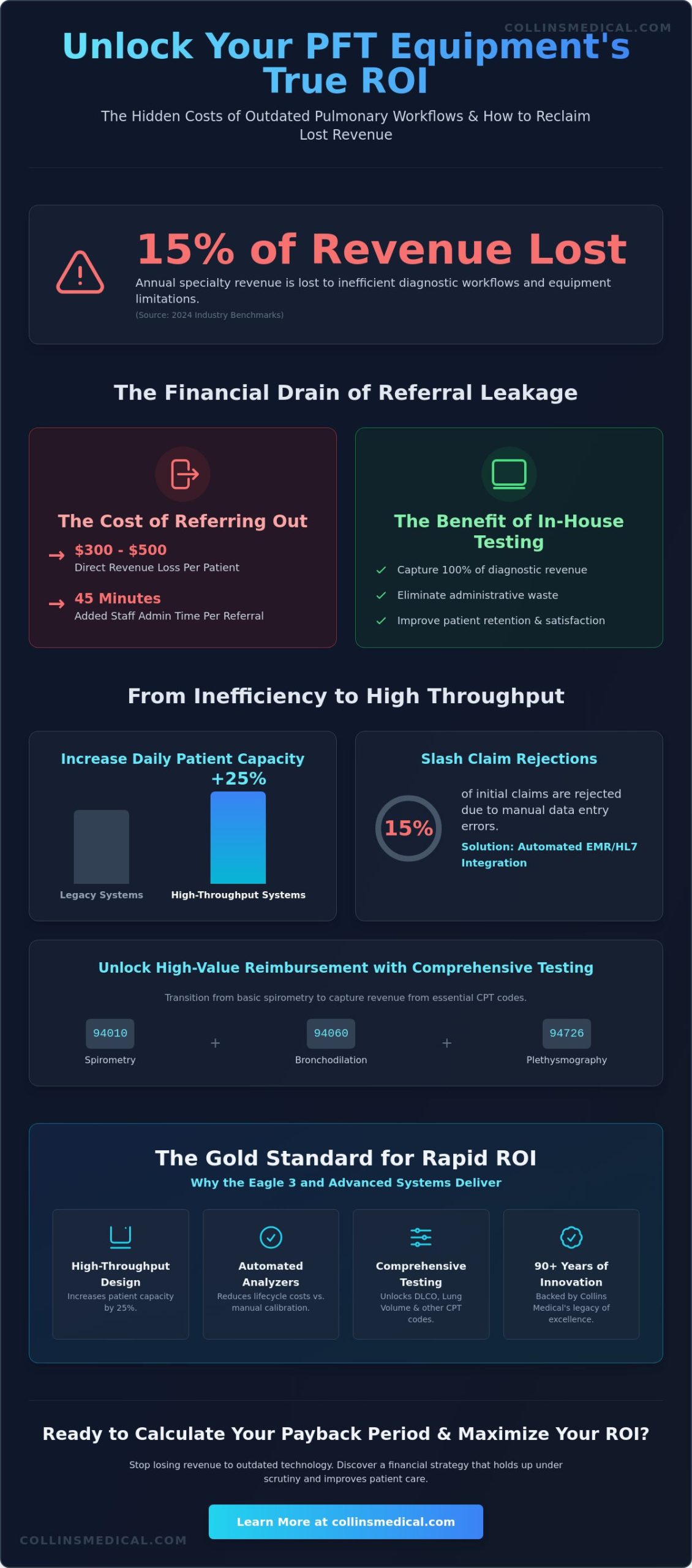
Sending patients to external labs for comprehensive testing creates a significant revenue gap. Statistics from 2025 indicated that clinics referring out full PFTs lose an average of $300 to $500 in potential revenue per patient. Beyond direct loss, the administrative burden of tracking external results and manually entering data into EMR systems adds roughly 45 minutes of staff time per referral. Referral leakage is the primary drain on pulmonary clinic margins. Bringing these capabilities in-house eliminates these delays and keeps the pft equipment return on investment high by consolidating the entire care cycle within one facility. This strategy improves patient satisfaction while securing the financial health of the practice.
Maximizing Revenue Through PFT Reimbursement and Clinical Efficiency
Achieving a high pft equipment return on investment requires a dual focus on maximizing billable events and minimizing operational waste. In 2026, the clinical landscape demands precision. Using high-throughput systems like the Eagle 3 allows facilities to increase daily patient capacity by 25% compared to legacy hardware. This efficiency directly impacts the bottom line by enabling more frequent use of core CPT codes. Standard procedures like 94010 (Spirometry), 94060 (Bronchodilation responsiveness), and 94726 (Plethysmography) remain the financial backbone of pulmonary clinics. However, capturing this revenue depends on technical reliability and speed.
Clinician time is a fixed cost. When results are fast and reliable, doctors spend less time troubleshooting and more time with patients. Advanced HL7 upgrades and seamless EMR integration play a pivotal role here. These systems reduce manual data entry errors, which account for 15% of initial claim rejections in some clinical settings. By automating the flow from the PFT lab to the billing office, healthcare leaders ensure that every test performed is a test paid for. Understanding the Medicare reimbursement guidelines for PFT is essential to maintain compliance and secure full payment for services rendered.
Navigating the 2026 Reimbursement Landscape in the US and UK
Revenue strategies differ significantly between the US and UK markets. In the United States, specifically for providers in MA 01747, success hinges on navigating Medicare and private insurance requirements. In contrast, UK private healthcare providers in Ashford, Kent, TN23 1LY, focus on diagnostic billing structures tailored to private medical insurance (PMI) standards. Common errors leading to denials include incorrect modifier usage or failing to document medical necessity. High-quality equipment ensures data meets the stringent “Gold Standard” of accuracy required for successful claims. For those interested in the evolution of these standards, explore our Definitive Guide to a Legacy of Pulmonary Excellence. Maintaining regional compliance in Massachusetts and Kent ensures your pft equipment return on investment stays protected against regulatory audits. If you’re ready to upgrade your facility’s throughput, you can request a personalized quotation from our expert team.
Reducing Total Lifecycle Costs (TLC) with Advanced Technology
Measuring pft equipment return on investment requires a shift from acquisition cost to Total Lifecycle Cost (TLC). TLC encompasses the initial purchase price, recurring consumables, scheduled maintenance, and the financial drain of equipment downtime. Facilities often overlook that a lower upfront price can lead to 20% higher operational costs over a five year period. Durable hardware, such as the stainless steel and polycarbonate components used by Collins Medical, extends the physical lifespan of the unit to 10 years or more. This longevity ensures the equipment remains a high performing asset rather than a liability. A case study on PFT lab profitability highlights that controlling these operational expenses is vital for maintaining a healthy margin.
- Consumables: High efficiency filters and optimized gas usage reduce the cost per test.
- Maintenance: Durable materials minimize the frequency of hardware repairs.
- Downtime: Reliable systems prevent the loss of revenue from canceled patient appointments.
The ROI of Self-Linearizing Analyzers and Remote Servicing
The Eagle 3 series introduces self-linearizing analyzers that redefine efficiency. Manual calibration is a labor intensive process. It often consumes 30 minutes of a technician’s day. Automated systems eliminate this burden. They optimize gas consumption by using precision sensors, which can reduce gas waste by 15% annually. This technical precision is rooted in A Legacy of Pulmonary Excellence that prioritizes clinical accuracy and operational speed.
Remote servicing adds another layer of savings for labs in Massachusetts and Kent alike. Traditional on-site technician visits involve expensive travel fees and scheduling delays. With remote troubleshooting, 85% of software related issues are resolved instantly. This “zero-downtime” approach keeps patient throughput high. It protects your bottom line by maximizing your pft equipment return on investment through constant availability.
Strategic Implementation: Why the Eagle 3 is the Gold Standard for ROI
Collins Medical bridges the gap between historical expertise and modern technological breakthroughs. With a 90-year legacy in respiratory diagnostics, the brand provides more than hardware; it’s a sustainable financial model. Choosing the Eagle 3 ensures your pft equipment return on investment remains positive throughout the entire lifecycle of the device. It’s a system built by an established partner that understands the rigorous fiscal pressures of 2026 healthcare budgets.
In a high-volume clinical setting performing 12 tests daily, the Eagle 3 system typically reaches its break-even point within 14 months. This efficiency stems from a design that minimizes downtime and eliminates the need for expensive, proprietary disposables. The system includes future-proof software that integrates seamlessly with existing hospital EMR and HL7 protocols. This prevents the costly “rip and replace” cycles common with lower-tier vendors that don’t prioritize long-term compatibility.
Administrator ROI Evaluation Checklist
- Interoperability: Does the software support bidirectional HL7 integration with current EMRs?
- Maintenance: Are there automated calibration routines to reduce technician labor hours?
- Durability: Is the hardware built to withstand 10 or more years of heavy clinical use?
- Updates: Does the vendor provide regular software enhancements to meet evolving diagnostic standards?
Requesting a Personalized ROI Analysis and Quotation
Strategic leaders require data specific to their patient demographics and billing codes. You can consult directly with our technical experts at our headquarters in Hopedale, MA 01747, or our UK facility in Ashford, Kent TN23 1LY. We provide a customized diagnostic technology roadmap that aligns your clinical goals with fiscal responsibility. It’s time to move beyond guesswork and see the actual numbers. Contact Collins Medical for a personalized Eagle 3 quote and discover how our 90-year legacy of pulmonary excellence supports your long-term pft equipment return on investment.
Future-Proof Your Pulmonary Lab with Strategic Technology
Maximizing your pft equipment return on investment requires a shift from viewing diagnostic tools as expenses to seeing them as strategic assets. By 2026, healthcare leaders must prioritize systems that minimize total lifecycle costs through improved clinical efficiency and high patient throughput. With over 90 years of pulmonary innovation, Collins Medical delivers this through the Eagle 3. It features self-linearizing technology that provides unparalleled accuracy without the constant need for manual calibration. This reduces labor hours and technical errors. Whether you’re partnering with Collins Medical LLC in MA 01747 or Collins Medical Ltd in Ashford, Kent, TN23 1LY, our global support teams ensure your equipment stays operational. It’s time to move beyond outdated legacy systems that drain your budget. The right technology doesn’t just pay for itself; it enhances the standard of care for every patient who walks through your doors. Take the first step toward a more profitable and precise diagnostic environment today.
Request an Eagle 3 ROI Consultation and Quote
Frequently Asked Questions
What is the average payback period for a full PFT system?
The average payback period for a full pulmonary function testing system typically ranges from 12 to 18 months for clinical environments performing at least 15 tests per week. Achieving a strong pft equipment return on investment depends on patient throughput and local reimbursement rates. Facilities in MA 01747 or Kent TN23 1LY often see faster recovery of capital when integrating high-efficiency systems that reduce test duration by 20 percent.
How do self-linearizing analyzers reduce my monthly operating costs?
Self-linearizing analyzers reduce monthly operating costs by eliminating the need for daily manual multi-point calibrations and reducing medical gas consumption by up to 30 percent. These systems use automated software protocols to maintain accuracy across the entire physiological range. This automation saves approximately 45 minutes of technician labor per day. It ensures the equipment remains compliant with ATS/ERS standards without constant human intervention.
Can I use existing EMR systems with new PFT equipment?
You can integrate new PFT equipment with existing EMR systems using standard HL7 interfaces or DICOM protocols. Collins Medical systems support bidirectional data flow, which allows patient demographics to populate automatically and results to upload instantly to the patient record. This connectivity eliminates manual data entry errors. It reduces the administrative time spent on each file by roughly 5 minutes, which improves overall clinic flow.
What are the most common CPT codes used for PFT reimbursement in 2026?
The most common CPT codes for PFT reimbursement in 2026 include 94010 for spirometry, 94060 for pre and post bronchodilator testing, and 94726 for plethysmography. Additionally, 94729 remains the standard for carbon monoxide diffusing capacity. Healthcare leaders should monitor the CMS Physician Fee Schedule for annual adjustments to these codes. Accurate coding is vital for maximizing your pft equipment return on investment and maintaining steady revenue streams.
How does remote servicing impact my equipment maintenance budget?
Remote servicing reduces your equipment maintenance budget by decreasing on-site technician visits by 40 percent and eliminating associated travel fees. Digital diagnostics allow engineers to identify hardware issues or software bugs instantly via secure cloud connections. This proactive approach increases total system uptime by 15 percent compared to traditional reactive maintenance models. It ensures your facility stays operational without long wait times for physical repairs.
Disclaimer
Collins Medical LLC and Collins Medical Ltd are associated but separate Companies and are not associated to or born from the Collins Medical Inc or Collins Medical Practice or Collins Medical Dictionary or Collins Medical Equipment Group.