What if the sticker price on your next pulmonary function testing system is actually the least important number in your 2026 budget? Most clinical directors focus solely on the initial cost of new pft equipment, but this narrow view often hides the true financial impact of technical downtime and escalating calibration gas expenses. You’re likely already feeling the pressure of balancing high upfront capital requirements against the need for unparalleled precision in patient care. It’s a difficult tightrope walk between maintaining fiscal responsibility and providing the ground-breaking diagnostics your patients deserve.
We understand that justifying a premium investment requires more than just a list of features; it demands a clear path to long term operational efficiency. This guide provides a comprehensive breakdown of current price tiers and demonstrates how advanced technology like the Eagle 3 can actually reduce your total lifecycle costs. From our headquarters in Massachusetts 01747 and our UK facility in Ashford, Kent, we’ll walk you through the hidden savings found in modern diagnostics. You’ll gain the financial clarity needed to transform your respiratory lab from a cost center into a model of clinical excellence and sustainable growth.
Key Takeaways
- Identify the optimal investment level for your facility by distinguishing between entry-level handheld devices and premium, full-scale diagnostic PFT suites.
- Evaluate the critical factors influencing the initial cost of new pft equipment, from high-precision hardware specifications to the choice between one-time software purchases and subscription models.
- Uncover the hidden operational expenses associated with pulmonary testing, including the long-term impact of calibration gases, consumables, and manual vs. automated linearization.
- Learn how the Eagle 3’s revolutionary engineering and remote servicing capabilities minimize total lifecycle costs by providing real-time troubleshooting without expensive travel fees.
- Develop a data-driven 2026 budget that balances superior clinical accuracy with significant long-term savings for your respiratory department.
Understanding the Price Tiers of Pulmonary Function Testing Equipment
Selecting the right diagnostic tools requires a balance between clinical precision and financial strategy. The cost of new pft equipment is primarily determined by the depth of data needed for patient care. While a basic clinic might only require simple flow-volume loops, specialized respiratory departments demand comprehensive Pulmonary function testing (PFT) capabilities to manage complex pathologies. Investing in the wrong tier can lead to operational bottlenecks that hinder patient outcomes.
Basic Spirometry vs. Full PFT Systems
Entry-level handheld spirometers offer portability but lack the advanced sensors required for DLCO or lung volume measurements. As patient volume exceeds 20 tests per week, the labor costs associated with manual data entry and lower accuracy often outweigh the initial savings of “cheap” hardware. High-performance suites, like those developed through a legacy of pulmonary excellence, integrate plethysmography and gas diffusion. These systems don’t just provide raw data; they offer clinical clarity. They reduce testing time by approximately 30% compared to basic setups, allowing for higher throughput in busy clinical environments.
The Impact of 2026 Market Trends on Pricing
By 2026, the cost of new pft equipment reflects a market stabilized after years of global supply chain volatility. Regulatory shifts, such as the full implementation of CE MDR standards, have pushed manufacturers toward higher quality components and more rigorous validation. Modern procurement now focuses on integrated software-hardware bundles. These bundles include HL7 upgrades and auto-diagnostic features as standard. In 2026, roughly 85% of new installations in facilities across MA 01747 and Ashford, Kent, prioritize systems that offer seamless EMR integration. This shift minimizes total lifecycle costs by reducing the need for expensive third-party middleware and frequent manual calibrations.
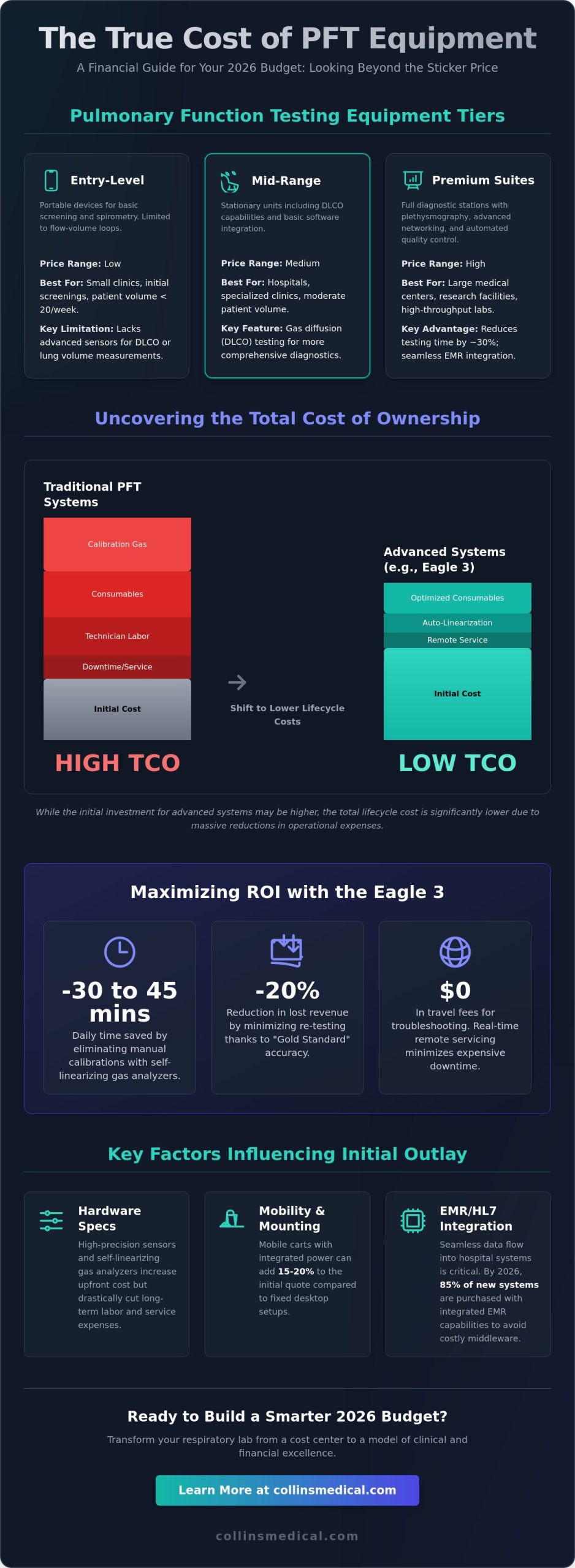
- Entry-Level: Portable devices focused on screening and basic spirometry.
- Mid-Range: Stationary units that include DLCO and basic software integration.
- Premium Suites: Full diagnostic stations with plethysmography, advanced networking, and automated quality control.
Key Factors Influencing the Initial Capital Outlay
The total cost of new pft equipment depends heavily on the underlying sensor technology and the specific clinical environment it serves. High-performance hardware, such as self-linearizing gas analyzers, represents a significant portion of the initial investment. These components ensure unparalleled precision by automatically adjusting for environmental variables, which eliminates the 30 to 45 minutes typically lost to manual calibration each morning. For facilities in MA 01747 or Ashford, Kent, TN23 1LY, choosing the right configuration is the first step in maintaining a lean, high-output laboratory.
- Hardware Specifications: Precision sensors and ultra-fast gas analyzers increase the upfront price but lower long-term technician labor costs.
- Mounting and Mobility: A fixed desktop setup is often more affordable, while mobile carts with integrated power supplies can add 15% to 20% to a quote.
- EMR and HL7 Integration: Seamless data flow into hospital systems requires specialized diagnostic platforms that often carry separate implementation fees.
The Premium for Accuracy and Precision
Investing in “Gold Standard” technology reduces the need for frequent re-testing, which accounts for nearly 20% of lost revenue in high-volume clinics. Self-linearizing technology provides a revolutionary advantage by maintaining accuracy throughout the day without human intervention. Adhering to strict Spirometry equipment standards is essential for clinical excellence and legal compliance in occupational health settings. To understand how these standards evolved, you can explore the definitive guide to a legacy of pulmonary excellence.
Software and Connectivity Requirements
The cost of new pft equipment is no longer just about the physical device. Modern diagnostic platforms use either one-time purchase licenses or recurring subscription models. Choosing a future-proof software suite ensures your lab accommodates upcoming respiratory health standards without requiring a total hardware overhaul. Hidden costs often reside in the network integration phase. Budgeting for HL7 upgrades ensures that patient data moves securely between the PFT lab and the central hospital database, preventing manual entry errors that compromise patient care. If you need a tailored solution for your facility, request a personalized quotation from our expert team.
The Hidden Costs: Maintenance, Calibration, and Consumables
The sticker price is only the beginning of your financial commitment. When budgeting for the cost of new pft equipment in 2026, administrators must account for the operational expenses that accrue over a 7 to 10 year lifecycle. High-precision testing requires specialized calibration gases and high-efficiency particulate air (HEPA) filters. While generic filters might seem cheaper, using high-quality OEM filters protects delicate internal sensors from moisture and debris. This prevents premature sensor failure, which frequently results in unexpected repair bills.
Understanding the baseline Spirometer Price Tiers is helpful for initial procurement, but the real financial burden often lies in labor. Manual linearization and daily biological controls can consume 45 minutes of a respiratory therapist’s shift. Modern, automated systems reduce this requirement to under 10 minutes. This shift allows staff to focus on patient throughput rather than technical upkeep. Over a standard work year, this equates to hundreds of hours in reclaimed clinical time.
Consumables and Lifecycle Expenses
Maintaining clinical accuracy depends on the integrity of your consumables. Budgeting for annual replacement parts like O-rings, sample lines, and specialized sensors is essential for regulatory compliance. Using non-validated consumables often leads to drift in measurements. This necessitates frequent recalibrations and increases the cost of new pft equipment over time. Clinical data suggests that OEM-supported maintenance schedules extend the functional life of a system by 25% compared to ad-hoc servicing.
Service Contracts and Technical Support
On-call repairs are the most expensive way to manage medical devices. A single on-site technician visit can cost between $1,500 and $3,000 once travel and hourly rates are factored in. Transitioning to comprehensive service agreements provides predictable annual spending. Systems equipped with remote diagnostic capabilities can slash traditional maintenance fees by 40%. These digital tools allow engineers in Massachusetts or Kent to troubleshoot software issues instantly. This eliminates the need for physical travel and reduces system downtime from days to hours.
Explore how our legacy of innovation helps you minimize long-term operational costs.
Maximizing ROI with the Eagle 3 and Collins Medical
Investing in the Eagle 3 isn’t just a purchase; it’s a strategic financial decision for any modern pulmonary department. While the initial cost of new pft equipment is a primary concern, the long-term value lies in minimizing lifecycle expenses. Collins Medical utilizes innovative engineering to build hardware that withstands high-volume clinical use. Our remote servicing technology allows technicians to perform real-time troubleshooting from our regional hubs. This approach removes the burden of travel fees; it ensures your lab stays operational without waiting days for a site visit.
Efficiency as a Revenue Driver
The Eagle 3 streamlines workflows to improve patient throughput. Faster testing cycles allow clinicians to see more patients daily, which directly boosts department revenue. High-durability components and automated maintenance routines reduce the total cost of ownership over the equipment’s 10-year lifespan. By maintaining superior accuracy, the Eagle 3 prevents the need for re-testing. It saves both time and consumable resources in a busy clinical setting.
Global Support from Massachusetts to Kent
Collins Medical provides specialized support across two major regions to ensure your equipment remains the gold standard in respiratory care. Our US clients receive direct assistance from our headquarters located in Hopedale, MA 01747. For those in the United Kingdom, we provide dedicated sales and service from our facility in Ashford, Kent TN23 1LY. Discover our legacy of pulmonary excellence and how it shapes our modern technology. You’re partnering with an established expert that understands the technical nuances of the global cost of new pft equipment and maintenance.
To secure a personalized quotation for your clinical needs, follow these specific steps:
- Identify your required testing modalities, such as DLCO or Lung Volumes.
- Contact our regional offices in Massachusetts or Kent to discuss your facility’s patient volume.
- Review your custom proposal, which includes detailed lifecycle cost projections and support options.
Future-Proof Your Respiratory Lab for 2026
Budgeting for clinical upgrades requires a strategic view of the total lifecycle. You’ve seen how price tiers and hidden maintenance fees shape the true cost of new pft equipment over time. Selecting a partner with a long-standing history ensures you aren’t just buying a machine; you’re investing in a legacy of precision. Collins Medical has pioneered respiratory technology since the 1930s, setting new standards for reliability across the globe. Our Eagle 3 system features revolutionary remote servicing capabilities that minimize downtime and operational overhead for busy clinics.
Leading hospitals in MA 01747 and Ashford, Kent, trust our solutions to deliver unparalleled accuracy and patient comfort. It’s essential to balance initial capital outlay with long-term efficiency to maximize your return on investment. Don’t let outdated technology or unpredictable maintenance costs stall your facility’s growth. Secure a system that combines historical expertise with ground-breaking innovation today. We’re ready to help you navigate these technical requirements with confidence and clarity.
Request a Personalised Quote for the Eagle 3 PFT System
Frequently Asked Questions
How much does a full diagnostic PFT system cost on average?
A full diagnostic PFT system typically ranges from $45,000 to $85,000 according to industry benchmarks from 2024. This price range covers the hardware required for plethysmography and diffusion capacity testing. When budgeting for the cost of new pft equipment, you must account for these capital expenditure figures to ensure your facility is prepared for 2026 standards.
What is the difference between a spirometer and a PFT machine in terms of investment?
A standalone spirometer is a low-capital entry point costing between $1,500 and $5,000, while a full PFT machine represents a comprehensive diagnostic suite. Spirometers focus on basic volume and flow measurements. PFT systems integrate advanced lung volumes and gas exchange capabilities. Facilities often start with spirometry and upgrade to full systems as patient volume exceeds 15 tests per week.
Are there hidden fees associated with PFT software and EMR integration?
Software licensing and HL7 integration fees usually add 10% to 20% to your initial purchase price. These costs cover the secure transfer of patient data between the testing system and hospital EMRs. You’ll also need to budget for annual software maintenance agreements. These agreements provide critical security patches and updates to comply with evolving 2026 healthcare data regulations.
How does the Eagle 3 system reduce long-term maintenance costs?
The Eagle 3 system utilizes revolutionary sensor technology designed to minimize the frequency of manual calibrations. This innovation reduces the need for expensive technician visits and proprietary consumables. By streamlining the diagnostic workflow, the Eagle 3 helps clinics lower their total lifecycle costs. It ensures high-quality results without the heavy overhead often associated with legacy respiratory technology.
Can I lease PFT equipment instead of purchasing it outright?
Leasing is a common financial strategy for 40% of private practices looking to manage the cost of new pft equipment without large upfront capital. Most medical equipment lenders offer 36 to 60 month terms with fair market value purchase options at the end of the term. This approach preserves cash flow and allows facilities in Massachusetts and Kent to upgrade to the latest technology every five years.
Disclaimer
Collins Medical LLC and Collins Medical Ltd are associated but separate Companies and are not associated to or born from the Collins Medical Inc or Collins Medical Practice or Collins Medical Dictionary or Collins Medical Equipment Group.